Stray Dog (1949)
★★★★½ — Stray Dog (1949)

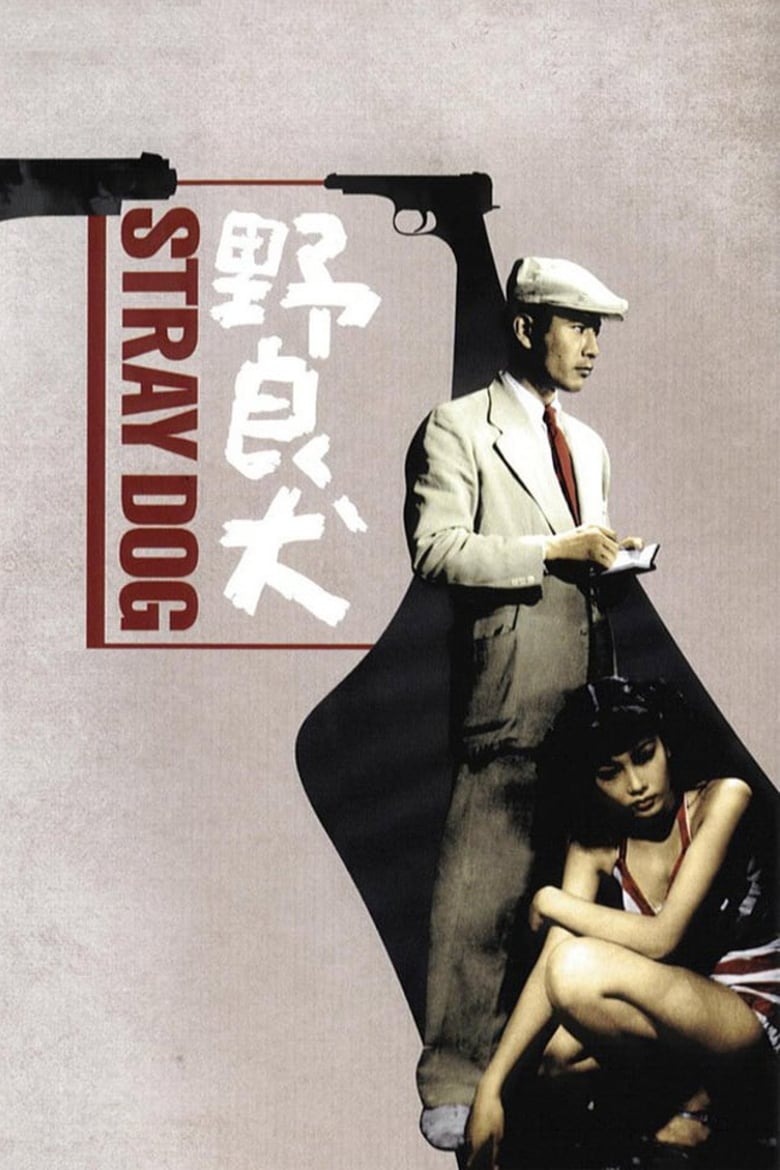
There's a moment in Stray Dog where you stop watching a crime thriller and start feeling the weight of a country trying to put itself back together. It sneaks up on you. One minute you're following a young detective through the sweat-soaked streets of postwar Tokyo, the next you're sitting with something much bigger: a question about what really separates the man hunting from the man being hunted. That's Kurosawa for you. He wraps his ideas in genre clothing and then slowly, methodically, strips the costume away.
The setup is deceptively simple. Rookie detective Murakami, played by a young Toshiro Mifune, has his pistol lifted on a packed, stifling streetcar. It's a moment of carelessness he'll spend the rest of the film paying for, because the gun doesn't just disappear. It starts showing up at crime scenes. Every shot fired with his stolen weapon is another wound to his conscience, and Mifune plays that guilt with a raw, coiled energy that's genuinely striking. This isn't the swaggering, larger-than-life Mifune of later years. This is a kid carrying shame like a physical burden, and it's one of the most compelling performances of his early career.
Opposite him, Takashi Shimura as the seasoned Detective Satō is everything Murakami isn't yet: steady, unhurried, quietly wise. The mentor-and-apprentice dynamic between them gives the film its emotional backbone. Shimura, who is just as extraordinary in Ikiru, has this gift for saying everything with very little. A glance, a slight pause, a hand on a shoulder. He grounds the whole picture.
What Kurosawa does with the heat is extraordinary. The summer of postwar Tokyo isn't just a backdrop, it's a pressure system. You feel it bearing down on every scene. Sweat on foreheads, shirts stuck to backs, the whole city moving slowly like it's wading through something thick. The documentary-style passages, where Murakami moves through black markets and back-alley pawnshops and jazz clubs crackling with nervous energy, have a texture that feels almost ethnographic. Kurosawa isn't just telling you about this world. He's pressing your face into it.
And because nothing here is wasted, that texture is always doing double duty. The cramped streets and the makeshift stalls and the desperate people selling whatever they can aren't just atmosphere. They're the argument the film is making. Murakami and the man who stole from him came from the same wreckage. Both returned from the war with nothing. One went one way, one went another. That gap, and the thinness of it, is what Stray Dog keeps returning to. It's not a film that lets you feel comfortable with easy moral lines.
It's fascinating to put this alongside Drunken Angel, made just the year before, which finds Kurosawa in similarly murky moral territory in the ruins of occupied Japan. The two films feel like companion pieces, both preoccupied with what postwar society does to the people caught inside it, both using genre as a way into something more searching. And you can see the same instincts that would lead, years later, to High and Low, another Tokyo crime story that tunnels beneath the surface of a city to find the human cost of inequality.
The slow build here will test some viewers, I won't pretend otherwise. There are stretches that are genuinely patient, almost meditative. But I'd argue that patience is precisely the point. The film wants you to understand the labour of it, the dead ends and the doubt and the sheer physical exhaustion of following a cold trail through an unforgiving city in brutal heat. By the time it reaches its conclusion, you've earned the feeling.
Four and a half stars. Stray Dog is a near-perfect film: rigorous in its craft, compassionate in its gaze, and quietly devastating in what it says about guilt, empathy and the cost of surviving something catastrophic. It's also just a brilliant thriller. Kurosawa rarely let those two things come apart.
Rating: ★★★★½ | Year: 1949 | Watched: 2026-02-28
Where to watch
Watch in the UK
Stream: BFI Player · BFI Player Amazon Channel · BFI Player Apple TV Channel
Rent: Apple TV Store · Amazon Video
Buy: Apple TV Store · Amazon Video
Physical: Amazon UK · Zavvi
Watch in the US
Stream: fuboTV · Criterion Channel
Rent: Amazon Video · Apple TV Store · Google Play Movies · YouTube
Buy: Amazon Video · Apple TV Store · Google Play Movies · YouTube
Physical: Amazon US
Affiliate disclosure: Movies With Macca may earn a small commission on purchases or subscriptions started via these links. It costs you nothing extra.
Related on Movies With Macca
More from Akira Kurosawa: High and Low (1963) · Throne of Blood (1957) · Ikiru (1952) · Sanjuro (1962)
More with Toshirō Mifune: High and Low (1963) · Throne of Blood (1957) · Sanjuro (1962) · Drunken Angel (1948)
More from Japan: Mononoke the Movie: The Phantom in the Rain (2024) · Mononoke the Movie: Chapter II - The Ashes of Rage (2025) · Blue (1993) · The Ghost of Yotsuya (1959)
More from the 1940s: Louisiana Story (1948) · The Ox-Bow Incident (1943) · Men Without Wings (1946) · The Bank Dick (1940)
More crime: A Better Tomorrow (1986) · Angst (1983) · Stolen Face (1952) · Cairo Station (1958)
More drama: Viy (1967) · Wonder (2017) · A Better Tomorrow (1986) · Beautiful Boy (2018)