Drunken Angel (1948)
★★★★ — Drunken Angel (1948)

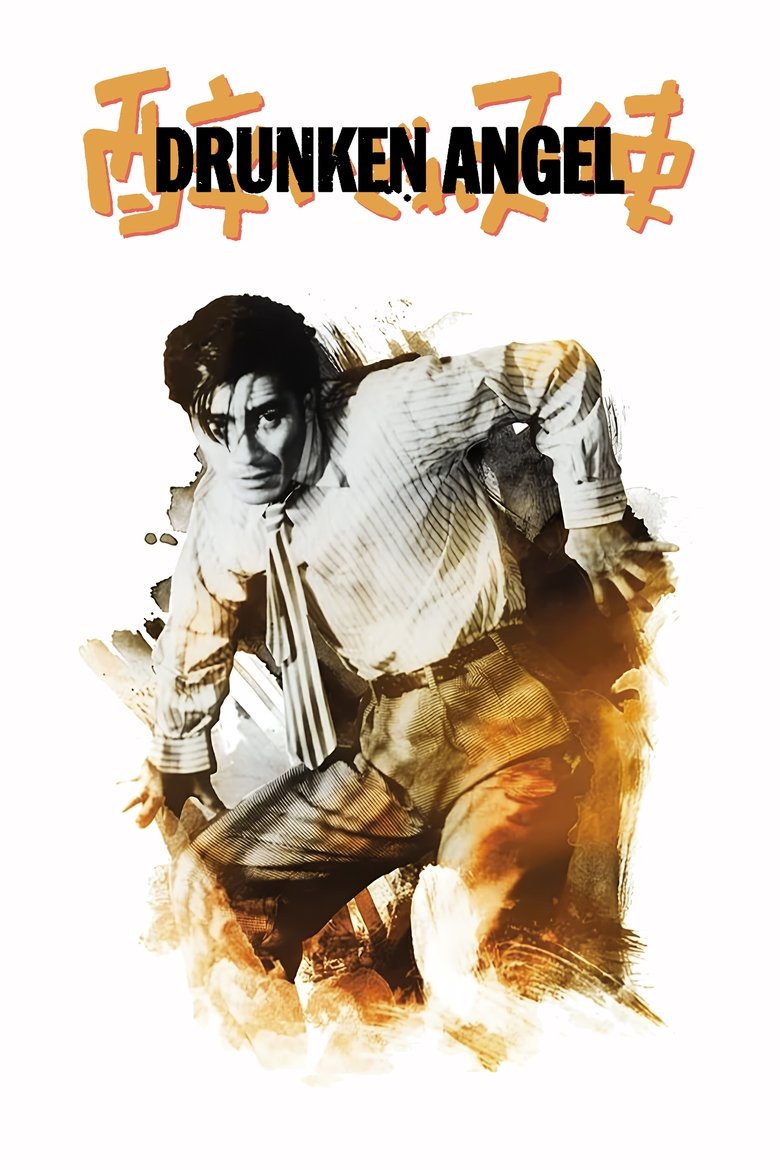
There's a moment watching Drunken Angel where you realise you're holding your breath. Not because of a jump scare or a twist, but because you genuinely don't know whether this story is going to break your heart or give you a reason to hope. That tension, sustained for nearly the entire runtime, is what makes this film so remarkable. And the fact that it was made in 1948, in a country still pulling itself out of the rubble of war, makes it all the more extraordinary.
The setup is deceptively simple. A bad-tempered, hard-drinking doctor working out of a bombed-out neighbourhood. A young yakuza with tuberculosis who refuses to admit he's dying. Two flawed, stubborn men locked in something that's part confrontation, part dependency, part something close to love, though neither of them would ever put it that way. It sounds like a character study, and it is, but it's also a crime film, a social document, and an almost unbearably honest portrait of what it looks like when a society tries to rebuild itself from nothing.
You feel the grit of post-war Japan in every single frame. The streets are muddy and chaotic. There's a fetid swamp at the heart of the neighbourhood that keeps reappearing, almost like a character in itself, a constant reminder of the rot underneath. Kurosawa doesn't romanticise any of it. The poverty is real, the despair is real, and so is the stubborn, flickering human warmth that refuses to go out entirely.
The performances are what seal it. Takashi Shimura plays the doctor with this brilliant, gruff idealism. He's a drunk, he's infuriating, he shouts at his patients, but you never doubt for a second that he cares. Shimura finds the quiet dignity in the man without ever softening the rough edges, and it's a masterful piece of work. Then there's Toshiro Mifune. I'll just say it plainly: I think Mifune is arguably the greatest screen actor who ever lived. And even here, in one of his earliest major roles, you can see exactly why. He brings this coiled, restless energy to the gangster that makes it impossible to take your eyes off him. Every scene he's in crackles. His clashes with Shimura are explosive and uncomfortable, but there's genuine humanity underneath all the bravado, and watching that humanity surface, slowly, painfully, is the emotional core of the whole film.
You can already see the beginnings of everything Kurosawa would become. The morally complicated heroes. The deep feeling for the marginalised and the dispossessed. The sense that society's failures land hardest on the people least equipped to survive them. If you've seen Ikiru (1952), you'll recognise that same compassionate gaze, turned here on characters who are rougher around the edges but no less deserving of it. And the Shimura and Mifune pairing gets even more electrifying in Stray Dog (1949), made just a year later, if you want to follow this particular thread.
A word on the print. The version I watched was scratched, with inconsistent contrast and the kind of visual wear that comes with a film of this age. In theory that should be a distraction. In practice, it somehow fits perfectly. The roughness matches the world on screen. It feels less like a technical limitation and more like the film has earned its scars.
It's not a flawless film. There are moments where the plotting feels a little loose, and some of the supporting characters don't get the space they deserve. But those are minor complaints against something that hits genuinely hard. Drunken Angel is bold, compassionate, and completely alive. A raw, powerful beginning to a golden era, and proof that Kurosawa arrived with something to say and the talent to say it unforgettably.
Four stars.
Rating: ★★★★ | Year: 1948 | Watched: 2025-08-24
Where to watch
Watch in the UK
Stream: BFI Player · BFI Player Amazon Channel · BFI Player Apple TV Channel
Physical: Amazon UK · Zavvi
Watch in the US
Stream: Criterion Channel
Physical: Amazon US
Affiliate disclosure: Movies With Macca may earn a small commission on purchases or subscriptions started via these links. It costs you nothing extra.
Related on Movies With Macca
More from Akira Kurosawa: High and Low (1963) · Stray Dog (1949) · Throne of Blood (1957) · Ikiru (1952)
More with Takashi Shimura: Stray Dog (1949) · Throne of Blood (1957) · Ikiru (1952) · Rashomon (1950)
More from Japan: Mononoke the Movie: The Phantom in the Rain (2024) · Mononoke the Movie: Chapter II - The Ashes of Rage (2025) · Blue (1993) · The Ghost of Yotsuya (1959)
More from the 1940s: Louisiana Story (1948) · The Ox-Bow Incident (1943) · Men Without Wings (1946) · The Bank Dick (1940)
More drama: Viy (1967) · Wonder (2017) · A Better Tomorrow (1986) · Beautiful Boy (2018)