Fantastic Planet (1973)

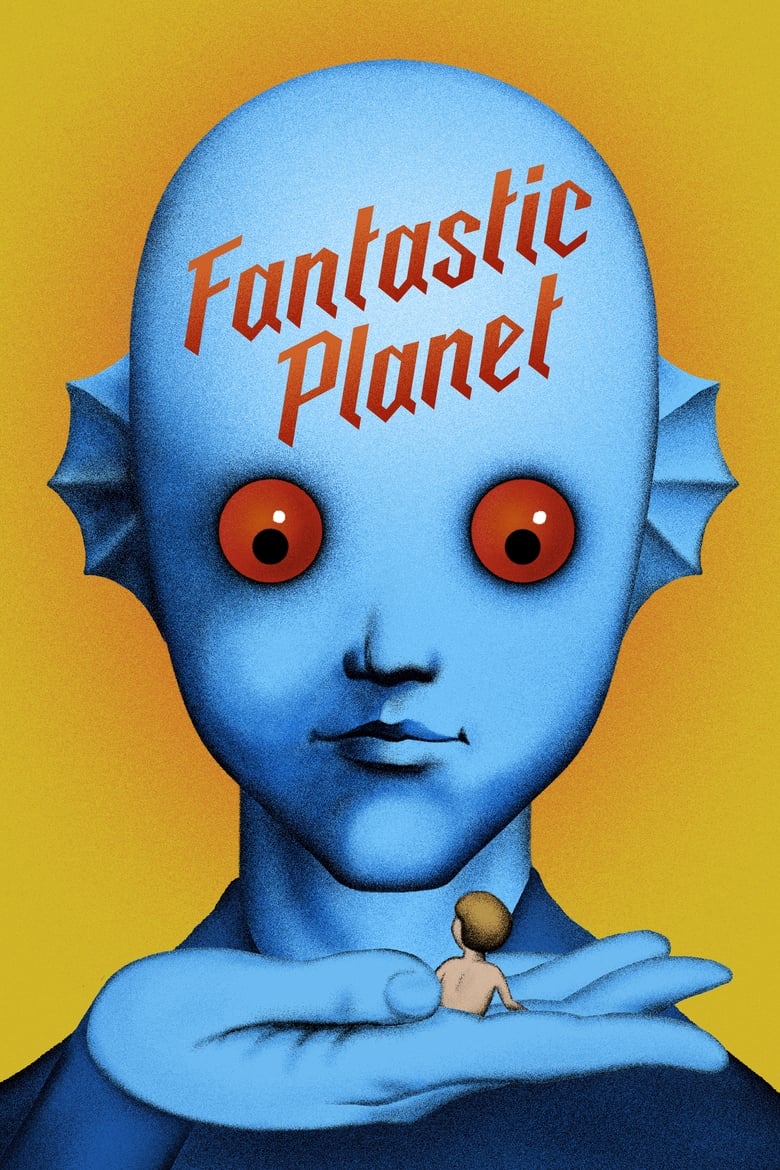
There's a moment early in Fantastic Planet where a giant blue hand reaches down and scoops up a tiny human like you or I might pick up a woodlouse off the kitchen floor. It's matter-of-fact, almost gentle, and it's one of the most unsettling things I've seen in any animated film. René Laloux and Roland Topor have built a world so strange and so fully realised that your brain keeps trying to find a foothold and keeps slipping. That feeling doesn't really go away for the entire runtime. Whether that's a compliment depends entirely on what you want from a film.
The setup is deceptively simple. On the alien world of Ygam, the Draags (enormous, blue, cold-eyed humanoids) treat tiny humans, called Oms, as pets, pests or lab subjects depending on their mood. Our way into this world is one such Om, kept as a plaything by a Draag child, who accidentally absorbs Draag knowledge through his owner's learning device and begins to understand the true nature of his captivity. From there, the film becomes something between a survival story and a philosophical treatise, wrapped in cut-out collage animation and colours so psychedelic they feel genuinely hallucinatory.
The allegory isn't subtle, and it isn't trying to be. This is a film about oppression, colonialism, the control of knowledge and the cyclical violence of power. It's clearly rooted in post-1968 European political thought, the kind of ambitious, intellectual filmmaking that assumes the audience is willing to work. And I was willing. The Draags' serene rationality set against the Oms' instinctual, scrappy resilience maps onto real-world dynamics of domination and resistance in ways that still feel sharp fifty years on. There's something genuinely chilling about how the Draags discuss the periodic culling of Oms with the same detached reasonableness you might use to talk about weeding a garden.
Every frame really is a painting. Topor's artwork is flat and stylised in a way that feels deliberately uncanny, creatures that are almost familiar but wrong in ways you can't quite name, landscapes that suggest both alien biology and abstract expressionism. It's impossible to forget. I found myself pausing just to sit with individual images. In that sense, the film absolutely earns its reputation as a landmark of animated art.
But here's where I have to be honest about my mixed feelings. For all its visual and intellectual brilliance, Fantastic Planet left me cold in ways I couldn't fully shake. The pacing is deliberate to the point of languid, the characters function more as archetypes than as people I could genuinely invest in, and the allegory occasionally becomes so abstract that any emotional connection gets squeezed out in favour of symbolism. I admired it more than I felt it. It's a cerebral puzzle rather than an emotional journey, and that distance is a real limitation. I never felt swept along; I felt observed, held at arm's length by the film's own aesthetic remove.
I think of something like Birdboy: The Forgotten Children, another politically charged animated film that deals in oppression and cycles of trauma, and the difference is that Birdboy makes you ache for its characters even as it buries them in symbolism. Fantastic Planet doesn't quite manage that. It's more interested in the architecture of its ideas than in the people (or Oms) living inside them.
That's not a reason to avoid it. It's a reason to go in with clear expectations. This is a museum piece in the best and most complicated sense of that phrase: visually revolutionary, historically significant, and genuinely unlike anything else in the history of animation. Its influence on science fiction art and design stretches further than most people realise. But a museum piece is something you study and admire from a respectful distance, and that's more or less the relationship this film wants with you.
Worth your time, absolutely. Worth your full emotional engagement? That's a harder sell. Three stars.
Rating: ★★★ | Year: 1973 | Watched: 2026-05-19