Louisiana Story (1948)
★½ — Louisiana Story (1948)

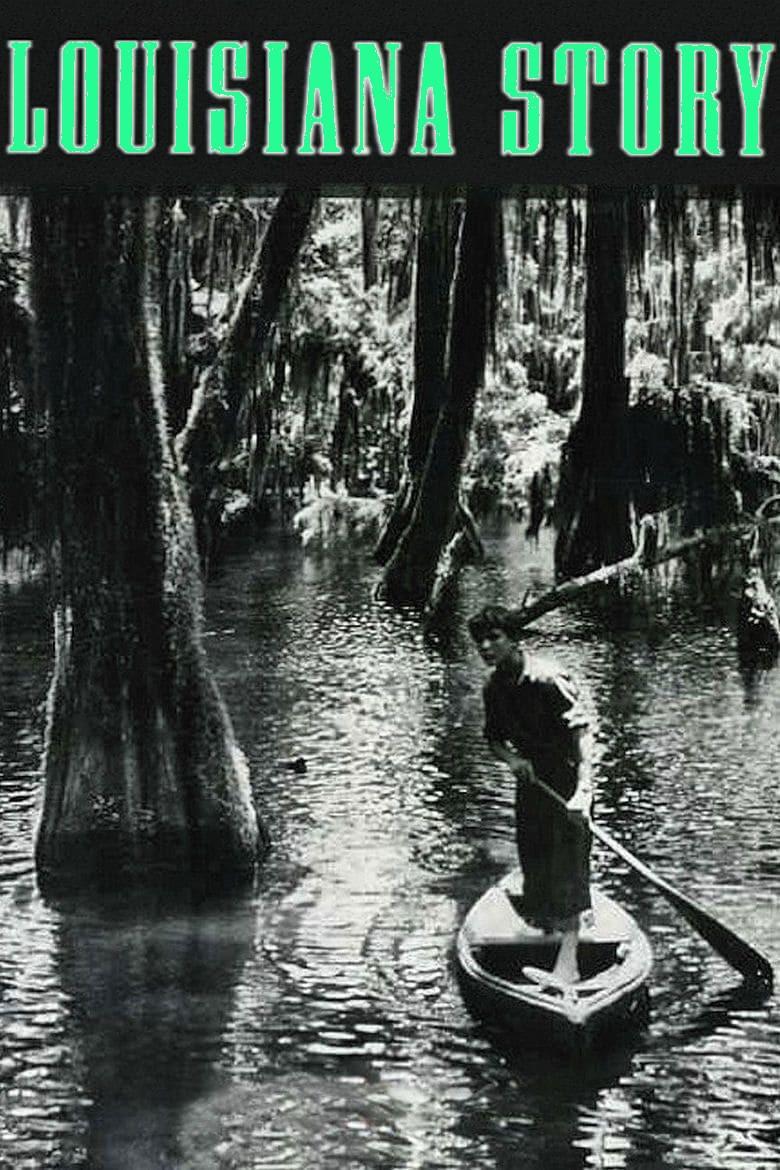
There's a version of Louisiana Story that I think I would have loved. A young Cajun boy, his pirogue gliding through the misty bayou, alligators lurking in the shallows, a world that feels ancient and fragile and utterly its own. Robert Flaherty opens the film with precisely that promise, and for a good while he delivers on it. The accents are real, the customs feel lived-in, and there's a genuine tenderness to the way he watches this boy move through his environment. It's immersive and unhurried in all the right ways. You settle in. You think you know what kind of film you're watching.
Then the oil rig turns up, and the film you thought you were watching quietly packs its bags and leaves.
That's not entirely unfair to what Flaherty is doing. The contrast between pastoral Cajun life and the grinding machinery of industrial oil exploration is clearly intentional. He wants the juxtaposition to mean something, and in isolated moments it does. But the pivot is abrupt in a way that never quite rights itself. Dialogue more or less evaporates. Character disappears. What replaces it are long, wordless sequences of drilling equipment, steel towers, pipelines and gushing wells, all scored by Virgil Thomson's orchestral soundtrack, which is genuinely haunting and probably the single best thing about the film's second half. But even Thomson can only carry so much weight when the storytelling beneath him has ground to a halt.
I kept waiting for the film to reconnect with the boy, to bring the human and the industrial back into proper collision. It does, occasionally, but not with enough conviction to restore what's been lost. The message about encroaching modernity and disrupted ways of life is perfectly legible. The problem is that Flaherty seems to trust his imagery so completely that he stops doing the work of earning an emotional response. You can't just point a camera at an oil slick and expect it to break someone's heart. You have to have built toward that moment first.
And the cinematography is interesting, I'll grant it that. The black-and-white compositions do turn oil-slicked water and cypress roots into something approaching abstract art. There are individual frames here that are genuinely striking. But visual beauty alone isn't enough when you've spent the last forty minutes watching machinery with no one to care about operating it.
What frustrates me most is how strong the first act is. That early glimpse of mid-century Cajun culture, the accents, the folklore, the boy's relationship with the natural world around him, it's a rare and valuable thing. As a historical document of a place and a way of life that was already disappearing in 1948, Louisiana Story has real worth. But a document and a film aren't quite the same thing, and this one loses its grip on being the latter about halfway through. It becomes a tone poem that's too detached to move you and too slow to simply dazzle.
One and a half stars. See it once if you're interested in the period or in Flaherty's place in documentary history. Appreciate what it preserves. Then forgive yourself for checking the clock.
Rating: ★½ | Year: 1948 | Watched: 2026-05-11
Where to watch
Watch in the US
Stream: Amazon Prime Video · TCM · Amazon Prime Video with Ads
Rent: Amazon Video
Buy: Amazon Video
Physical: Amazon US
Affiliate disclosure: Movies With Macca may earn a small commission on purchases or subscriptions started via these links. It costs you nothing extra.
Related on Movies With Macca
More from the 1940s: The Ox-Bow Incident (1943) · Men Without Wings (1946) · The Bank Dick (1940) · The Seventh Victim (1943)
More adventure: Alice in Wonderland (1951) · The Eagle (1925) · The General (1926) · Kirikou and the Wild Beasts (2005)
More drama: Viy (1967) · Wonder (2017) · A Better Tomorrow (1986) · Beautiful Boy (2018)