Alice in Wonderland (1951)

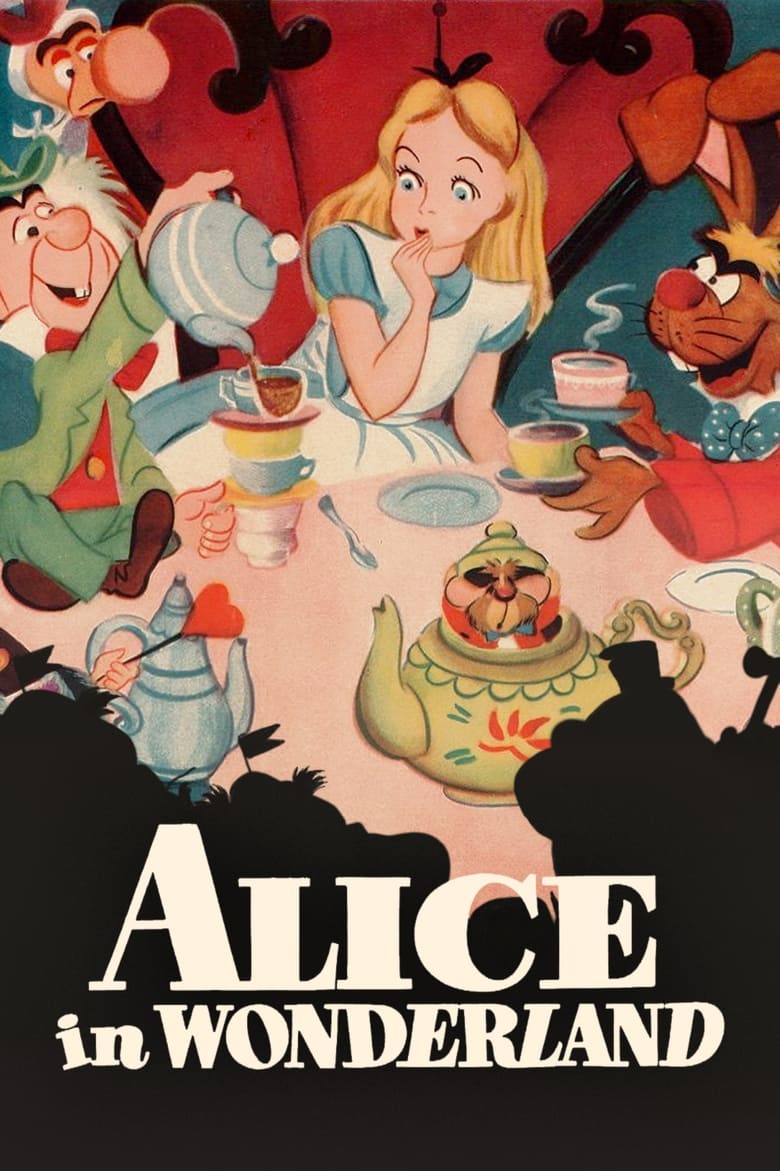
There's a version of Alice in Wonderland that could genuinely disturb you. Lewis Carroll's original stories are strange in a way that gets under the skin, full of logic that twists back on itself, a world that seems to operate on cruelty dressed up as nonsense, and a little girl who is perpetually out of her depth in a place that doesn't care whether she sinks or swims. That film has never really been made. Disney's 1951 effort certainly isn't it, and I'm not sure it ever wanted to be.
What we do get is cheerful, brightly coloured, and moves at a decent clip. The songs are catchy, the animation is clean and expressive, and there's a genuine energy to individual sequences that makes it easy enough to sit through. The Cheshire Cat is fun. The Mad Hatter's tea party has a pleasant chaos to it. The Queen of Hearts barking her way through every scene she's in gets a laugh or two. On a surface level, it works. Nobody's going to switch it off.
But the problem is that surface is just about all there is. Disney takes Carroll's deliberately disconnected, dreamlike world and turns it into a series of disconnected gags and musical numbers, and then seems surprised that there's no throughline holding it together. Alice drifts from one oddity to the next, reacting to things, occasionally complaining, and then drifting on again. There's no emotional engine running underneath any of it. No stakes, no growth, no reason to be particularly invested in where she ends up. She's less a character than a camera, pointing us at the next curiosity before moving on.
That might be forgivable if the curiosities themselves were more unsettling, more genuinely strange. But the film sands the edges off Carroll's weirdness and gives us something that's whimsical rather than surreal. It's the difference between a funfair and a fever dream. Carroll's Wonderland should feel like the latter. This one opts firmly for the former.
Visually, it's pleasant enough, but it's not among Disney's more impressive efforts from the era. It lacks the lush, painterly detail of their work on Pinocchio, which managed to be genuinely menacing while still technically being a children's film. That picture understood that you can scare kids a little, unsettle them, make the world feel genuinely threatening, and still tell a story with warmth and purpose. Alice doesn't take that risk. Everything is kept at a safe, cheerful distance.
The characters suffer for it too. The Cheshire Cat, who should be the most unsettling thing in the film, is mostly just smug and pleasant company. The Mad Hatter is broad and silly rather than genuinely unhinged. They're sketches rather than characters, defined by a single quirk they repeat until the scene ends. Carroll's originals had a kind of internal logic, however twisted, that made them feel oddly real. Here they're reduced to performing their one trick and then stepping aside.
I don't want to be too hard on it, because it is what it is. Sit a young child in front of it and they'll probably have a fine time. The colours are bright, the pace never drags too badly, and there's enough happening on screen to hold attention. As a piece of entertainment for a rainy afternoon, it does the job. It's harmless. It's occasionally fun. It is, in the most lukewarm possible sense, fine.
But Carroll's work endures because it's genuinely strange, because it pokes at the absurdity of rules and authority and the baffling cruelty of adult logic, and none of that is really present here. This is an adaptation that captures the surface imagery of Wonderland without capturing what makes Wonderland matter. It plays it safe at every turn, and Carroll was never safe.
Two and a half stars. Worth a watch once, with small children or mild curiosity, and then fairly easy to leave behind.
Rating: ★★½ | Year: 1951 | Watched: 2026-04-30