Ran (1985)
★★★★★ — Ran (1985)

How on Earth did one man orchestrate this? That question kept running through my head all the way through Ran, and I'm still not sure I have a satisfying answer. What I do know is that I've just watched something that doesn't feel like a film so much as a natural disaster captured on celluloid. An earthquake in widescreen. A thunderstorm given a running time.
This is the culmination of a genius's life's work, and it shows in every single frame. Kurosawa didn't just make a movie here. He summoned an entire world, dragged it through fire, and left us standing in the rubble wondering what we'd just witnessed. It's ancient and eternal and unbearably tragic all at once, and I mean that as the highest compliment I can give.
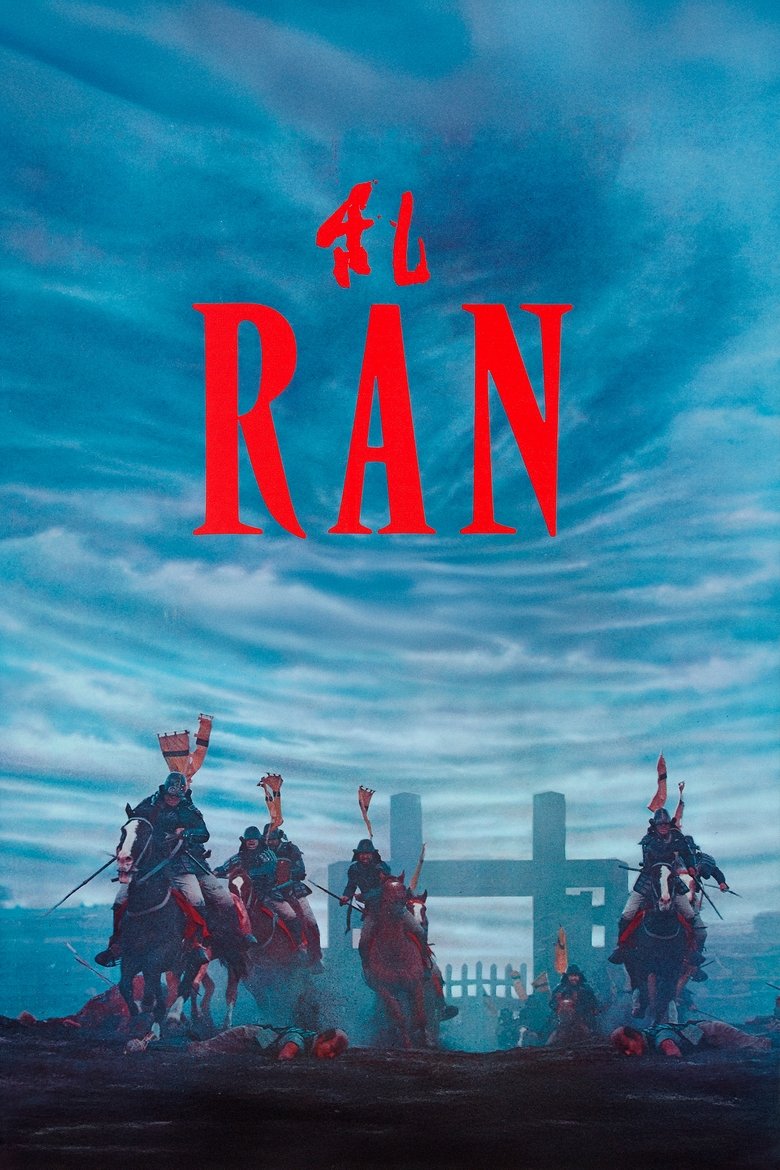
The scale is the first thing that hits you, and it never stops hitting. We're not talking CGI armies or digital extras filling out the background. We're talking real people, hundreds of them, clashing across mountaintops and valleys in battle sequences so immersive you can almost smell the blood and sweat. The siege sequence midway through the film is an extraordinary piece of choreography and carnage, shot with such visual clarity and controlled fury that it makes most modern action set-pieces look timid and hollow by comparison. And crucially, you can always tell who's fighting who. The use of colour coding across the warring factions is one of those quietly brilliant decisions that separates a great film from a masterpiece.
Speaking of colour: the visual poetry here is something else entirely. Crimson banners against ash-grey skies. A lone figure drifting through a skeletal grove of trees like Death himself out for a wander. The colours aren't just beautiful, they mean something. Red, yellow, blue, each used with purpose and precision. Every composition feels painted rather than photographed, which is a comparison that gets thrown around lazily, but here it's simply accurate. Toru Takemitsu's score is equally immortal, haunting and sparse, swelling at exactly the right moments to quietly break your heart. It doesn't just accompany the film. It breathes with it.
At its heart, this is a retelling of King Lear, transposed into feudal Japan with such confidence and conviction that the Shakespeare source almost dissolves entirely. Hidetora, the ageing warlord played with haunting gravitas by Tatsuya Nakadai, is Lear in samurai armour. His descent into madness isn't melodramatic or showy. It's inevitable. You watch him unravel like a scroll being slowly torn apart by time and pride and consequence, and it's as moving as anything I've seen in a cinema. The tragedy works because Kurosawa makes you understand the man before he destroys him.
I've spent a lot of time with Kurosawa's work on this A-Z World Movie Tour. I think Throne of Blood (1957) is a fascinating companion piece to this, another Shakespeare adaptation transplanted into feudal Japan, though a much colder and more claustrophobic beast. And I'll always carry a torch for Seven Samurai and High and Low (1963), both of which I'd still place a hair above Ran purely because they're tighter, meaner, more relentless. But that's a bit like arguing about which mountain is most impressive while standing at the top of one of them.
Because here's the thing: Ran is a swan song wrapped in fire. It's the final roar of a titan who still had more to say than most directors ever manage across an entire career. And it's also, I think, the reason I find it genuinely difficult to score modern spectacles generously. When you've seen what one man achieved with real locations, real people, and an absolute command of the frame, the glossy unreality of so much contemporary blockbuster filmmaking starts to feel like a bit of a con. This is what it looks like when spectacle and soul occupy the same film at the same time.
Five stars. No hesitation.
Rating: ★★★★★ | Year: 1985 | Watched: 2025-07-06
Where to watch
Watch in the UK
Stream: Studiocanal Presents Amazon Channel
Rent: Apple TV Store · Rakuten TV · Amazon Video · Google Play Movies
Buy: Rakuten TV · Amazon Video · Google Play Movies · YouTube
Physical: Amazon UK · Zavvi
Watch in the US
Stream: Lionsgate+ Amazon Channel · BFI Player Amazon Channel
Physical: Amazon US
Affiliate disclosure: Movies With Macca may earn a small commission on purchases or subscriptions started via these links. It costs you nothing extra.
Related on Movies With Macca
More from Akira Kurosawa: High and Low (1963) · Stray Dog (1949) · Throne of Blood (1957) · Ikiru (1952)
More with Tatsuya Nakadai: High and Low (1963) · Harakiri (1962) · Sanjuro (1962) · Yojimbo (1961)
More from Japan: Mononoke the Movie: The Phantom in the Rain (2024) · Mononoke the Movie: Chapter II - The Ashes of Rage (2025) · Blue (1993) · The Ghost of Yotsuya (1959)
More from the 1980s: Nightmare City (1980) · A Better Tomorrow (1986) · Style Wars (1983) · Garlic Is as Good as Ten Mothers (1980)
More action: A Better Tomorrow (1986) · The General (1926) · Hand of Death (1976) · Daredevil (2003)
More drama: Viy (1967) · Wonder (2017) · A Better Tomorrow (1986) · Beautiful Boy (2018)