Space Amoeba (1970)
★★ — Space Amoeba (1970)

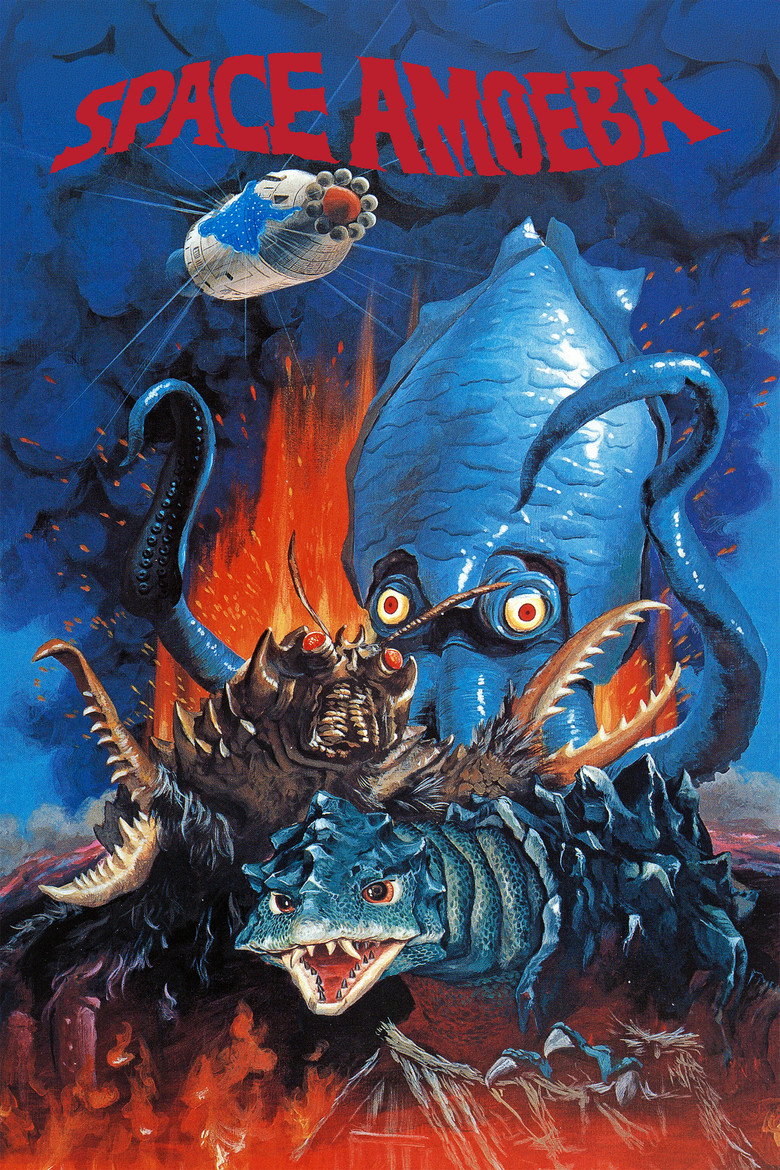
There's a version of Space Amoeba that sounds genuinely brilliant. An alien lifeform drifts in from the outer solar system, crash-lands in the South Pacific, and begins hijacking local wildlife, warping a turtle, a spider, and a crab into colossal, grotesque monstrosities. That's a solid premise. Cosmic contamination, body horror on a kaiju scale, a remote island setting baking under the sun. You could do something properly unsettling with that, or at the very least something riotously fun. Instead, what Toho delivered in 1970 is a film that feels like it time-travelled straight from the mid-fifties, and not in a charming way.
It's the kind of film where you keep waiting for it to shift into gear, and it never quite does. The pacing is sluggish almost from the first frame. Scientists stare at monitors. Somebody says "It's growing!" with all the urgency of a man reading a shopping list. There are longing shots of tropical scenery that pad things out rather than building atmosphere. The human subplot, which takes up a frankly alarming proportion of the running time, is painfully dull. None of the characters leave much of an impression, and the drama between them generates roughly the same tension as watching paint dry on a warm afternoon.
The alien entity itself, the so-called space amoeba, never coheres into anything genuinely threatening. It functions less as a villain and more as a narrative convenience, a floating plot device that drifts from creature to creature without personality or menace. Compare that to something like the original Mothra vs. Godzilla (1964), where there's genuine mythological weight and real stakes to the monster conflict, and you start to appreciate just how much craft can separate Toho's better efforts from its more workmanlike ones. Space Amoeba sits firmly in the latter camp.
The monsters themselves are a bit of a letdown, which is not what you want to be saying about a kaiju picture. Gezora, the giant cuttlefish, has a certain soggy charm. But the giant turtle, Kamoebas, looks like someone hot-glued a handful of spikes onto a manhole cover, stuck a pair of eyes on it, and declared the job done. The suits are rubbery even by the forgiving standards of Showa-era tokusatsu, and the fight sequences are brief, poorly lit and choreographed with all the excitement of a slow-motion shuffle. There's no real sense of scale or destruction, no memorable setpiece to walk away quoting to your mates.
What's especially frustrating is that the science-fiction angle, which could have pushed things somewhere interesting, feels dated on arrival. This was 1970. 2001: A Space Odyssey had already come out. Planet of the Apes had already come out. The idea of extraterrestrial contamination transforming earthly life had real potential to feel eerie and modern. Instead the film treats it like a throwaway device, and the whole thing wraps up with a resolution so anticlimactic you'd be forgiven for thinking you'd missed something. You haven't. It just sort of stops.
I've sat through some genuinely rough early Toho efforts. Varan (1958) has its problems, but there's at least a raw, shaggy energy to it. Space Amoeba doesn't even have that. It's not offensive. It's not incompetent exactly. It's just profoundly, stubbornly unremarkable. A film that had every ingredient for a decent time and somehow produced something you'll struggle to remember by the following morning.
Two stars. If you're deep in the Showa kaiju rabbit hole and determined to tick off every entry, it's a curiosity worth an afternoon. For everyone else, there are far better places to spend ninety minutes in the company of men in rubber suits stomping on miniature villages.
Rating: ★★ | Year: 1970 | Watched: 2025-11-13
Where to watch
Watch in the US
Stream: Criterion Channel
Physical: Amazon US
Affiliate disclosure: Movies With Macca may earn a small commission on purchases or subscriptions started via these links. It costs you nothing extra.
Related on Movies With Macca
More from Ishirō Honda: Varan (1958) · Mothra vs. Godzilla (1964) · Beast Man Snow Man (1955) · The Mysterians (1957)
More from Japan: Mononoke the Movie: The Phantom in the Rain (2024) · Mononoke the Movie: Chapter II - The Ashes of Rage (2025) · Blue (1993) · The Ghost of Yotsuya (1959)
More from the 1970s: Fantastic Planet (1973) · Here and Elsewhere (1976) · Italianamerican (1974) · Punishment Park (1971)
More science fiction: Invasion of the Body Snatchers (1956) · Fantastic Planet (1973) · Nightmare City (1980) · The Long Walk (2025)
More adventure: Alice in Wonderland (1951) · The Eagle (1925) · Louisiana Story (1948) · The General (1926)