
Punishment Park (1971)
★★★½ — Punishment Park (1971)

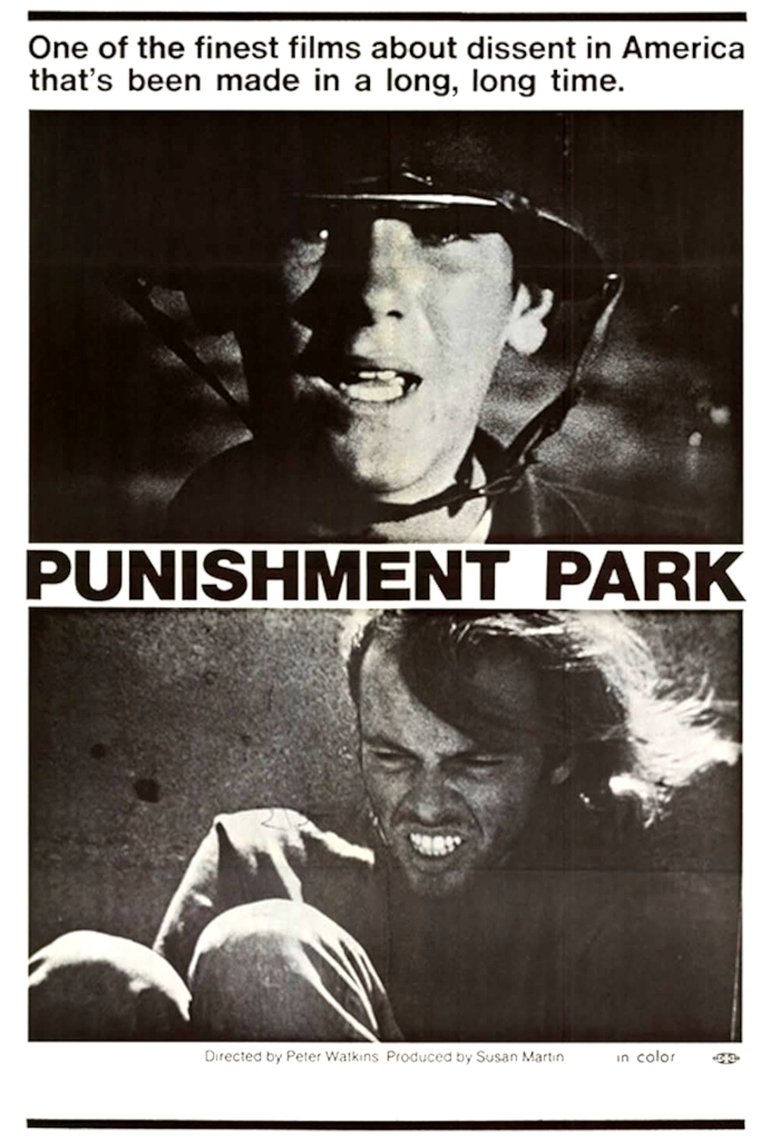
There's a moment in Punishment Park where you stop watching and start squirming. Not because of gore or spectacle, but because the machinery of injustice on screen feels so mundanely, bureaucratically real that it stops feeling like fiction altogether. Peter Watkins made this in 1971, and it hit me like something ripped from a news feed I'd rather not have seen this morning.
The setup is an alternate-history America during the Vietnam War era, where dissidents, anti-war activists, Black Panthers and student radicals are no longer afforded proper trials. Instead, they're hauled before tribunal panels and offered a choice: serve a lengthy prison sentence, or survive three days crossing a stretch of Californian desert to reach an American flag, with law enforcement in pursuit. That's Punishment Park. Shot on grainy 16mm with handheld cameras and available light, Watkins makes it all look like news footage. And crucially, it feels like news footage. When the film came out, plenty of people weren't entirely sure it wasn't.
The performances are rough, deliberately so. Many of the cast weren't professional actors but people playing close versions of themselves, and Watkins reportedly kept real arguments and genuine emotional breakdowns in the final cut. You can feel the seams. Somebody loses their composure in a tribunal scene and it doesn't look like acting because it probably isn't. Conventionally, that would be a weakness. Here, it's the whole point. This isn't a film trying to entertain you. It's trying to make you uncomfortable enough that you can't look away and can't entirely dismiss what you're seeing as safely fictional.
What Watkins does with the tribunal sequences is particularly sharp. The dissidents argue, rage, plead, and are ignored with the polished efficiency of a system that has already made up its mind. The panel members aren't cackling villains. They're measured, reasonable-sounding people who have simply decided that certain lives and certain voices are acceptable losses. That's what makes it so chilling. The horror isn't theatrical. It's procedural.
And then the desert sequences. Exhausted people running across baking, punishing terrain while armed men follow. The camera stays close, stays handheld, keeps the sweat and the panic and the physical reality of it all in frame. Watkins doesn't glamourise the pursuit or turn it into action cinema. It's grinding and grim and grimly logical within the world he's built.
It reminded me a fair bit of The War Game, Watkins's earlier pseudo-documentary about nuclear war, which the BBC famously suppressed for decades because it was deemed too upsetting to broadcast. Same filmmaker, same method: take the tools of documentary journalism and point them at something the establishment would rather you didn't look at too carefully. Both films work not despite their rough edges but because of them.
Where Punishment Park earns its place on the shelf of essential political cinema is in how little it's aged ideologically. The specific context is Vietnam-era America, but the concerns, state surveillance, the criminalisation of protest, the dehumanisation of anyone who challenges power, feel like they were written last week. Watkins doesn't give you heroes you can cheer for or villains you can safely hate. He gives you a system, and asks you to watch it function. That's a harder thing to sit with.
It's not a comfortable watch, and I wouldn't call it a perfect one. The film is rough, repetitive in places, and there are moments where the agitprop engine whirrs loudly enough that you feel the hand of the director pushing you toward a response. But Watkins earns the right to be didactic here, because he's also genuinely angry, and that anger is grounded in something real. When dissent gets treated as treason, he's saying, democracy starts wearing its own face as a mask. Fifty-odd years on, the warning still stands.
Three and a half stars.
Rating: ★★★½ | Year: 1971 | Watched: 2026-05-09
Where to watch
Watch in the UK
Physical: Amazon UK · Zavvi
Watch in the US
Stream: FlixFling
Rent: FlixFling
Buy: FlixFling
Physical: Amazon US
Affiliate disclosure: Movies With Macca may earn a small commission on purchases or subscriptions started via these links. It costs you nothing extra.
Related on Movies With Macca
More from Peter Watkins: The War Game (1966)
More from the 1970s: Fantastic Planet (1973) · Here and Elsewhere (1976) · Italianamerican (1974) · The Last Picture Show (1971)
More drama: Viy (1967) · Wonder (2017) · A Better Tomorrow (1986) · Beautiful Boy (2018)
More thriller: Invasion of the Body Snatchers (1956) · Angst (1983) · The Long Walk (2025) · Stolen Face (1952)



