Here and Elsewhere (1976)
Here and Elsewhere (1976)

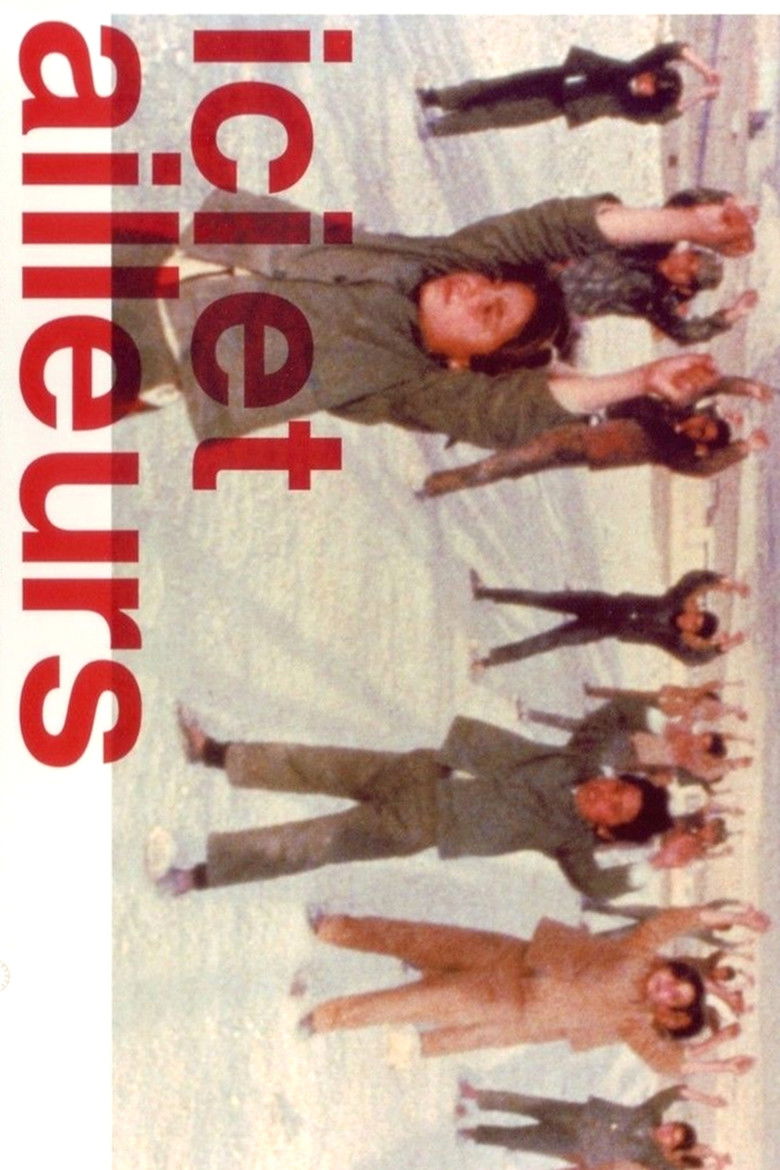
There's a moment in Here and Elsewhere where the film seems to turn on itself and ask: what right do we have to be here at all? That question, directed inward by the filmmakers as much as outward at the audience, is what separates this from almost anything else I've seen. It's a film that eats its own tail, and it's all the more powerful for it.
Jean-Luc Godard, Jean-Pierre Gorin, and Anne-Marie Miéville originally set out to make a pro-Palestinian documentary in the early 1970s, shooting in refugee camps with revolutionary fervour and political conviction. What they came back with, years later, was something they couldn't leave alone. Rather than release it as intended, they reworked the footage into an essayistic, self-interrogating piece that questions the very act of making it. The result is one of the most intellectually honest and emotionally demanding films I've encountered: a work that refuses to let itself off the hook.
It's not easy to watch, and I don't mean that as a warning so much as a description of its purpose. The film layers voiceover with still images, archival material, and staged scenes in ways that keep pulling the rug out from under you. There's no linear narrative, no clean polemic, no comfort of a thesis neatly argued and resolved. Instead, it forces you to sit with the gap between what images show and what they mean, between the romanticised idea of "elsewhere" as a site of noble struggle and the grinding, unromantic reality of displacement and survival. Children recite slogans they don't understand. Families are dignified in the face of erasure. Landscapes carry the weight of wars still being fought.
What strikes me hardest, watching this nearly fifty years after it was made, is how little has changed. The cycles of occupation, displacement, and failed diplomacy that the film circles around are not history. They're the evening news. And that's not something you can watch Here and Elsewhere and feel comfortable about, because the film anticipates its own irrelevance to power and mourns it in advance. Its warnings weren't heeded. Its images didn't change enough. It knew they might not, and it made the film anyway.
That moral honesty is what gives it such force. It's a film acutely aware of Western complicity, but also of its own position within that complicity. Godard and his collaborators aren't standing outside pointing fingers. They're implicating themselves, questioning whether their solidarity was genuine solidarity or a kind of aesthetic consumption of other people's suffering. That's a brutal question to ask of your own work, and the fact that they asked it publicly, in the film itself, is extraordinary.
I think about this alongside Letter from Siberia (1957), another essayistic film where the voiceover and the image are in constant, productive friction with each other. Chris Marker understood that a film could argue with itself, that commentary and image don't have to agree. Godard and Miéville push that idea somewhere darker and more urgent here. And if you've seen Lessons of Darkness (1992), Werner Herzog's haunting document of a scorched Kuwait, you'll find a strange echo: both films use images of devastation to ask what images of devastation can actually do.
I'm leaving this unrated, and I think that's the only honest response. Rating it feels like exactly the kind of consumption the film warns against. It's not a film you score; it's a film you're accountable to. Dense, abstract, and deliberately alienating at times, yes. But its formal daring is inseparable from its moral urgency. It doesn't tell you what to think. It forces you to question how you see, and whether seeing is ever enough.
It lingers. Especially now, when the same tragedies keep repeating, decade after decade, and the images keep piling up, and the world keeps watching.
Rating: Not rated | Year: 1976 | Watched: 2026-05-13
Related on Movies With Macca
More from France: Fantastic Planet (1973) · Letter from Siberia (1957) · Lessons of Darkness (1992) · The Man Who Sleeps (1974)
More from the 1970s: Fantastic Planet (1973) · Italianamerican (1974) · Punishment Park (1971) · The Last Picture Show (1971)
More documentary: Letter from Siberia (1957) · Lessons of Darkness (1992) · Style Wars (1983) · Shinjuku Boys (1995)