Seven Samurai (1954)
★★★★★ — Seven Samurai (1954)

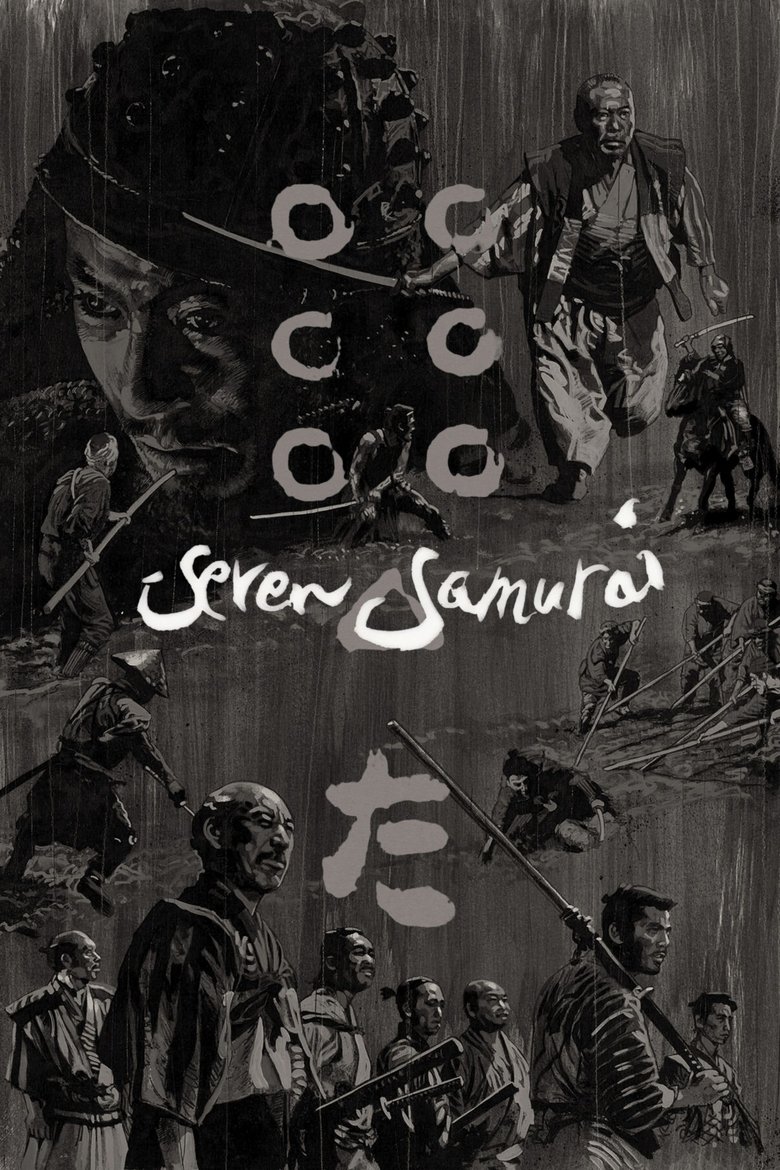
Some films age. Seven Samurai doesn't. It just sits there, over seventy years old, completely unbothered, daring you to find a flaw. I can't. Five stars, no hesitation, no asterisks.
There's something almost disorienting about watching it for the first time, or even the fifth. You're aware, somewhere in the back of your mind, that this thing was made in 1954, that the world was a completely different place, that cinema itself was still finding its feet in so many ways. And then it just pulls you in completely and you forget all of that. It stops being a historical artefact and becomes something alive. That's the closest thing to a time machine I've ever experienced sitting in front of a screen.
A lot of that is down to Akira Kurosawa, who I'd put at the very top of the conversation when you're talking about the greatest directors who ever lived. Full stop. The man had a command of image, pace and tension that most filmmakers can only dream of. He builds this story, the village, the threat, the gathering of the samurai, the preparation, the inevitable violence, with such patience and such confidence that by the time the final act arrives you feel every drop of rain, every desperate swing of a sword. Nothing is wasted. Every scene is doing work.
And then there's Toshiro Mifune. I've watched him in a number of Kurosawa's films, including Sanjuro and Stray Dog, and the man is simply one of the best screen actors there has ever been. Here he's a force of nature, all physicality and wild energy, and yet there's real depth underneath it. He never lets you look away. But what I love about Seven Samurai is that the whole ensemble carries equal weight. Every one of the seven feels like a fully drawn human being, not a type, not a placeholder. That's astonishing work across the board.
What keeps striking me is how modern it feels in its storytelling instincts. The structure, the way it earns its action, the way it treats the villagers not as a backdrop but as people with their own fears and their own complications, it would be impressive in any era. The fact that it was made when it was made almost beggars belief.
People sometimes talk about long films as though length is a problem to be tolerated. Seven Samurai runs to about three and a half hours and I've never once felt it drag. Every stretch of quiet has a purpose. Kurosawa understood that you have to care about what you're watching before any of the spectacle means anything. So he makes you care, deeply, before he gives you the spectacle. It's the oldest trick in storytelling and he executes it perfectly.
I don't throw around the phrase "one of the all-time greats" lightly. But this is genuinely one of those films where you finish it and you just sit there for a moment. It's the kind of film that makes you grateful cinema exists. If you've somehow not seen it yet, sort that out immediately. And if you have seen it, you probably already know exactly what I mean.
Five stars.
Rating: ★★★★★ | Year: 1954 | Watched: 2025-04-07
Where to watch
Watch in the UK
Stream: BFI Player · BFI Player Amazon Channel · BFI Player Apple TV Channel
Rent: Apple TV Store · Amazon Video
Buy: Apple TV Store · Amazon Video
Physical: Amazon UK · Zavvi
Watch in the US
Stream: HBO Max Amazon Channel · HBO Max
Rent: Amazon Video · Apple TV Store · Google Play Movies · YouTube
Buy: Amazon Video · Apple TV Store · Google Play Movies · YouTube
Physical: Amazon US
Affiliate disclosure: Movies With Macca may earn a small commission on purchases or subscriptions started via these links. It costs you nothing extra.
Related on Movies With Macca
More from Akira Kurosawa: High and Low (1963) · Stray Dog (1949) · Throne of Blood (1957) · Ikiru (1952)
More with Toshirō Mifune: High and Low (1963) · Stray Dog (1949) · Throne of Blood (1957) · Sanjuro (1962)
More from Japan: Mononoke the Movie: The Phantom in the Rain (2024) · Mononoke the Movie: Chapter II - The Ashes of Rage (2025) · Blue (1993) · The Ghost of Yotsuya (1959)
More from the 1950s: Invasion of the Body Snatchers (1956) · Alice in Wonderland (1951) · Letter from Siberia (1957) · Invaders from Mars (1953)
More action: A Better Tomorrow (1986) · The General (1926) · Hand of Death (1976) · Daredevil (2003)
More drama: Viy (1967) · Wonder (2017) · A Better Tomorrow (1986) · Beautiful Boy (2018)