When the Wind Blows (1986)
★★½ — When the Wind Blows (1986)

There's a particular kind of frustration that comes from watching a film you can see is well-made, well-intentioned, and clearly cares deeply about what it's saying, but which you cannot quite bring yourself to love. That's exactly where I ended up with When the Wind Blows. Two and a half stars, and I've been turning it over in my head trying to decide if that's too harsh or not harsh enough.
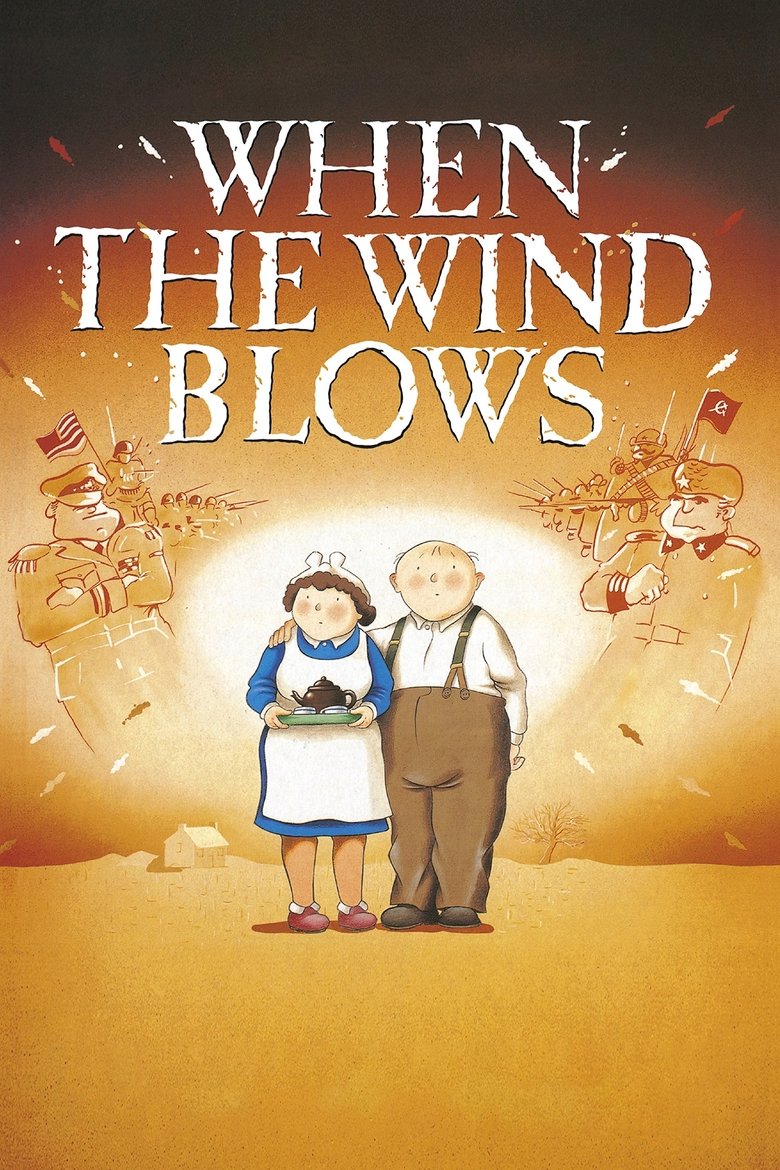
The animation is genuinely lovely. Raymond Briggs' watercolour aesthetic carries over faithfully from the page, all soft edges and muted, domestic warmth that makes the horror creeping in around the margins feel all the more cruel by contrast. An elderly couple, Jim and Hilda, potter about their rural home, following government pamphlets to the letter and keeping their chins up while the world quietly ends around them. Visually, it's a melancholic, distinctive piece of work, and the decision to render the human figures in a slightly different style to the painted backgrounds gives the whole thing an unsettling, dreamlike quality. There's real craft here, no question about it.
And the intent is clear enough. This is a film about Cold War complacency, about the danger of trusting authority and keeping calm when calm is the worst possible response. Jim and Hilda's cheerful, baffled optimism, their belief that the government booklet will see them right, their worry about proper meals and good manners while radiation sickness quietly takes hold, is meant to be heartbreaking. It's a critique dressed up as a gentle domestic story, and on paper that's a powerful idea.
But good intentions don't always translate into good viewing, and this is where my patience started to fray. Eighty minutes is a long time to spend with characters whose defining characteristic is that they simply will not understand what is happening to them. The flimsy shelter, the folded doors, the cheerful cups of tea as their bodies begin to fail them, it's affecting for a while. Then it becomes repetitive. Then, and I feel a bit rotten saying this, it becomes grating. The naivety that's supposed to make you ache for them tips, somewhere around the midpoint, into something that made me want to shout at the screen.
I kept thinking of Peter Watkins' The War Game, which covers similar nuclear anxiety territory and does it with such brutal, efficient precision that it barely gives you room to breathe. That film is an assault. It grabs you by the collar and doesn't let go. When the Wind Blows opts for the slow accumulation of helplessness instead, which is a legitimate artistic choice, but one that I'd argue needed a tighter hand on the edit. Fifty minutes, maybe an hour, and this could have been devastating. At eighty it outstays its welcome, and empathy starts to curdle into impatience, which is absolutely the last thing a film like this should be producing in its audience.
I also found myself thinking about Lessons of Darkness (1992), a film that approaches mass destruction and environmental catastrophe in an entirely different way but manages to make the horror feel genuinely apocalyptic through restraint and atmosphere rather than duration. There's a lesson in that about how long you need to make your point land.
None of this is to say When the Wind Blows is a bad film. It isn't. As a historical document of 1980s nuclear anxiety in Britain, it's genuinely valuable, a time capsule of a very specific kind of dread that gripped a generation. The soundtrack has a stark, eerie quality that suits the material. The performances behind Jim and Hilda are warm and convincing. And there are moments, particular images, that stick with you.
But a film can be admirable without being enjoyable, and it can be visually accomplished without being emotionally effective. When the Wind Blows is all of those things, in both directions. Worth seeing once, especially if you're interested in animation as a vehicle for serious subject matter. Just don't expect it to leave you wrecked in the way it clearly wants to.
Two and a half stars.
Rating: ★★½ | Year: 1986 | Watched: 2026-03-29
Where to watch
Watch in the UK
Rent: Amazon Video
Buy: Amazon Video
Physical: Amazon UK · Zavvi
Watch in the US
Stream: Amazon Prime Video · Night Flight Plus · Eternal Family · Midnight Pulp
Rent: Amazon Video · Fandango At Home
Buy: Amazon Video · Fandango At Home
Physical: Amazon US
Affiliate disclosure: Movies With Macca may earn a small commission on purchases or subscriptions started via these links. It costs you nothing extra.
Related on Movies With Macca
More from United Kingdom: Lessons of Darkness (1992) · Shinjuku Boys (1995) · The Curse of Frankenstein (1957) · Blue (1993)
More from the 1980s: Nightmare City (1980) · A Better Tomorrow (1986) · Style Wars (1983) · Garlic Is as Good as Ten Mothers (1980)
More animation: Fantastic Planet (1973) · Alice in Wonderland (1951) · Mononoke the Movie: The Phantom in the Rain (2024) · Mononoke the Movie: Chapter II - The Ashes of Rage (2025)
More war: Lessons of Darkness (1992) · The General (1926) · Men Without Wings (1946) · Fires Were Started (1943)