Fires Were Started (1943)
★★½ — Fires Were Started (1943)

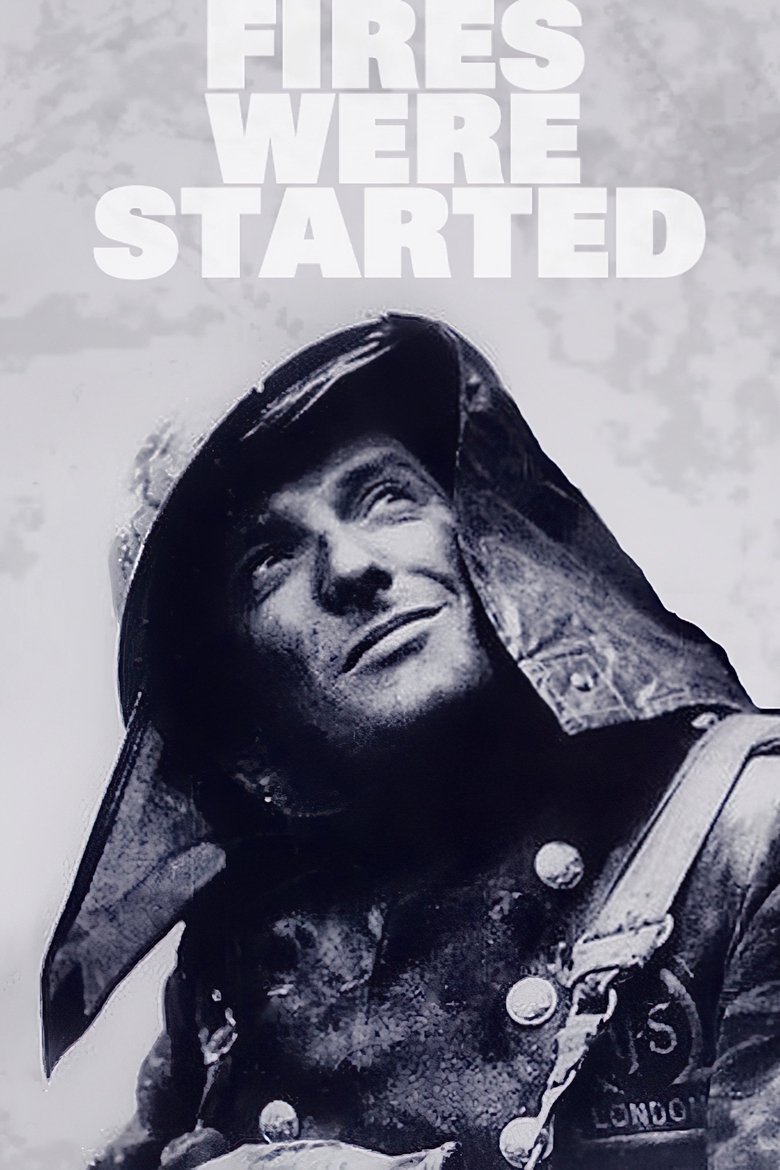
There's a moment in Fires Were Started where you stop watching a film and start watching history. The bombed-out streets are real. The soot is real. The men hauling hoses through the dark are real firefighters, not actors drafted in to play heroes for the cameras. Humphrey Jennings shot this in the middle of the Blitz, and that fact alone gives it a weight that no amount of conventional filmmaking craft could manufacture. The trouble is, once you've absorbed that weight, you're left asking whether what surrounds it actually works as a film. My honest answer is: only just.
This is a curious hybrid, part docudrama, part propaganda piece, part historical artefact, and it wears all three identities at once without ever fully committing to any of them. It follows a new recruit through his first day with the National Fire Service, from the mundane rituals of clocking in and learning the ropes, through to a night of genuine chaos as the Blitz descends and the crew fight to save a munitions ship from the flames. The structure is loose, almost procedural, and Jennings leans hard into the rhythm of waiting. Long stretches pass with little happening beyond watchful faces and quiet preparation, and then the fire comes and everything lurches into urgency.
The black-and-white cinematography is frequently stunning. Shooting on location amid actual ruins and smouldering wreckage, Jennings and his collaborators capture something that feels less like drama and more like reportage. You can almost smell the smoke coming off the screen. There's an immediacy here that is genuinely rare, the kind of thing you can't fake and can't recreate after the fact. In that sense, Fires Were Started belongs in the same conversation as Werner Herzog's Lessons of Darkness (1992), another film that finds an almost uneasy beauty in destruction and lets the reality of what's in front of the camera do the heavy lifting.
But as cinema, it's dramatically inert in ways that are hard to overlook. The performances, many from the actual firefighters rather than professional actors, are authentic to a fault. They're convincing precisely because they're not performing, but that same quality means there's precious little to hold onto emotionally. Characters blend into one another. Dialogue skews toward the procedural. There's no traditional plot threading it together, and while I can respect the artistic choice to resist melodrama, the film rarely stirs the feelings it so clearly wants you to have. You admire the people on screen. You don't particularly feel for them.
It's worth noting that 1943 was a remarkable year for films grappling with moral gravity in entirely different ways. I reviewed The Ox-Bow Incident from the same year, a film that also strips away sentimentality but generates almost unbearable tension from its restraint. Jennings aims for something similar and lands somewhere cooler and more distant.
There's poetry in the film's quietude, I won't deny that. The shots of men waiting, smoking, sharing a song around a piano before heading out into the night, have a documentary grace that genuinely moves you in the right mood. And the climactic fire sequence delivers the visceral charge the rest of the film withholds. But the pacing meanders, and "meanders" feels like the only honest word for it. Tedium isn't always a flaw in a film that's trying to capture the grinding, unglamorous texture of wartime duty, but it doesn't make for easy watching either.
What I keep coming back to is this: Fires Were Started earns admiration more than enjoyment. It's not good or bad in the conventional sense. It's a sober, unvarnished record of ordinary people doing extraordinary things under fire, made while the fire was still burning. That is genuinely remarkable. But remarkable circumstances don't automatically produce remarkable films, and Jennings, for all his craft and sincerity, can't quite bridge the gap between historical document and dramatic experience.
Watch it for the insight, not the entertainment. Approach it as testimony rather than storytelling. Two and a half stars.
Rating: ★★½ | Year: 1943 | Watched: 2026-04-09
Where to watch
Watch in the UK
Buy: Apple TV Store
Physical: Amazon UK · Zavvi
Watch in the US
Stream: OVID
Physical: Amazon US
Affiliate disclosure: Movies With Macca may earn a small commission on purchases or subscriptions started via these links. It costs you nothing extra.
Related on Movies With Macca
More from United Kingdom: Lessons of Darkness (1992) · Shinjuku Boys (1995) · The Curse of Frankenstein (1957) · Blue (1993)
More from the 1940s: Louisiana Story (1948) · The Ox-Bow Incident (1943) · Men Without Wings (1946) · The Bank Dick (1940)
More drama: Viy (1967) · Wonder (2017) · A Better Tomorrow (1986) · Beautiful Boy (2018)
More war: Lessons of Darkness (1992) · The General (1926) · Men Without Wings (1946) · When the Wind Blows (1986)