Lessons of Darkness (1992)
Lessons of Darkness (1992)

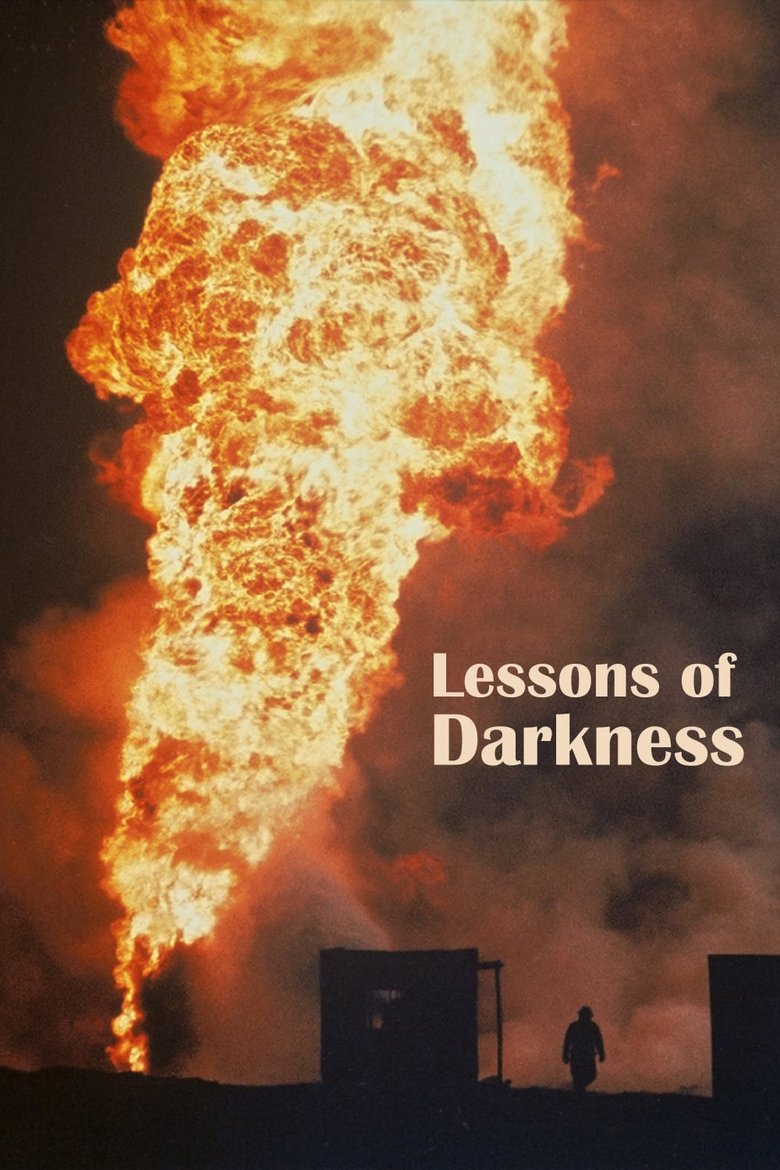
There's a moment in Lessons of Darkness where you stop thinking about Kuwait, about the Gulf War, about geopolitics, and you start wondering whether you're watching footage of a dying planet from somewhere out in space. Blackened skies stretching to the horizon. Rivers of crude oil moving like something alive and malevolent. Flames leaping hundreds of feet into the air while tiny human figures move beneath them, dwarfed and seemingly doomed. Werner Herzog shoots the burning oil fields of post-war Kuwait and what he gives you isn't a documentary. It's a vision of the apocalypse, and it's genuinely one of the most astonishing things I've ever seen on screen.
Herzog isn't interested in journalism here. There are no talking heads, no chronological account of the conflict, no explainer graphics. He frames this scorched landscape as something mythological, almost biblical, and his narration leans into that fully. When he speaks, it's with that unmistakable delivery of his, poetic fatalism laced with a strand of dry, almost cosmic irony, and those moments are where the film is most alive. He's meditating on human folly, on our capacity to corrupt and destroy, on the indifference of a world that will burn long after we're gone. It's the same restless, slightly mad philosophical spirit I've always admired in his work. If you've seen Fitzcarraldo, you'll recognise the obsession with the sublime, with grandeur pushed past the point of sanity.
And visually? There's no argument to be had. The imagery here is staggering, and I mean that without reservation. Some of these shots look less like documentary footage and more like frames from a science fiction film set on a world already lost. Fantastic Planet (1973) came to mind more than once, which is a strange comparison but I think an honest one. Both films present a landscape so alien and so wrong that you feel it in your chest rather than process it through your brain. The difference is that Herzog's images are real, and that knowledge never quite leaves you.
So why the mixed feelings? Because between those narrated passages and those genuinely staggering images, there are long stretches of silence. Minutes at a time with no commentary, no music, no human voice. Just the burning fields, again and again. I understand the intention. Herzog wants you to sit with it, to feel the weight of it, to be overwhelmed rather than guided. It's a bold choice. But for me, and I'll own this completely, it doesn't always work. The problem with relying on spectacle alone is that spectacle repeats. The hundredth column of fire doesn't hit the same as the first, and without Herzog's voice or any kind of structural anchor, the emotional impact starts to thin out. The silence doesn't deepen the dread so much as it creates a kind of distance, and I found myself drifting when I should have been shattered.
It's a real frustration, because when this film is working it's genuinely profound. The contrast between human ambition, military technology, industrial scale destruction, and the raw, indifferent power of what's been unleashed is exactly the kind of thing Herzog was born to articulate. He sees something here that most filmmakers wouldn't even know to look for. The pacing just gets in the way of itself too often.
I'm leaving it unrated, and that feels right. Applying a star rating to Lessons of Darkness feels like the wrong instrument for the job. It's not a film I'd measure in those terms. It's brilliant in bursts and demanding in ways that don't always pay off, but it's also a work of genuine vision from a filmmaker who has never once been content to make things easy for you or for himself. See it for what it achieves. Just be honest with yourself about what it asks in return.
Rating: Not rated | Year: 1992 | Watched: 2026-05-13
Where to watch
Watch in the US
Stream: Philo · Fandor Amazon Channel · Shout! Factory Amazon Channel · Cineverse Amazon Channel
Rent: Amazon Video · Apple TV Store · Google Play Movies · YouTube
Buy: Amazon Video · Apple TV Store · Google Play Movies · YouTube
Physical: Amazon US
Affiliate disclosure: Movies With Macca may earn a small commission on purchases or subscriptions started via these links. It costs you nothing extra.
Related on Movies With Macca
More from Werner Herzog: The Great Ecstasy of Woodcarver Steiner (1974) · Fitzcarraldo (1982)
More with Werner Herzog: Garlic Is as Good as Ten Mothers (1980) · The Great Ecstasy of Woodcarver Steiner (1974)
More from France: Fantastic Planet (1973) · Letter from Siberia (1957) · Here and Elsewhere (1976) · The Man Who Sleeps (1974)
More from the 1990s: Shinjuku Boys (1995) · Blue (1993) · Cemetery Man (1994) · Anastasia (1997)
More war: The General (1926) · Men Without Wings (1946) · Fires Were Started (1943) · When the Wind Blows (1986)
More documentary: Letter from Siberia (1957) · Style Wars (1983) · Here and Elsewhere (1976) · Shinjuku Boys (1995)