The Magnificent Seven (1960)
★★★½ — The Magnificent Seven (1960)

That main theme. You know the one. It hits, and suddenly you're sitting up straighter, and your pulse is doing something it probably shouldn't for a film you've seen a dozen times. Elmer Bernstein's score for The Magnificent Seven is one of those rare pieces of film music that doesn't just accompany the action, it is the action. Pure adrenaline, instantly recognisable, endlessly imitated, and still completely undefeated. If a piece of music can make a man feel like he could ride into battle on horseback, this is that piece of music.
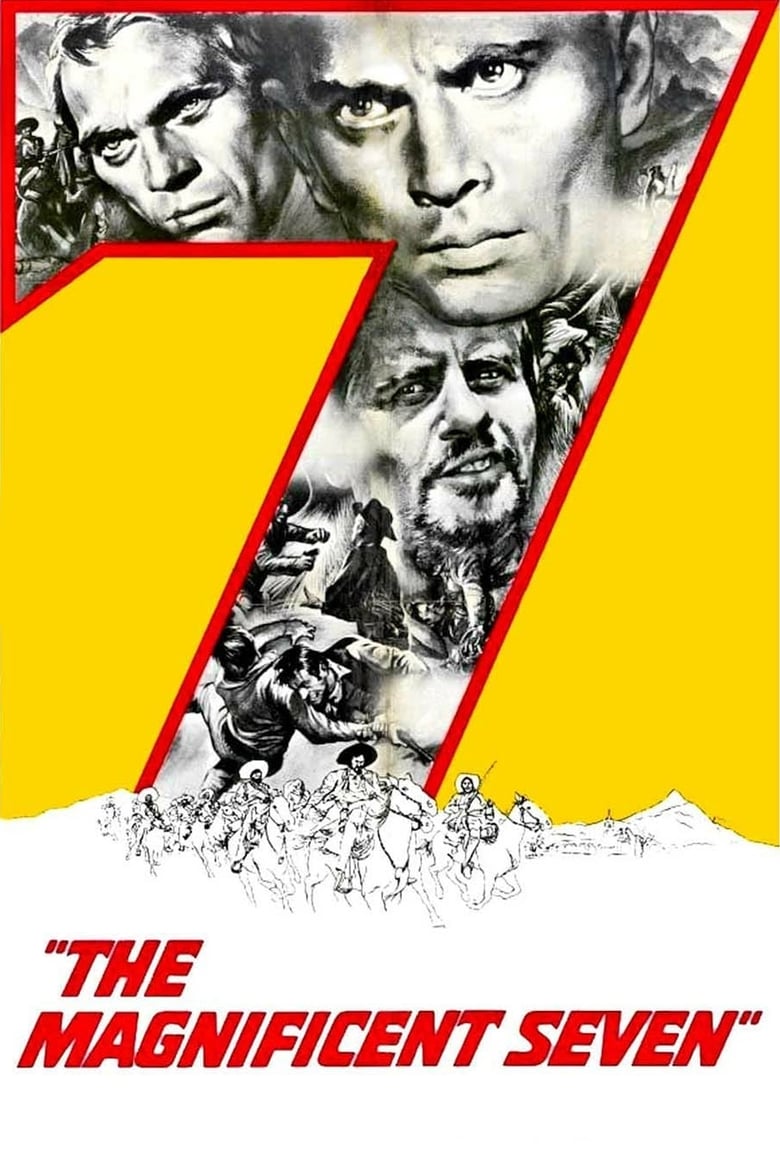
John Sturges's 1960 Western is a rousing, beautifully crafted piece of work, and I mean that sincerely. The cast alone is almost absurdly stacked: Yul Brynner commanding the screen with barely a flicker of expression, Steve McQueen doing that thing he does where he seems to be acting in a completely different, better film than everyone else around him, and then Charles Bronson, James Coburn, and more besides, each given just enough shading to feel like a distinct human being rather than a walking archetype. The chemistry between them crackles with playful rivalry and unspoken loyalty, the kind of ensemble dynamic that feels effortless precisely because it isn't. Their camaraderie is the beating heart of the picture.
The action is cleanly shot, the pacing is brisk without feeling rushed, and the moral spine of the story, ordinary men choosing to risk their lives for people who can offer them almost nothing in return, remains as timeless as it gets. As a standalone Western, this is top-tier stuff. Exciting, emotionally grounded, visually striking. I'd stack it comfortably alongside the finest the genre has to offer, and I've got a lot of love for the genre. Rio Bravo came out just the year before, and that's a film I absolutely adore, but The Magnificent Seven holds its own in that same golden stretch of late-fifties, early-sixties Western brilliance.
But here's where I have to be honest with myself, and with you. Because we can't really talk about this film without talking about Akira Kurosawa's Seven Samurai. This is, in almost every meaningful structural sense, a near scene-for-scene transplant of that film, lifted from feudal Japan and set down on the Mexican frontier. And knowing that casts a long, long shadow. Not because there's anything dishonourable about adaptation, there isn't, but because the comparison is genuinely illuminating about what each version is trying to do.
Where Kurosawa was interested in the weight of sacrifice, the tragedy underneath the heroism, the philosophical cost of a life lived by the sword, Sturges is interested in the ride. The swagger. The moment. The Magnificent Seven trades depth for derring-do, and it makes that trade knowingly and confidently. It's leaner, flashier, and considerably less philosophically rich than its source. It wears its heart on its sleeve where Seven Samurai carries its sorrow somewhere deeper. That's not a fatal flaw. But it is a real one, and pretending otherwise would be doing the film a disservice.
What you're left with, then, is something that I'd call an all-time great Western without quite calling it a revolution. It earns its place in the pantheon through sheer force of craft, personality, and that extraordinary score. It just doesn't rewrite the rulebook the way its source material did, because the rulebook had already been rewritten, and this is the glorious, slightly shinier reprint.
Three and a half stars.
Ride with it. Just ride with it knowing what it is.
Rating: ★★★½ | Year: 1960 | Watched: 2026-02-15
Where to watch
Watch in the UK
Stream: MGM Plus Amazon Channel
Rent: Apple TV Store · Amazon Video · Sky Store
Buy: Apple TV Store · Amazon Video · Google Play Movies · Sky Store
Physical: Amazon UK · Zavvi
Watch in the US
Stream: fuboTV · MGM+ Amazon Channel · Philo · MGM Plus Roku Premium Channel
Rent: Amazon Video · Apple TV Store · Google Play Movies · YouTube
Buy: Amazon Video · Apple TV Store · Google Play Movies · YouTube
Physical: Amazon US
Affiliate disclosure: Movies With Macca may earn a small commission on purchases or subscriptions started via these links. It costs you nothing extra.
Related on Movies With Macca
More with Yul Brynner: The Light at the Edge of the World (1971)
More from the 1960s: Viy (1967) · Persona (1966) · Carnival of Souls (1962) · Daisies (1966)
More western: The Ox-Bow Incident (1943) · Rio Bravo (1959) · Ride Lonesome (1959) · The Great Train Robbery (1903)
More action: A Better Tomorrow (1986) · The General (1926) · Hand of Death (1976) · Daredevil (2003)