Rio Bravo (1959)
★★½ — Rio Bravo (1959)

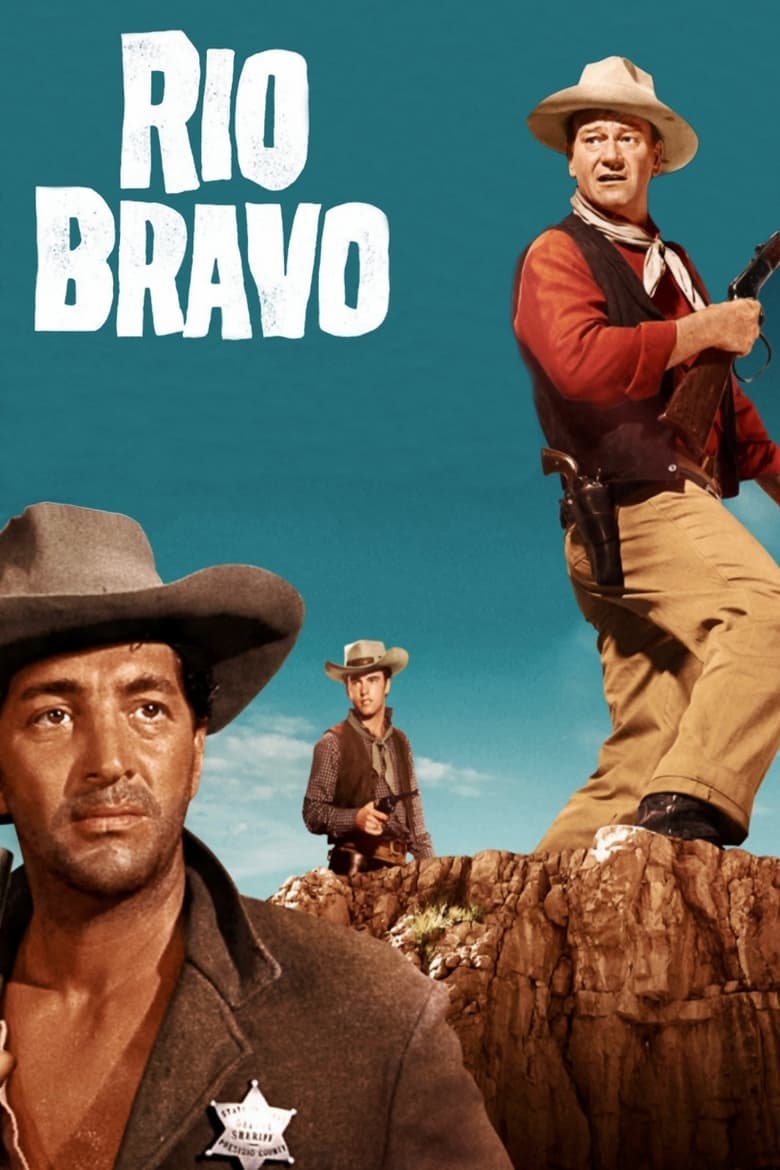
Let me be honest with you: I went into Rio Bravo expecting to finally understand what all the fuss was about. It's one of those films that gets wheeled out whenever someone wants to defend the Golden Age Western, the kind of title that appears on "greatest ever" lists with such regularity you start to feel like you're missing something fundamental if it doesn't click for you. Well, I've seen it now, and I'm still waiting for that click.
The setup is solid enough. John Wayne's Sheriff Chance has a dangerous prisoner locked up and needs to hold him until the U.S. Marshal arrives. That's your siege. In come the hired guns trying to spring the prisoner, and in come Chance's unlikely allies: a recovering drunk played by Dean Martin, a fresh-faced Ricky Nelson, and the scene-stealing Walter Brennan doing his loveable-codger routine. There's a saloon, there are standoffs, there are songs. Actual songs, performed at length, mid-film. And somehow none of it generates much heat.
The problem isn't that Rio Bravo is poorly made. Howard Hawks clearly knows what he's doing, and the film is handsome in a clean, well-pressed sort of way. But handsome and well-pressed is exactly the trouble. It's stagey, shot largely on studio sets, and it moves with the unhurried confidence of a film that doesn't think it needs to earn your attention. The villains have no menace to speak of. The stakes, despite everything the plot insists about danger and duty, feel remarkably low. You're never in any real doubt about how this ends, and the journey there is padded with long stretches of chat and waiting that mistake patience for depth.
Wayne does what Wayne does: quiet authority, a straight back, a jaw that could stop a bullet. But there's no friction in the performance, no shadow behind the eyes. Sheriff Chance is exactly who he appears to be from the first frame to the last. Compare that to the morally knotted antiheroes who'd come to define the genre just a few years later, and you start to feel the absence of complexity like a missing tooth. Good guys wear white hats here. Bad guys scowl. Justice arrives right on schedule. Nobody is asked to examine themselves too closely, least of all the audience.
I've got a lot of affection for the Western as a form. I think Ride Lonesome, made the very same year, does far more with far less, packing genuine unease and moral weight into a leaner runtime. That film trusts the genre to carry meaning. Rio Bravo, for all its reputation, feels more comfortable with procedure than passion, more interested in depicting duty than dramatising it. The machinery is visible, and it's well-oiled, but watching machinery isn't the same as feeling something.
To be fair to it, the camaraderie between the leads has a loose, lived-in warmth. Martin in particular suggests interesting things about pride and self-destruction that the film, frustratingly, never quite develops. And Brennan is genuinely fun in the way that only someone utterly committed to a broad comic performance can be. These are pleasures, real ones, just not enough to sustain nearly two and a half hours.
Two and a half stars. Rio Bravo isn't bad. It's competent, occasionally charming, and clearly made by people who cared about the craft. But in a genre that thrives on boldness, on landscapes that dwarf the human, on stories that ask hard questions about violence and justice and what it costs to do the right thing, this one plays it remarkably safe. It doesn't hold a candle to the films it's so often mentioned alongside, and no amount of critical reverence is going to change that for me. If this is supposed to be one of the great Westerns, it makes me all the more grateful for the ones that actually take risks.
Rating: ★★½ | Year: 1959 | Watched: 2026-04-19
Where to watch
Watch in the UK
Rent: Apple TV Store · Rakuten TV · Amazon Video · Google Play Movies
Buy: Apple TV Store · Rakuten TV · Amazon Video · Google Play Movies
Physical: Amazon UK · Zavvi
Watch in the US
Rent: Amazon Video · Apple TV Store · Google Play Movies · YouTube
Buy: Amazon Video · Apple TV Store · Google Play Movies · YouTube
Physical: Amazon US
Affiliate disclosure: Movies With Macca may earn a small commission on purchases or subscriptions started via these links. It costs you nothing extra.
Related on Movies With Macca
More from the 1950s: Invasion of the Body Snatchers (1956) · Alice in Wonderland (1951) · Letter from Siberia (1957) · Invaders from Mars (1953)
More western: The Ox-Bow Incident (1943) · Ride Lonesome (1959) · The Great Train Robbery (1903) · Bone Tomahawk (2015)
More drama: Viy (1967) · Wonder (2017) · A Better Tomorrow (1986) · Beautiful Boy (2018)