
The Light at the Edge of the World (1971)
★½ — The Light at the Edge of the World (1971)

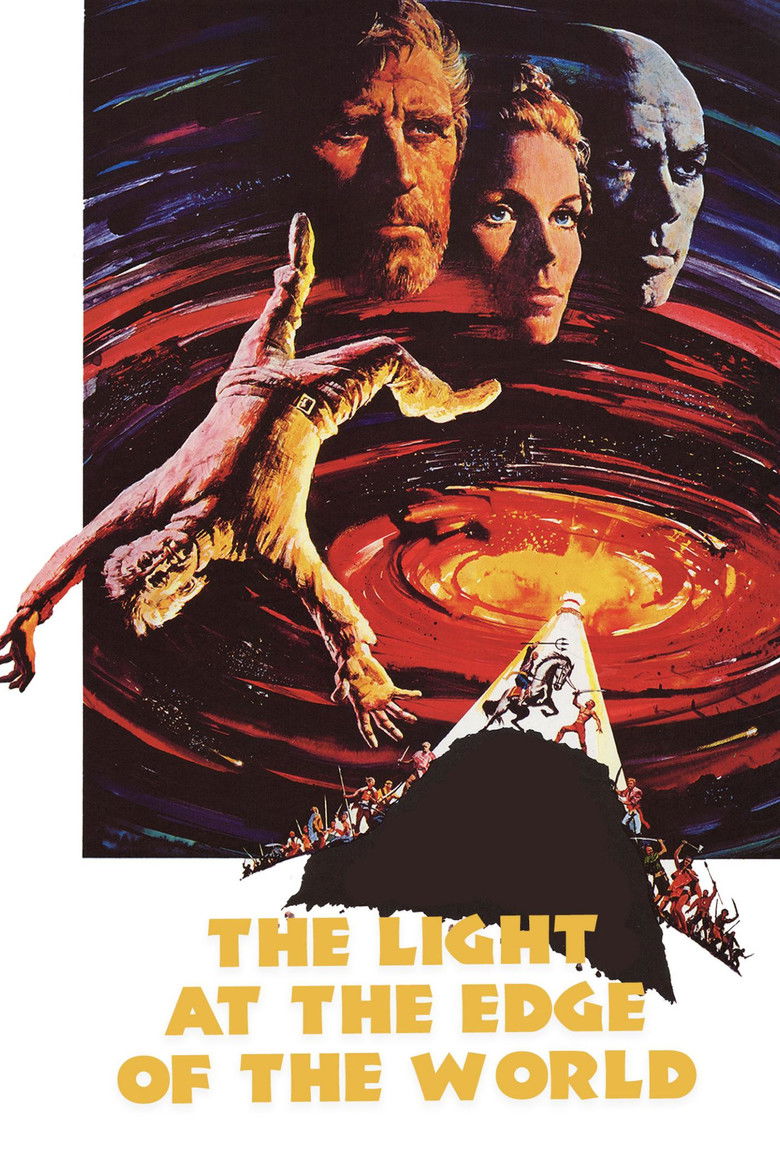
Let me be upfront about something: I went into this one fully expecting aliens. The poster, a glowing orb hanging over a misty, foreboding coastline, had me absolutely convinced I was getting some kind of 1970s sci-fi mystery. Maybe a low-budget Close Encounters knockoff, maybe something weirder and more wonderful. Either way, I was ready for it. So when the actual film turned out to be a slow, muddled pirate drama starring Kirk Douglas, built around a lighthouse conspiracy that grows less coherent with every passing scene, the disappointment hit hard and never really let up.
The premise involves a mysterious light off the coast of South America, and if that sounds like it could be genuinely intriguing, the film quickly puts paid to any such hope. What follows is a procession of men shouting at each other on boats, brooding close-ups of Douglas looking concerned about things I'd largely stopped caring about, and what feels like an entire act's worth of arguing over navigation charts and wind direction. I'm not opposed to slow-burn filmmaking, but slow-burn only works if there's something smouldering underneath. Here, it feels more like someone left a damp cloth over the whole thing.
And then there are the pirates. Not space pirates. Not even particularly interesting pirates. Just a collection of blokes hanging around a lighthouse in what I assume is supposed to be period-accurate 17th century gear, though the film's relationship with time, geography and basic internal logic seems to have gone entirely on holiday. The story keeps gesturing towards tension and mystery without ever committing to either, and the dialogue sounds, at points, as though it was passed through three separate translators before anyone thought to check whether it made sense in English.
I'll give it this much: there are flickers of something here. A few atmospheric wide shots of the sea do capture a genuinely bleak, windswept mood, and one or two of the standoffs carry a faint pulse of tension. Douglas, for his part, is giving it his all, because that's apparently just what Kirk Douglas did regardless of the material in front of him. But these moments are islands in a very long, very grey ocean, and there's not enough of them to justify the journey.
The core problem is that the film can't make up its mind what it wants to be. Is it a thriller? A mystery? A historical swashbuckler? It reaches for all three and lands on none of them, producing something that's less than the sum of its already fairly modest parts. It's easy enough to see, watching it now, why it sank without much of a trace on release. It doesn't fail spectacularly. It just fails quietly, slowly, and at considerable length.
This was my Liechtenstein entry for the A-Z World Movie Tour, and while I appreciate that finding a Liechtenstein production is never going to be the easiest task, I genuinely hope my next dip into unfamiliar cinematic waters is a bit more rewarding than this one. For comparison, my Punishment Park (1971) watch from the same era showed exactly how much raw grip a low-budget film from this period can have when it actually knows what it's trying to say. This one, sadly, does not.
One and a half stars.
Rating: ★½ | Year: 1971 | Watched: 2025-07-11
Where to watch
Watch in the UK
Physical: Amazon UK · Zavvi
Watch in the US
Stream: Shout! Factory Amazon Channel
Rent: Amazon Video
Buy: Amazon Video
Physical: Amazon US
Affiliate disclosure: Movies With Macca may earn a small commission on purchases or subscriptions started via these links. It costs you nothing extra.
Related on Movies With Macca
More from Liechtenstein: A Virgin Among the Living Dead (1973)
More from the 1970s: Fantastic Planet (1973) · Here and Elsewhere (1976) · Italianamerican (1974) · Punishment Park (1971)
More adventure: Alice in Wonderland (1951) · The Eagle (1925) · Louisiana Story (1948) · The General (1926)
More drama: Viy (1967) · Wonder (2017) · A Better Tomorrow (1986) · Beautiful Boy (2018)



