Carnival of Souls (1962)
★★★½ — Carnival of Souls (1962)

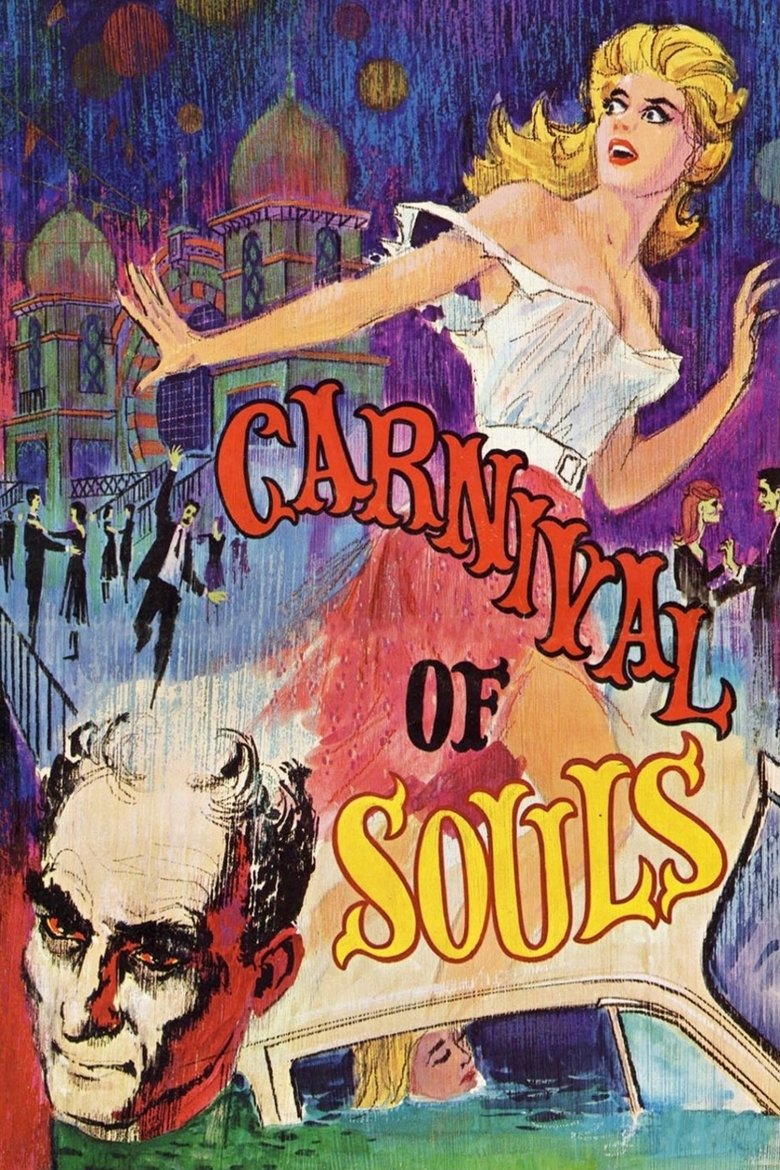
There's a moment in Carnival of Souls where the world simply stops acknowledging our protagonist. She's there, right in front of people, speaking to them, and they look straight through her as if she's made of glass. It's the kind of image that lodges itself in the back of your skull, and it cost next to nothing to put on screen. That's the quiet miracle of this film: it does so much with so little.
I watched the colourised version, which I know immediately raises eyebrows. Colourisation is usually a sin, a clumsy smear of artificiality over work that was composed with black-and-white contrast in mind. But here, strangely, it works. The tint is subtle, almost watercolour-like, and it gives the whole thing a faded, ghostly softness. It looks less like a restored print and more like a photograph left in the sun too long. A memory bleaching at the edges. Rather than cheapening the atmosphere, it amplifies it.
The story itself is stripped back to its essentials. A young organist survives a car crash under unsettling circumstances and begins to unravel. She's pulled, almost magnetically, towards a vast, decaying riverside pavilion. Spectral figures keep appearing. The world keeps slipping. At 80 minutes it doesn't hang about, and director Herk Harvey, who came from industrial filmmaking of all things, uses that brevity brilliantly. Long static shots, disorienting sound design, and the protagonist's own organ music drifting through empty spaces build a sense of dread that more expensive horror films fail to achieve with all the tools in the world.
What strikes me most is how psychological it all feels. This isn't a film about gore or shocks. It's about isolation and identity dissolving at the seams, about being present in the world but not of it. In that sense it reminds me of Persona, another film where a woman's grip on herself becomes the real subject of dread. Carnival of Souls is rougher, obviously, and nowhere near as formally rigorous, but the instinct is similar: get inside a fractured consciousness and stay there until it becomes genuinely uncomfortable.
The weaknesses are real and worth naming. The acting is uneven across the board, and the pacing goes flat in places, particularly in the mid-section. And yes, the finale's twist is thoroughly telegraphed. By today's standards it's almost gentle in its predictability. But I'd push back on holding that against it too hard. In 1962 this kind of existential, surreal approach to horror was genuinely unusual. It prefigures other, better-known films that would explore similar territory with a woman slowly becoming invisible to the world around her. Invasion of the Body Snatchers, which I've written about before, shares some of that same paranoid energy, though it channels its anxieties through a more explicitly social lens. Carnival of Souls is quieter and more personal.
What Harvey made here is less a traditional horror film and more a tone poem about being unseen while still breathing. The pavilion, empty and cavernous, feels like the landscape of a bad dream you can't quite shake on waking. The silences feel wrong in exactly the right way. And there's a melancholy running through the whole thing that gives it a weight its budget has no right to support.
Rough around the edges, yes. Occasionally stiff, certainly. But its vision is singular, and it earns its cult reputation without having to try too hard to justify it. Short, genuinely strange, and steeped in a mood that lingers well after the credits roll.
Three and a half stars.
Rating: ★★★½ | Year: 1962 | Watched: 2026-05-07
Where to watch
Watch in the UK
Stream: Amazon Prime Video · FilmBox Live Amazon Channel · Amazon Prime Video with Ads · Bloodstream
Rent: Apple TV Store · Amazon Video · Sky Store · Brew
Buy: Apple TV Store · Amazon Video · Google Play Movies · Sky Store
Physical: Amazon UK · Zavvi
Watch in the US
Stream: Amazon Prime Video · fuboTV · HBO Max Amazon Channel · MGM+ Amazon Channel
Rent: Amazon Video · Apple TV Store · Brew · Google Play Movies
Buy: Amazon Video · Apple TV Store · Brew · Google Play Movies
Physical: Amazon US
Affiliate disclosure: Movies With Macca may earn a small commission on purchases or subscriptions started via these links. It costs you nothing extra.
Related on Movies With Macca
More from the 1960s: Viy (1967) · Persona (1966) · Daisies (1966) · Symbiopsychotaxiplasm: Take One (1968)
More horror: Invasion of the Body Snatchers (1956) · Viy (1967) · Nightmare City (1980) · Angst (1983)
More mystery: Mononoke the Movie: The Phantom in the Rain (2024) · Mononoke the Movie: Chapter II - The Ashes of Rage (2025) · One Way or Another (1975) · Gone Girl (2014)