The Discreet Charm of the Bourgeoisie (1972)
★★½ — The Discreet Charm of the Bourgeoisie (1972)

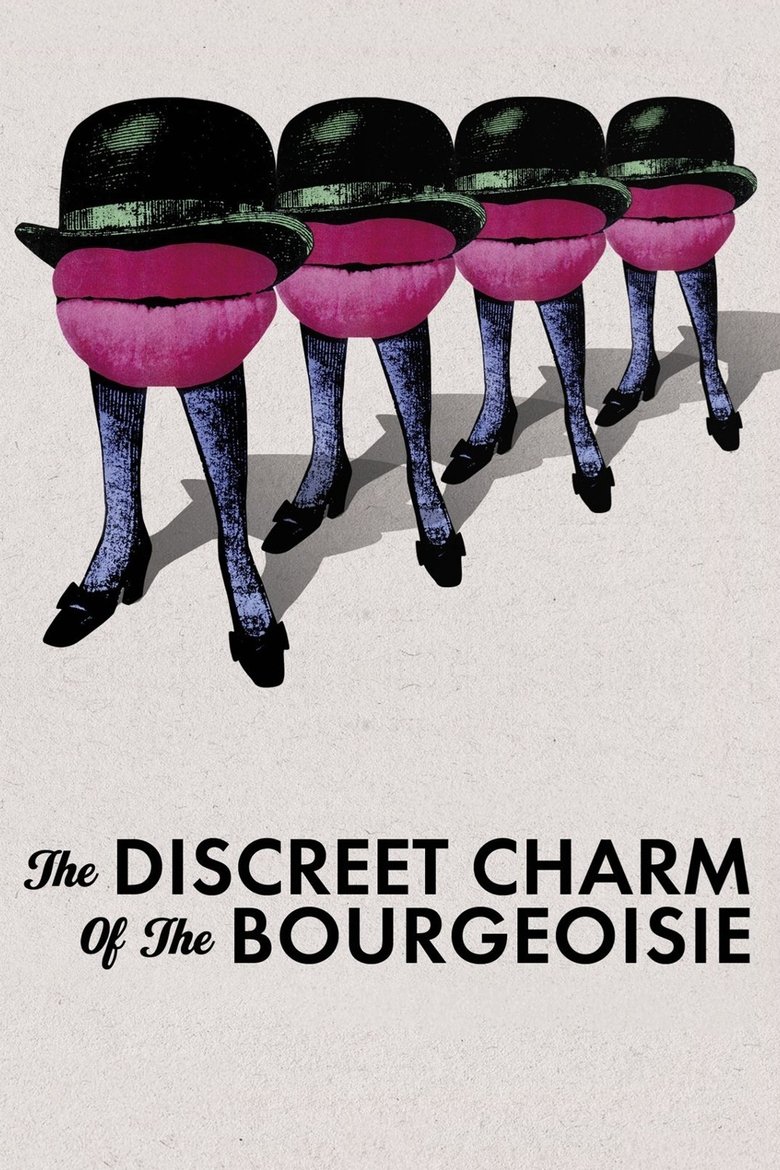
Here's a question nobody warned me about before I sat down with Luis Buñuel's The Discreet Charm of the Bourgeoisie: how do you process a film that is clearly, objectively brilliant, and yet keeps you at a cool, comfortable distance for its entire runtime? Because that's exactly where I landed with this one. Admiring it from across the room, like a piece of art in a gallery you respect but wouldn't hang in your house.
The premise, such as it is, follows a circle of wealthy French diplomats and their associates as they attempt, repeatedly and unsuccessfully, to sit down for dinner together. That's it. Except it isn't, because what keeps derailing them is an escalating parade of the absurd: assassinations, dead bodies turning up at inopportune moments, police raids, and dream sequences that bleed so seamlessly into reality that you stop trusting what you're watching. Buñuel isn't interested in giving you firm ground to stand on. He pulls it away the moment you find it.
Having spent time with his earlier collaborations with Salvador Dalí, particularly Un Chien Andalou and L'Âge d'or, I went in thinking I had some idea of what to expect from Buñuel's brand of strangeness. I was wrong. This film unsettles in a quieter, more insidious way. Where those earlier works are visceral and confrontational, this one wraps its provocation in fine linen and good wine. The chaos arrives politely.
And that contrast is the whole point. The satire here is razor-sharp, even if the blade is gloved. These people talk politics while actual suffering floats past them like background noise. They cling to the etiquette of dinner whilst bodies pile up around them. They are, to a person, utterly oblivious to their own moral bankruptcy, which Buñuel frames with an almost clinical precision. The cinematography is pristine: elegant compositions, smooth tracking shots, a visual calm that makes every surreal rupture hit harder. There's a real intelligence at work in how the film looks, in how deliberately composed and orderly everything appears on the surface while the foundations rot quietly underneath.
So why only three and a half stars? Because I've read reviews that call this film "extraordinarily funny," and I have to be honest: I didn't laugh once. The humour is so dry, so witheld, so rooted in a kind of existential shrug, that it lands for me as discomfort rather than comedy. I was never quite sure if I was meant to be laughing or wincing, and I'm not certain Buñuel cared either way. The dream-within-a-dream structure, characters dying and reappearing, the total abandonment of cause and effect, kept me intellectually engaged but emotionally at arm's length. I was watching it rather than feeling it. And there's a difference.
That's not a flaw, exactly. It might even be the intention. These characters are insulated from real feeling by their class and their privilege, and perhaps Buñuel insulates us from the film in the same way, making us experience, structurally, the same detachment we're meant to be critiquing. If so, that's a clever trick. It's also a slightly frustrating one to sit through.
What I can say without hesitation is that Buñuel is in complete control of every frame. This is a filmmaker who knows precisely what he's doing and why. The film is thematically rich, visually masterful, and as a dismantling of class pretension and political hypocrisy, it's damning in the most composed possible way. It absolutely deserves its reputation.
Three and a half stars.
Just go in with the right expectations. Don't expect laughs. Expect unease. Expect to feel slightly complicit. And maybe, when you next sit down for a dinner party, you'll catch yourself wondering whether you're the host or the punchline.
Rating: ★★½ | Year: 1972 | Watched: 2025-11-04
Where to watch
Watch in the UK
Stream: Studiocanal Presents Amazon Channel
Rent: JustWatch TV · Apple TV Store · Amazon Video · Google Play Movies
Buy: Apple TV Store · Amazon Video · Google Play Movies · Sky Store
Physical: Amazon UK · Zavvi
Watch in the US
Stream: BFI Player Amazon Channel
Rent: Amazon Video · Apple TV Store · Google Play Movies · YouTube
Buy: Amazon Video · Apple TV Store · Google Play Movies · YouTube
Physical: Amazon US
Affiliate disclosure: Movies With Macca may earn a small commission on purchases or subscriptions started via these links. It costs you nothing extra.
Related on Movies With Macca
More from Luis Buñuel: Land Without Bread (1933) · Simon of the Desert (1965) · L'Âge d'or (1930) · Un Chien Andalou (1929)
More with Fernando Rey: The French Connection (1971)
More from France: Fantastic Planet (1973) · Letter from Siberia (1957) · Lessons of Darkness (1992) · Here and Elsewhere (1976)
More from the 1970s: Fantastic Planet (1973) · Here and Elsewhere (1976) · Italianamerican (1974) · Punishment Park (1971)
More comedy: The Eagle (1925) · The General (1926) · Americana (2023) · The Naked Gun: From the Files of Police Squad! (1988)