La Jetée (1962)
★★★ — La Jetée (1962)

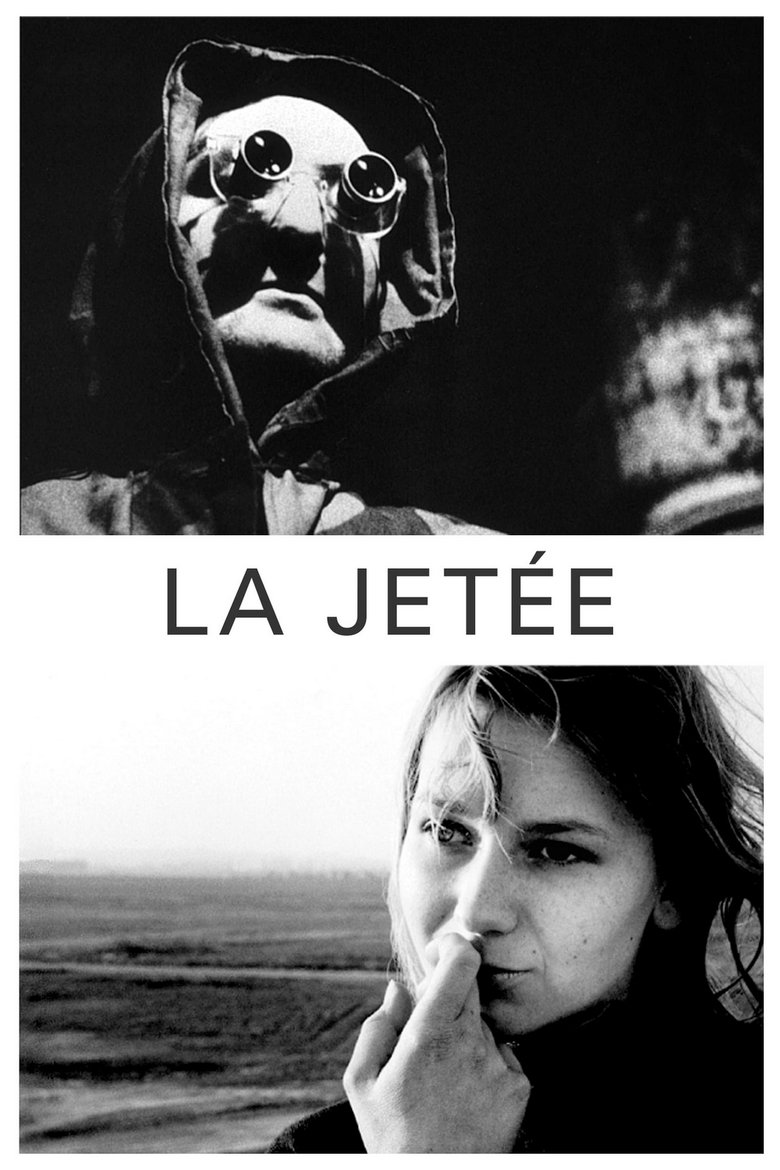
There's a moment in La Jetée where a woman blinks. That's it. A few seconds of movement in a film built almost entirely from still photographs, and it stops you cold. It feels like a miracle. It feels like life itself breaking through. Chris Marker pulls off something extraordinary there, and honestly, that single shot justifies the whole experiment.
Because make no mistake, this is an experiment. Marker tells the story of a man haunted by a childhood memory of a woman on an airport jetty, a man who is later used as a guinea pig for time travel in the ruins of a post-nuclear Paris. He does it almost entirely through black-and-white photographs, a measured voiceover narration, and an eerie, choral score that crawls under your skin and stays there. It's less a film in any conventional sense and more a radio drama illustrated with slides. Or a prose poem with a pulse. Whatever you call it, it works.
As someone who loves a good time travel story, what gets me about La Jetée is that it has absolutely no interest in the mechanics. There's no explanation of the machine, no paradox to untangle, no puzzle to solve. Time here is an emotional loop, something inescapable and predetermined, and Marker treats it with the weight of fate rather than the glee of science fiction. The mood is thick with longing and a low, creeping dread. You feel the tragedy before you can articulate it.
And the ending. I won't spell it out, but it's one of the most quietly gutting twists I've encountered in any film, made all the more powerful because it arrives so softly, so inevitably. It doesn't announce itself. It just happens, and you sit with it.
Now, I should be honest about my mixed feelings. La Jetée runs to about 28 minutes, and even at that length, the restraint occasionally tips into a certain cool remove. There's a part of me that finds it easier to admire than to love. The very qualities that make it remarkable, the minimalism, the dreamlike detachment, also keep it at arm's length. I respect it enormously. I'm not sure I'd call it a favourite.
It's worth saying that Terry Gilliam took this film's DNA and built Twelve Monkeys from it, expanding the premise into a full-scale, time-scrambling sci-fi epic with Bruce Willis and Brad Pitt. And honestly? As much as I appreciate what Marker does here, Twelve Monkeys hits harder for me personally. It's messier, louder, more chaotic, but it gets me in the gut in a way that La Jetée approaches but doesn't quite reach. That's not a criticism of the original so much as an admission of my own taste. Marker's film is the purer, more disciplined work. Gilliam's is the one I'd rewatch on a Saturday night.
I've spent some time with other films from this corner of experimental and essay filmmaking, including another Marker work and Here and Elsewhere (1976), and there's a consistent sensibility across that world: film as a way of thinking out loud, images pressed into service as argument or feeling rather than story. La Jetée is perhaps the purest expression of that idea.
It's not conventional viewing. It asks something of you. But what it gives back, that strange, melancholic atmosphere, that blinking woman, that ending, lingers long after the 28 minutes are up. A short, silent scream across the decades.
Three stars.
Rating: ★★★ | Year: 1962 | Watched: 2025-09-22
Where to watch
Watch in the UK
Rent: Amazon Video
Buy: Apple TV Store · Amazon Video
Physical: Amazon UK · Zavvi
Watch in the US
Rent: Amazon Video · Apple TV Store · Fandango At Home
Buy: Amazon Video · Apple TV Store · Fandango At Home
Physical: Amazon US
Affiliate disclosure: Movies With Macca may earn a small commission on purchases or subscriptions started via these links. It costs you nothing extra.
Related on Movies With Macca
More from Chris Marker: Letter from Siberia (1957)
More from France: Fantastic Planet (1973) · Letter from Siberia (1957) · Lessons of Darkness (1992) · Here and Elsewhere (1976)
More from the 1960s: Viy (1967) · Persona (1966) · Carnival of Souls (1962) · Daisies (1966)
More drama: Viy (1967) · Wonder (2017) · A Better Tomorrow (1986) · Beautiful Boy (2018)
More romance: The Eagle (1925) · The Last Picture Show (1971) · The General (1926) · The Docks of New York (1928)