Close Encounters of the Third Kind (1977)
★★★½ — Close Encounters of the Third Kind (1977)

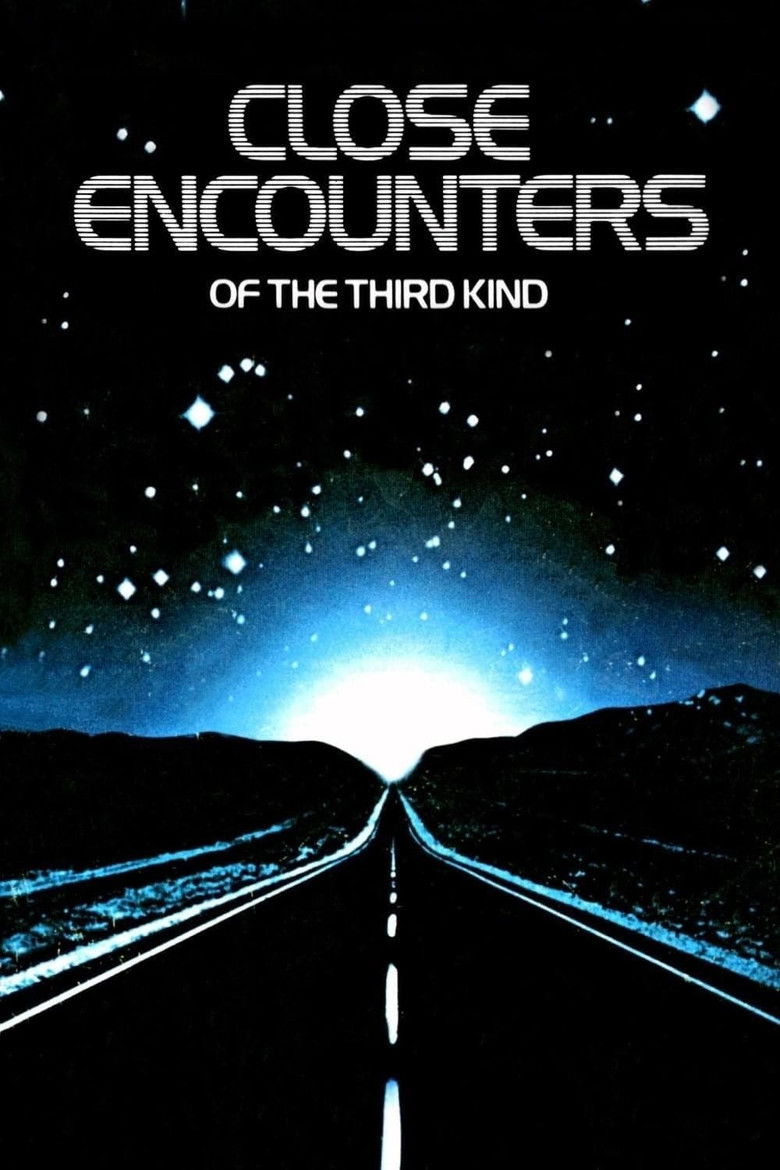
That final sequence. You know the one. The mothership descends, the lights cascade, and five simple musical notes become the most important conversation humanity has ever had. It still gets me, genuinely, even now. Whatever reservations I carry about Close Encounters of the Third Kind, and I have a few, that closing act earns its reputation as one of the most awe-inspiring stretches of film ever committed to celluloid. Spielberg doesn't give us an invasion. He gives us a handshake. And somehow that feels far more profound.
This is a film that shifted the cultural imagination around alien contact. Where so much science fiction of the era leaned into paranoia and threat, Spielberg reached for something rarer: wonder. The unknown here isn't a predator lurking at the edge of the frame. It's an invitation. And the film is all the more powerful for it. Richard Dreyfuss, as Roy Neary, carries that premise on his back with a performance that's committed almost to the point of madness. He's not playing a hero. He's playing a man coming apart at the seams, driven by a compulsion he can't name or resist, and Dreyfuss makes you believe every fraying moment of it. John Williams' score does the rest, swelling with a cosmic grandeur that only he and Spielberg together seemed capable of conjuring. Those five notes aren't just a plot device. They're a feeling.
But I'd be doing you a disservice if I pretended the film is without its rough patches, because time has not been uniformly kind to it. The special effects, which were genuinely revolutionary at the time, now look, and I'll be blunt here, really quite dated. The glowing UFOs skimming across the night sky, the obvious optical compositing, the wirework that occasionally tips from magical into quaint. It's hard to watch some of those early saucer sequences without a smile that Spielberg almost certainly didn't intend. That's not a fatal flaw, but it does puncture the spell at moments when you most need to believe.
The bigger problem, for me, is the middle section. There's a long stretch where Roy obsessively sculpts Devil's Tower from anything he can get his hands on, mashed potatoes, garden soil, whatever's nearest, while government agents move silently through hushed scenes collecting evidence and exchanging meaningful looks. It's designed to build mystery. What it actually builds, too often, is a nagging restlessness. I found myself checking in on my patience more than I'd like to admit. The payoff eventually justifies a lot of it, but the journey through that middle act asks quite a lot of your goodwill.
I've talked before about how Spielberg could do almost no wrong in this particular era. I reviewed Jaws and came away thinking it was close to a perfect genre film. Close Encounters is a different beast, more ambitious in some ways, less disciplined in others. Where Jaws is taut and controlled, this one sprawls, and not always purposefully. It's the trade-off Spielberg made when he decided to reach for the sublime rather than the suspenseful. Sometimes you grab it. Sometimes your arms aren't quite long enough.
And yet. That ending. The light. The music. The sheer, almost sacred feeling of two forms of intelligence meeting each other without fear. It's one of those rare film moments that makes you feel small in the best possible way, small in the way that looking up at a clear night sky does. Spielberg would return to similar territory with E.T., and arguably pulled it off with more consistency, but there's something raw and ambitious about Close Encounters that its successor can't quite replicate.
Three and a half stars.
It creaks in places. The middle sags, the effects date it, and Roy's domestic collapse is sketched rather than fully felt. But its heart, that genuine, trembling belief in the possibility of something beautiful beyond our understanding, still shines brightly enough to matter. See it once. You owe it to yourself. Just maybe have something to fidget with during the mashed potato bit.
Rating: ★★★½ | Year: 1977 | Watched: 2025-08-01
Where to watch
Watch in the UK
Rent: Apple TV Store · Rakuten TV · Amazon Video · Google Play Movies
Buy: Apple TV Store · Rakuten TV · Amazon Video · Google Play Movies
Physical: Amazon UK · Zavvi
Watch in the US
Stream: Sony Pictures Core Amazon Channel
Rent: Amazon Video · Apple TV Store · Google Play Movies · YouTube
Buy: Amazon Video · Apple TV Store · Google Play Movies · YouTube
Physical: Amazon US
Affiliate disclosure: Movies With Macca may earn a small commission on purchases or subscriptions started via these links. It costs you nothing extra.
Related on Movies With Macca
More from Steven Spielberg: Duel (1971) · E.T. the Extra-Terrestrial (1982) · The Lost World: Jurassic Park (1997) · Jurassic Park (1993)
More with Richard Dreyfuss: American Graffiti (1973) · Jaws (1975)
More from United Kingdom: Lessons of Darkness (1992) · Shinjuku Boys (1995) · The Curse of Frankenstein (1957) · Blue (1993)
More from the 1970s: Fantastic Planet (1973) · Here and Elsewhere (1976) · Italianamerican (1974) · Punishment Park (1971)
More science fiction: Invasion of the Body Snatchers (1956) · Fantastic Planet (1973) · Nightmare City (1980) · The Long Walk (2025)
More drama: Viy (1967) · Wonder (2017) · A Better Tomorrow (1986) · Beautiful Boy (2018)