
American Graffiti (1973)
★★★ — American Graffiti (1973)

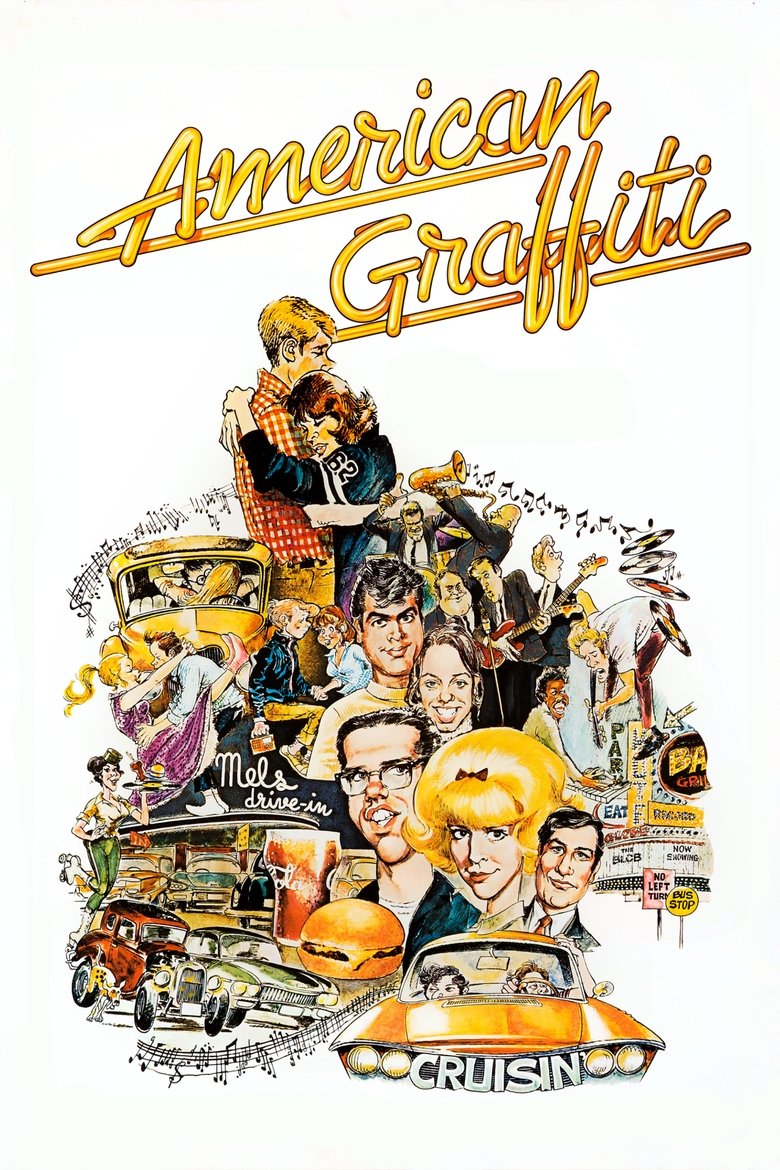
There's no villain in American Graffiti. Nobody's trying to stop a bomb going off or rescue someone from peril. The most dramatic thing on screen might be a drag race along a strip of California asphalt, or a teenager trying to sweet-talk his way past a curfew. And yet, by the time those final title cards roll, something genuine catches in your throat. That's a trick worth paying attention to.
George Lucas made this before he became the man who gave us Star Wars and reshaped blockbuster cinema forever. Knowing that, it's almost startling how intimate this film is. No spaceships, no mythology, no spectacle. Just one long night in a small California town in 1962, a group of teenagers deciding who they want to be, and the quiet, creeping sense that this particular kind of freedom is already running out of road.
What Lucas understood, and what gives the film its strange power, is that nostalgia isn't really about the past. It's about loss. This isn't a celebration of cruising and doo-wop and gleaming bonnets under neon signs. It's a farewell to all of that. Vietnam is coming. The decade is about to crack open. These kids don't know it yet, but we do, and that dramatic irony hangs over every scene like weather.
Visually, the film is gorgeous. The golden California light, the immaculate classic cars, the soda shops and the glowing signage: it all feels like a memory you didn't actually live but somehow carry around with you anyway. It's painted rather than photographed, if that makes sense. Everything is a little too warm, a little too perfect, because that's how memory works. It flatters the past.
And the soundtrack. God, the soundtrack. The whole film runs on doo-wop, early rock and roll and surf guitar, one song bleeding into the next, and it's not just decoration. Music is the nervous system of this world. These characters define themselves by what's on the radio. Every scene breathes to a different beat, and it works better than a conventional score would. You don't just hear the era, you feel it in your chest.
But I have to be honest: the film meanders. It's episodic by design, and some of those episodes resolve with more of a shrug than a punch. A few of the storylines simply trail off without the emotional payoff they seem to be building toward. For a film that's clearly in love with mood and atmosphere, that's partly forgivable. But there were moments where I was watching at a slight remove, admiring the craft without quite feeling it.
The thing that does land, and lands hard, is the ending. Those title cards revealing what happens to each character in the years that follow cut through all the warmth and nostalgia and leave you with something considerably colder. It's a blunt editorial choice and it's the right one. Suddenly the whole film reconfigures itself. All that cruising and laughing and carrying on wasn't just fun. It was the last of something.
As social commentary, it's subtle rather than strident, which suits it. Lucas isn't lecturing. He's just showing you this one night and trusting you to understand what's about to be lost. The simplicity of wanting to find a parking spot on Main Street, of defining your whole identity by your car and your radio station, that isn't naivety being mocked. It's innocence being mourned.
Three stars.
It's not great cinema by any conventional measure. It doesn't build, it doesn't resolve, and it doesn't drive anywhere in particular. But as a portrait of a specific moment fading into history, it's close to perfect. More atmosphere than narrative, more elegy than entertainment. I admired it more than I loved it, but I haven't stopped thinking about those title cards since.
Rating: ★★★ | Year: 1973 | Watched: 2025-10-05
Where to watch
Watch in the UK
Rent: Apple TV Store · Rakuten TV · Amazon Video · Google Play Movies
Buy: Apple TV Store · Rakuten TV · Amazon Video · Google Play Movies
Physical: Amazon UK · Zavvi
Watch in the US
Stream: YouTube TV
Rent: Amazon Video · Apple TV Store · Google Play Movies · YouTube
Buy: Amazon Video · Apple TV Store · Google Play Movies · YouTube
Physical: Amazon US
Affiliate disclosure: Movies With Macca may earn a small commission on purchases or subscriptions started via these links. It costs you nothing extra.
Related on Movies With Macca
More from George Lucas: Star Wars: Episode I – The Phantom Menace (1999) · Star Wars: Episode III – Revenge of the Sith (2005) · Star Wars: Episode II – Attack of the Clones (2002) · Star Wars (1977)
More with Richard Dreyfuss: Close Encounters of the Third Kind (1977) · Jaws (1975)
More from the 1970s: Fantastic Planet (1973) · Here and Elsewhere (1976) · Italianamerican (1974) · Punishment Park (1971)
More comedy: The Eagle (1925) · The General (1926) · Americana (2023) · The Naked Gun: From the Files of Police Squad! (1988)
More drama: Viy (1967) · Wonder (2017) · A Better Tomorrow (1986) · Beautiful Boy (2018)



