Shogun Assassin (1980)
★★★★ — Shogun Assassin (1980)

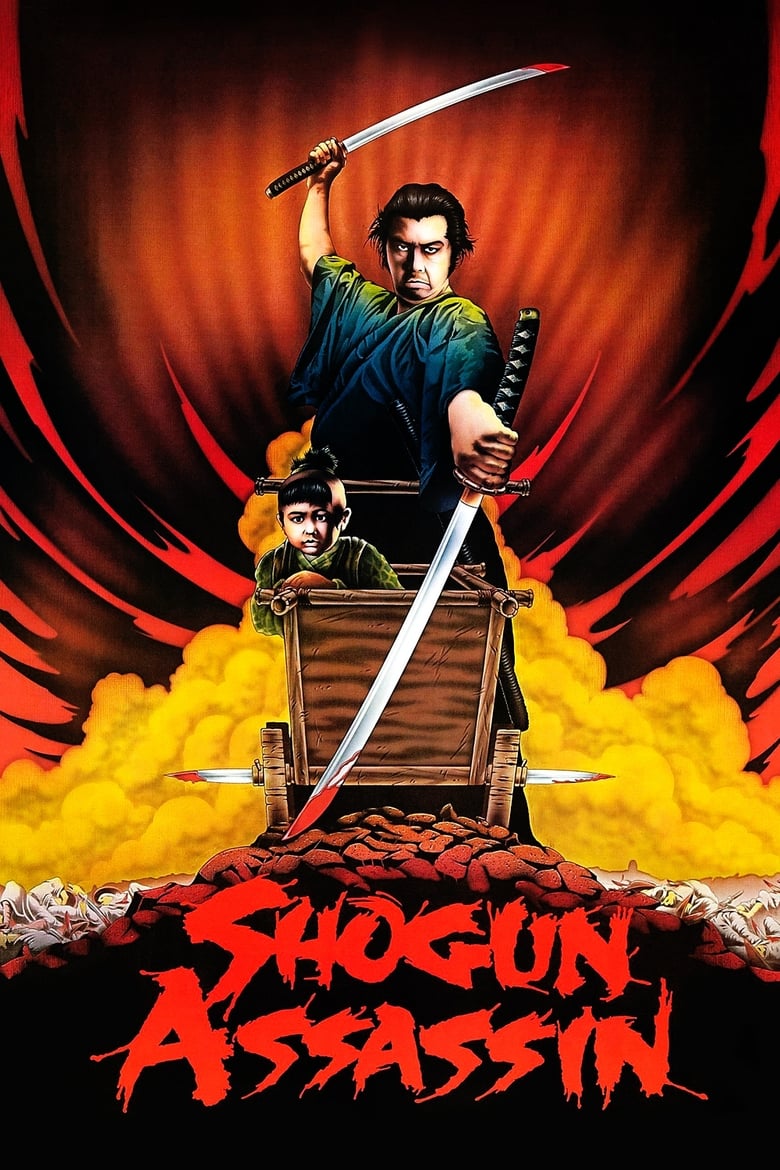
"It sounds... ridiculous." That's what a samurai says in this film, right before his throat opens up like a burst pipe and blood geysers everywhere. And honestly? That single moment tells you everything you need to know about Shogun Assassin. It is ridiculous. Gloriously, completely, unapologetically ridiculous. And I loved every single second of it.
Here's the thing about what this film actually is: it's a Frankenstein job. Someone took the first two entries in the Japanese Lone Wolf and Cub series, hacked them together, slapped on a brand new synth-heavy soundtrack, rewrote the story, and dubbed the whole thing into English for Western audiences. On paper, that sounds like a recipe for a disaster, a cynical cash-grab that strips the soul out of something more carefully crafted. In practice? It is one of the most purely entertaining films I've seen in years.
The soundtrack deserves a paragraph of its own. It's this propulsive, electronic, almost hypnotic thing, completely anachronistic for a period samurai picture, and yet it works in a way that defies all logic. It gives the whole film this strange, dreamlike momentum, like you're watching a myth being told rather than a story being shown. Pair that with the voiceover narration, delivered from the perspective of the young child travelling with his warrior father, and you've got something genuinely haunting. That child's voice drifting over scenes of carnage is an odd, quietly brilliant touch. It shouldn't work. It absolutely does.
And then there are the fight scenes. Look, I've seen some spectacular action choreography over the years. I think back to The Raid 2 and how that film made violence feel both brutal and balletic. Shogun Assassin operates in a very different register, it's scrappier, wilder, more cartoonish in its excess, but it has its own undeniable energy. When the blade swings, limbs go. When someone gets hit, blood doesn't trickle, it explodes. It's grindhouse through and through, and it commits to that identity completely.
The only real caveat I'll give, the reason this sits at four and a half rather than a full five, is that a handful of fight sequences appear with absolutely no narrative justification whatsoever. Random groups of enemies just sort of materialise, get slaughtered, and the film moves on as if nothing happened. I'm not asking for deep motivation here, this is not that kind of film, but even by grindhouse standards a couple of these moments made me laugh out loud at how little effort was made to connect them to anything. It's a minor complaint. A very minor one. But it's there.
What strikes me most, stepping back from it, is how effectively the whole patchwork construction holds together. You'd expect the seams to show constantly, two films stitched into one with a new sonic identity sewn over the top. Instead it flows. The dubbing gives everything a uniform texture, the score pulls it into a single emotional world, and the central image of a father and son moving through a landscape of death is simple enough to anchor whatever chaos surrounds it.
If you have any affection at all for grindhouse cinema, for Japanese action films, or honestly just for films that go completely over the top and do so with genuine style, get this on. It's the kind of film that reminds you why you fell in love with movies in the first place. Pure, daft, bloody, brilliant fun.
Four and a half stars.
Rating: ★★★★ | Year: 1980 | Watched: 2025-05-18
Where to watch
Watch in the UK
Rent: Amazon Video
Buy: Amazon Video
Physical: Amazon UK · Zavvi
Watch in the US
Stream: Criterion Channel
Rent: Amazon Video
Buy: Amazon Video
Physical: Amazon US
Affiliate disclosure: Movies With Macca may earn a small commission on purchases or subscriptions started via these links. It costs you nothing extra.
Related on Movies With Macca
More from Kenji Misumi: The Ghost of Yotsuya (1959)
More from Japan: Mononoke the Movie: The Phantom in the Rain (2024) · Mononoke the Movie: Chapter II - The Ashes of Rage (2025) · Blue (1993) · The Ghost of Yotsuya (1959)
More from the 1980s: Nightmare City (1980) · A Better Tomorrow (1986) · Style Wars (1983) · Garlic Is as Good as Ten Mothers (1980)
More action: A Better Tomorrow (1986) · The General (1926) · Hand of Death (1976) · Daredevil (2003)
More adventure: Alice in Wonderland (1951) · The Eagle (1925) · Louisiana Story (1948) · The General (1926)