Detour (1945)
★★★½ — Detour (1945)

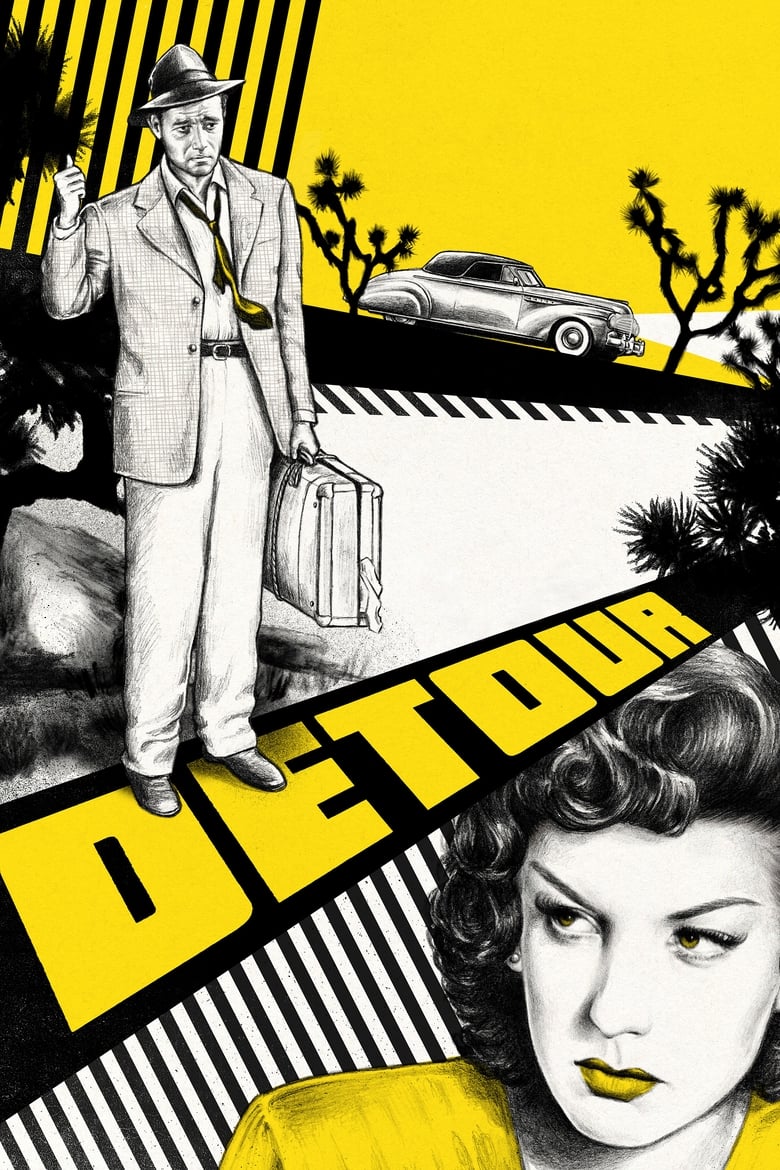
There's a moment early in Detour where Al Roberts, hunched over a counter in some nowhere diner, starts narrating his own catastrophe in a voice that sounds like a man already resigned to the verdict. He hasn't been convicted of anything yet. He doesn't need to be. That voiceover, soaked in weariness and bitter irony, tells you everything about what kind of film this is: one where fate isn't just cruel, it's casual about it. Indifferent. Almost bored.
At 68 minutes, Detour is one of the leanest films noir ever produced, and I mean that as the highest possible compliment. Edgar G. Ulmer made it on a budget that wouldn't cover catering on a modern studio picture, and yet it packs more dread and psychological unease into its running time than most thrillers twice the length manage in their entire careers. Al Roberts (Tom Neal) is a down-on-his-luck pianist hitchhiking across America to reunite with his singer girlfriend. That's the setup. What follows is a chain of misfortunes so relentlessly compounding that you start to wonder whether the universe has it in for this particular man, or whether he's simply the kind of person bad luck gravitates towards.
The film's power comes almost entirely from what Ulmer does with next to nothing. Cramped car interiors. Roadside diners bathed in shadow. Foggy highways that seem to lead nowhere reassuring. The cinematography turns every frame into a visual expression of entrapment, all stark angles and expressionistic lighting that would feel at home in a German silent. It's a style born partly from necessity and partly from genuine artistry, and the result is a film that feels claustrophobic even when characters are outdoors. I'd already noticed something of that resourceful visual instinct in Ulmer's work when I wrote about Bluebeard (1944), made just the year before, but here it's even more concentrated, even more controlled.
Then there's Ann Savage as Vera. I don't want to oversell her, because the performance sells itself. Vera is the hitchhiker Al picks up, and she arrives in the film like a weather system, all menace and unpredictability. She's simultaneously a victim of circumstance and one of the most predatory characters in noir history, and Savage plays both sides of that without blinking. There's nothing soft about the performance, no attempt to make Vera likeable or pitiable on easy terms. She's venomous and magnetic and utterly unforgettable, and she single-handedly shifts the film's centre of gravity the moment she appears.
Where I hesitate slightly is at the ending. I won't spell it out, but it arrives with a jarring abruptness that feels less like the poetic fatalism noir does so well and more like the script simply ran out of road. It doesn't undermine everything that came before, but it does leave you wanting a little more resolution, or at least a moment to breathe and take stock. There's a difference between a film that ends on an ellipsis and a film that ends mid-sentence. Detour occasionally feels like the latter.
But even with that reservation, this is potent stuff. The existential dread is real. The sense that one bad decision, one wrong turn, one piece of terrible timing can unravel a life completely, that lands with genuine force. Noir has always been the genre of bad luck and moral compromise, and few films wear that identity as purely or as honestly as this one does. It doesn't glamourise the doom. It just presents it, flat and matter-of-fact, the way Roberts himself narrates it: as if the outcome was always inevitable, and the only question was how long it would take to arrive.
Short, sharp, punishing and precise. Three and a half stars.
Rating: ★★★½ | Year: 1945 | Watched: 2026-02-27
Where to watch
Watch in the UK
Stream: Amazon Prime Video · Amazon Prime Video with Ads · Brew
Rent: Apple TV Store · Amazon Video · MovieMe
Buy: Apple TV Store · Amazon Video
Physical: Amazon UK · Zavvi
Watch in the US
Stream: Amazon Prime Video · MGM+ Amazon Channel · Brew · YouTube TV
Rent: Amazon Video · Apple TV Store · Fandango At Home · FlixFling
Buy: Amazon Video · Apple TV Store · Fandango At Home · FlixFling
Physical: Amazon US
Affiliate disclosure: Movies With Macca may earn a small commission on purchases or subscriptions started via these links. It costs you nothing extra.
Related on Movies With Macca
More from Edgar G. Ulmer: People on Sunday (1930) · The Black Cat (1934) · Bluebeard (1944)
More from the 1940s: Louisiana Story (1948) · The Ox-Bow Incident (1943) · Men Without Wings (1946) · The Bank Dick (1940)
More drama: Viy (1967) · Wonder (2017) · A Better Tomorrow (1986) · Beautiful Boy (2018)
More thriller: Invasion of the Body Snatchers (1956) · Angst (1983) · The Long Walk (2025) · Punishment Park (1971)