Battleship Potemkin (1925)
★★½ — Battleship Potemkin (1925)

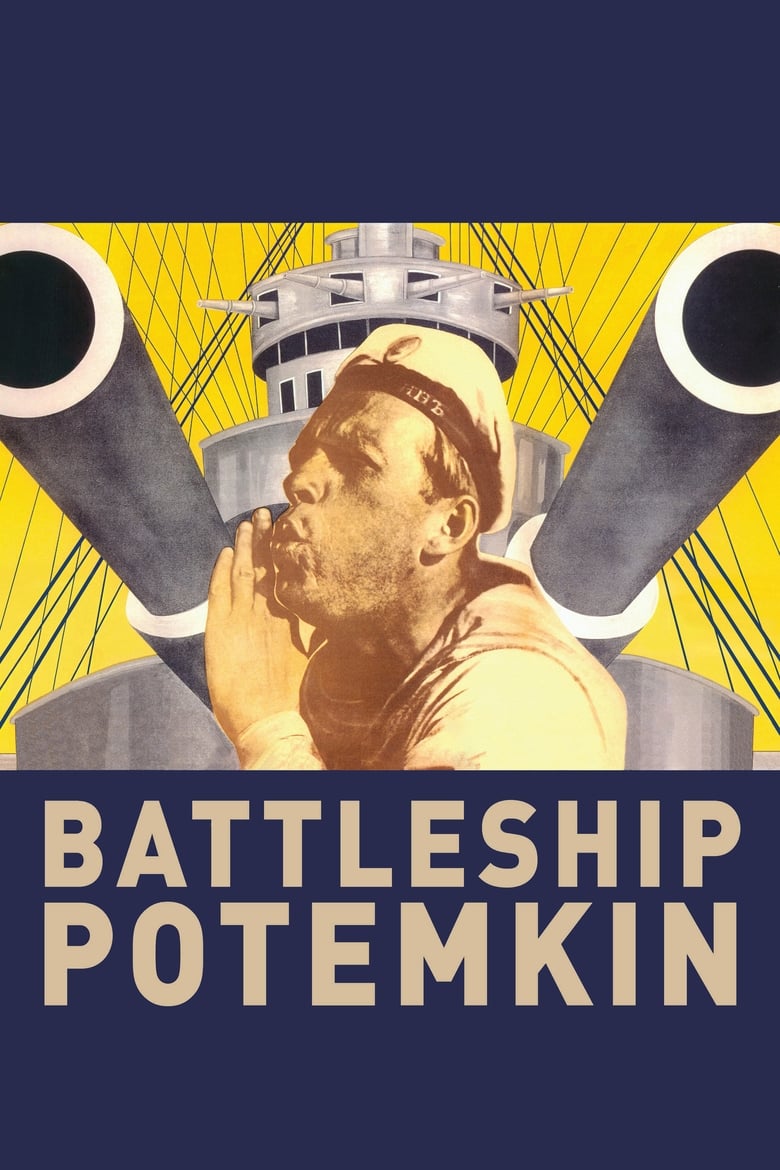
Here's the honest truth: I think Battleship Potemkin is one of the most important films ever made, and I also think I didn't really enjoy watching it. Both of those things are true, and I'm not going to pretend otherwise.
Let's start with what Sergei Eisenstein actually pulled off here, because it deserves proper credit. The Odessa Steps sequence alone is worth studying for the rest of your life if you care about film editing. The way he cuts between faces contorted in terror, soldiers advancing in mechanical lockstep, and bodies tumbling down those endless stone steps, it builds a rhythm that gets under your skin whether you want it to or not. He's not just telling a story in that sequence, he's controlling your nervous system. The intercutting, the acceleration of pace, the close-ups landing like punches, it's a lesson in how editing can manufacture emotion almost chemically. Film grammar as we understand it today has Eisenstein's fingerprints all over it, and the Odessa Steps is the clearest proof of that.
So yes. Landmark. Revolutionary. Studied for good reason. All of that is genuinely true.
But watching it in 2025, as someone who simply wants to sit down with a film and be pulled in, is a very different experience from appreciating its historical weight. It's silent, it's stark, and it's propaganda, make no mistake about that. The performances are broad to the point of caricature, all wide eyes and open mouths and melodramatic gestures, which made sense for the silent era and for a film that needed to land its message in packed Soviet cinemas. In that context, it works. Stripped of that context, it can feel more like watching a series of political posters come to life than watching a story unfold.
The characters aren't really characters in any traditional sense. They're types. Symbols. Instruments of Eisenstein's argument rather than people you follow or feel for as individuals. That's a deliberate choice, not a flaw exactly, but it does mean there's very little to hold onto if the political messaging doesn't fire you up personally. The film doesn't want your empathy for a protagonist. It wants your fury at a system. Whether it gets it probably depends on how much of that fury you already brought with you.
I've sat with other silent films from around this period and found ways in. The General (1926) still makes me laugh out loud and I could watch it any day of the week. The Docks of New York (1928) gave me characters I actually cared about. Potemkin is doing something fundamentally different from both of those, something closer to what I found in Earth (1930), that Soviet tradition of treating landscape and collective struggle as the real subject, where individual human beings are almost incidental. I respect that as an artistic and political project. I'm just being straight with you that it doesn't make for easy or particularly enjoyable viewing.
What I keep coming back to is this question of what we mean when we call a film "good." If good means technically accomplished, historically significant, and genuinely influential on almost every film that came after it, then Battleship Potemkin is about as good as it gets. If good means I'd happily put it on again, that I felt entertained, moved, or gripped throughout, then it's a much harder sell. It doesn't try to entertain. It doesn't try to develop its people beyond their function in the argument. It's a piece of engineered political art, and on those terms it succeeds brilliantly.
But I can only be honest about my own experience of it. I watched it with respect and with genuine admiration for what Eisenstein achieved. I can't say I watched it with joy. Two and a half stars feels right: higher than a film I'd call bad, lower than a film I'd call a favourite. Essential viewing if you care about film history. A slightly stern evening if you're just after a good time.
Rating: ★★½ | Year: 1925 | Watched: 2025-08-20
Where to watch
Watch in the UK
Stream: BFI Player · BFI Player Amazon Channel · Klassiki · BFI Player Apple TV Channel
Rent: Apple TV Store · Amazon Video
Buy: Apple TV Store · Amazon Video
Physical: Amazon UK · Zavvi
Watch in the US
Stream: HBO Max Amazon Channel · Brew · YouTube TV · Criterion Channel
Rent: Amazon Video · Apple TV Store · Fandango At Home · FlixFling
Buy: Amazon Video · Apple TV Store · Fandango At Home · FlixFling
Physical: Amazon US
Affiliate disclosure: Movies With Macca may earn a small commission on purchases or subscriptions started via these links. It costs you nothing extra.
Related on Movies With Macca
More from Soviet Union: Viy (1967) · Earth (1930) · By the Bluest of Seas (1936) · The Color of Pomegranates (1969)
More from the 1920s: The Eagle (1925) · The General (1926) · The Docks of New York (1928) · A Throw of Dice (1929)
More drama: Viy (1967) · Wonder (2017) · A Better Tomorrow (1986) · Beautiful Boy (2018)
More history: Apocalypto (2006) · Rio 2096: A Story of Love and Fury (2013) · Harakiri (1962) · Night and Fog (1956)