A Trip to the Moon (1902)
★★½ — A Trip to the Moon (1902)

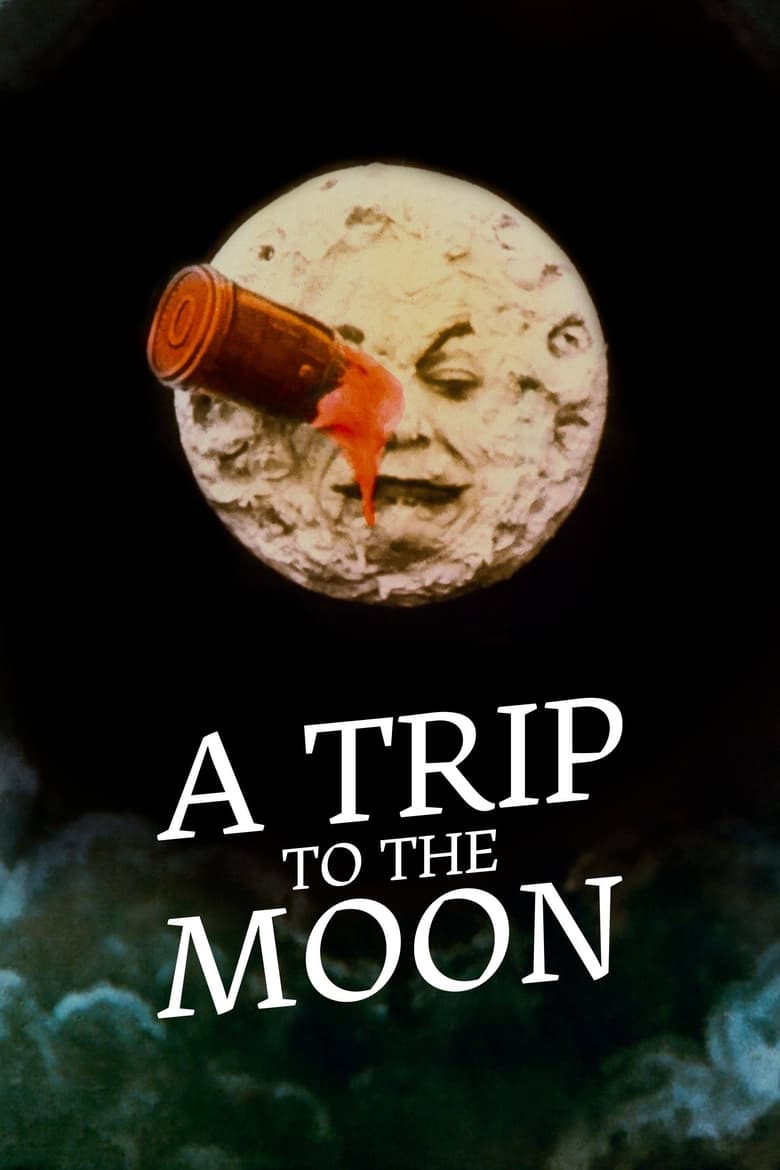
Fourteen minutes. That's all it takes for Georges Méliès to make you feel like you're watching both the birth of an art form and a particularly vivid hallucination. A Trip to the Moon is not a good film by any standard you'd apply today. But I'm not sure "good film" is the right frame for something this strange, this old, and this frankly miraculous in its ambition.
Let me be clear about what Méliès actually pulled off here: this is 1902. Barely a decade after moving images were first projected for a paying audience. And here's a magician-turned-filmmaker launching a rocket from a cannon, embedding it in the face of the Moon (a face that winces, brilliantly, on impact), and staging a full-blown battle between robed astronomers and umbrella-wielding lunar creatures. The special effects, hand-painted frames, double exposures, theatrical trapdoors lifted straight from stage illusion, are nothing short of astonishing for their moment. Watching it now, you can almost hear the collective intake of breath from an audience in 1902 who had never seen anything remotely like it. That feeling doesn't entirely evaporate, even now.
But I'm not going to sit here and pretend the experience is uniformly wonderful, because it isn't. The acting is pure pantomime cranked well past eleven. Every gesture is enormous, every expression frozen into a theatrical mask, every reaction held a beat too long as if the cast are playing to the back row of a music hall. Which, of course, they essentially are. The pacing lurches in a way that's less avant-garde and more just uneven, and the narrative is barely there at all. It's a series of vaudeville sketches held together with moon dust and sheer nerve. There are stretches where "enchanting" tips into "exhausting" and you're watching less out of pleasure than out of a kind of respectful historical duty.
That tension is what lands it at two and a half stars for me. I can admire it enormously without actually enjoying all of it. The imagination on display is genuinely unshackled. Méliès had no template, no rulebook, no established grammar of cinema to fall back on. He was making it up as he went, raiding his background in stage magic and theatrical spectacle, and the results are as batshit as they are visionary. It reminded me a little of watching Fantastic Planet (1973), another film where the sheer weirdness of the imagery keeps pulling you forward even when the storytelling around it struggles to hold together. Different era, same restless creative energy.
What gets me, sitting with it now, is the timeline. Méliès made this roughly sixty years before Apollo 11 actually touched down on the lunar surface. And here we are, another sixty or so years after that, watching his cardboard Moon and his pantomiming astronomers and his little rocket fired from a gigantic cannon, and there's something quietly poetic about how human it all is. We dreamed it before we knew how to do it. We imagined the Moon with a face before we understood it had none. The film is a fever dream, yes, but it's the kind of fever dream that only comes from a specific type of person: one who looks up at the night sky and thinks, right, but what if we went there?
It's also worth noting, especially if you're on a silent-era kick, that The Great Train Robbery, made just a year later, makes for a fascinating companion piece. Where Méliès reached for the fantastical, that film grabbed for gritty momentum. Two filmmakers, one moment in history, pulling in completely opposite directions. Both essential for understanding what cinema was trying to be before it knew what it was.
A Trip to the Moon is not something I'd put on for a casual Friday night. It's a historical document as much as a film, and you have to meet it on those terms. But as a time capsule of pure, unfiltered imagination, as proof that humans were always going to do something extraordinary with moving pictures, it's irreplaceable. Watch it once. Respect it deeply. Smile at the Moon with the face.
Two and a half stars.
Rating: ★★½ | Year: 1902 | Watched: 2026-03-12
Where to watch
Watch in the UK
Stream: Amazon Prime Video · Amazon Prime Video with Ads · Artiflix
Rent: Amazon Video
Buy: Amazon Video
Physical: Amazon UK · Zavvi
Watch in the US
Stream: HBO Max Amazon Channel · HBO Max · Artiflix
Rent: Amazon Video
Buy: Amazon Video
Physical: Amazon US
Affiliate disclosure: Movies With Macca may earn a small commission on purchases or subscriptions started via these links. It costs you nothing extra.
Related on Movies With Macca
More from France: Fantastic Planet (1973) · Letter from Siberia (1957) · Lessons of Darkness (1992) · Here and Elsewhere (1976)
More from the 1900s: The Great Train Robbery (1903)
More history: Apocalypto (2006) · Rio 2096: A Story of Love and Fury (2013) · Harakiri (1962) · Night and Fog (1956)
More adventure: Alice in Wonderland (1951) · The Eagle (1925) · Louisiana Story (1948) · The General (1926)