Rear Window (1954)
★★★★ — Rear Window (1954)

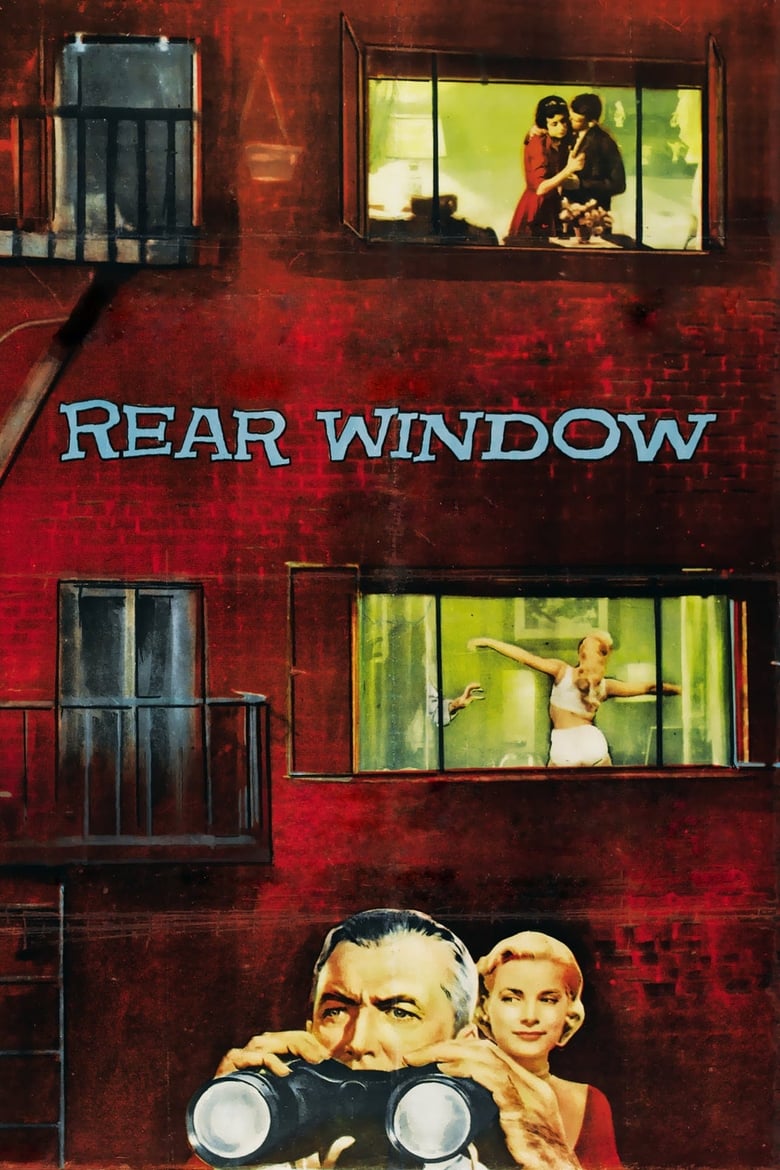
There's a moment in Rear Window where you catch yourself leaning forward, squinting at a lit window across a courtyard, trying to read the body language of a stranger you've never met and will never speak to. And then it hits you: Hitchcock has done it. He's turned you into exactly the kind of person this film is about. You're a voyeur now. Congratulations.
James Stewart plays L.B. Jefferies, a photographer laid up in his Greenwich Village apartment with a broken leg, sweating through a New York heatwave with nothing to do but watch his neighbours through the rear window. There's the newlyweds, the lonely spinster, the dancer, the couple with the little dog. Jefferies catalogues them like specimens, projecting whole narratives onto their daily routines. And then one night, something doesn't quite add up about the travelling salesman across the way, and Jefferies decides, with the particular certainty of a man who has nothing but time and a pair of binoculars, that a murder has been committed. What unfolds is one of the most gripping films ever made, set almost entirely within the confines of a single apartment and the courtyard it overlooks.
The genius of it is how little Hitchcock actually shows you. A door creaks. A light flickers off at an odd hour. A dog noses around the flower beds. In isolation, none of it means anything. Stacked up, watched and rewatched through Jefferies's increasingly obsessive gaze, it becomes something suffocating. The tension doesn't come from action. It comes from waiting, from the horrible suspense of almost knowing.
Grace Kelly is, to put it plainly, a revelation. Her Lisa Fremont glides into this sweltering, cramped world in silk and pearls, and you might initially think she's window dressing. She is not. She's braver than Jefferies by a country mile, and Kelly plays the deadpan courage of that beautifully. There's real wit in the performance too, a kind of quiet amusement at the absurdity of the situation she's somehow wandered into. She's the heartbeat of the film, even when the camera insists on treating Jefferies as the centre of everything.
I'll admit something slightly embarrassing: I'd been spoiled on the broad strokes before I ever sat down to watch this properly, because I'd seen the Simpsons parody years before I saw the real thing. I knew roughly where it was going. And it still got me. That's how well-constructed this film is. Knowing the destination doesn't blunt the journey one bit, because the pleasure is in watching Hitchcock control every single beat, every glance, every shadow. The ending lands like a gut-punch regardless, a reminder that the world often sees what it wants to see, even when the truth is right there, framed in a window, staring back.
What makes Rear Window linger, though, is what sits underneath the thriller mechanics. This is a film about mid-century American life, about isolation behind closed doors, about suspicion as a kind of neighbourhood pastime. Each window across that courtyard is its own little story, its own quiet anxiety. It's the same suburban unease that runs through so much of the era's best work, including Invasion of the Body Snatchers (1956), where the horror is less about the monster and more about how well everyone had been pretending everything was fine. Here, Hitchcock asks what happens when you stop pretending and actually look.
I've spent a good amount of time with Hitchcock across different periods of his career. I think Vertigo edges this for me in terms of sheer emotional weight, and Dial M for Murder (1954), made the same year as this, is a terrific companion piece in how it uses confined space to ratchet up dread. But Rear Window might be the purest distillation of what Hitchcock does: he makes you complicit. You watch, you judge, you suspect, and then he holds the mirror up and asks you to think about what kind of person does that.
Pure, distilled voyeurism. Four stars.
Rating: ★★★★ | Year: 1954 | Watched: 2025-06-05
Where to watch
Watch in the UK
Rent: Apple TV Store · Rakuten TV · Amazon Video · Google Play Movies
Buy: Apple TV Store · Rakuten TV · Amazon Video · Google Play Movies
Physical: Amazon UK · Zavvi
Watch in the US
Stream: YouTube TV
Rent: Amazon Video · Apple TV Store · Google Play Movies · YouTube
Buy: Amazon Video · Apple TV Store · Google Play Movies · YouTube
Physical: Amazon US
Affiliate disclosure: Movies With Macca may earn a small commission on purchases or subscriptions started via these links. It costs you nothing extra.
Related on Movies With Macca
More from Alfred Hitchcock: Sabotage (1936) · Rebecca (1940) · Vertigo (1958) · Dial M for Murder (1954)
More with James Stewart: Vertigo (1958)
More from the 1950s: Invasion of the Body Snatchers (1956) · Alice in Wonderland (1951) · Letter from Siberia (1957) · Invaders from Mars (1953)
More thriller: Invasion of the Body Snatchers (1956) · Angst (1983) · The Long Walk (2025) · Punishment Park (1971)
More mystery: Mononoke the Movie: The Phantom in the Rain (2024) · Mononoke the Movie: Chapter II - The Ashes of Rage (2025) · Carnival of Souls (1962) · One Way or Another (1975)