Sabotage (1936)
★★½ — Sabotage (1936)

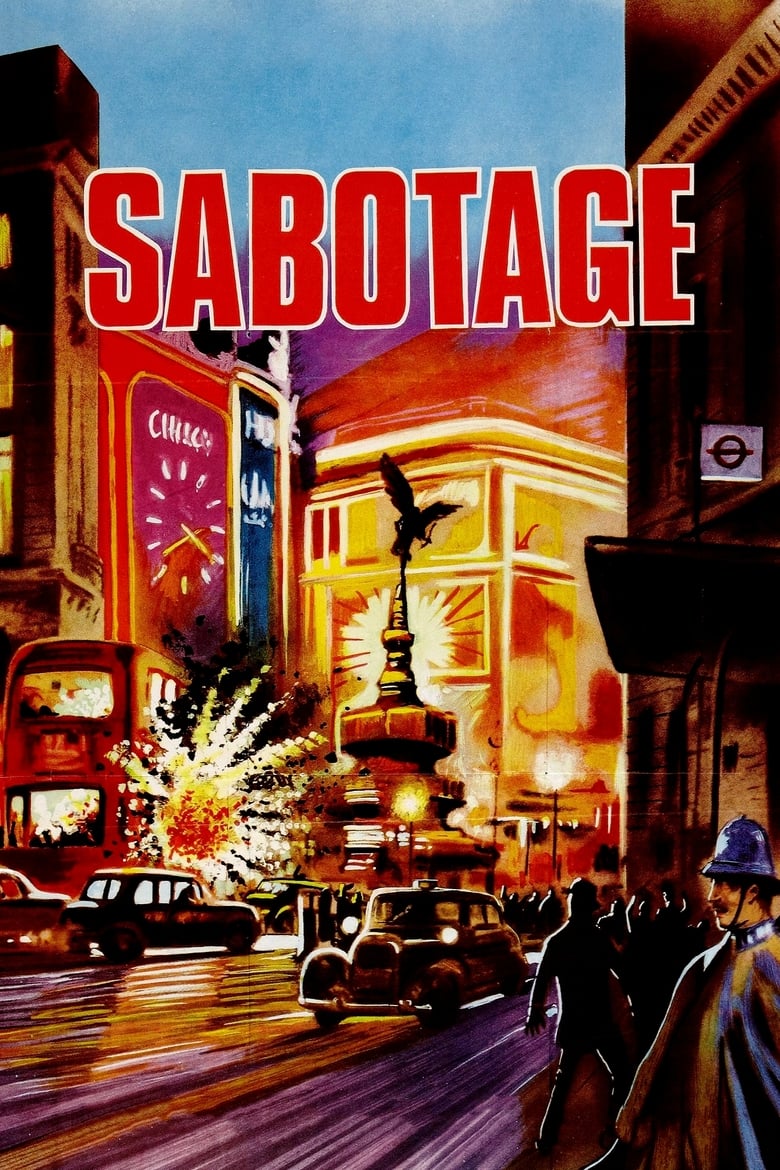
There's a moment in Sabotage that made me sit up straight. A bus. A package. A ticking clock. For a few minutes, Hitchcock puts the screws on in exactly the way you'd hope, and you feel the film transform into something genuinely uncomfortable. Then it passes, and the dragging talky picture reasserts itself, and you're left wishing the whole thing could have been that tense for two hours instead of ten minutes.
That's the frustrating thing about this 1936 thriller: it contains a real director in there somewhere, fighting to get out. The premise is strong enough. A woman discovers that her husband, who runs a small London cinema, is secretly involved in terrorist sabotage. Domestic life and political violence colliding under the same roof is exactly the kind of ironic, suffocating setup Hitchcock would go on to use so brilliantly. But the execution here too often lets the material down. The pacing sags badly in the middle sections. The stakes feel muddled rather than urgent. And the emotional core, which ought to be burning by the final act, never quite catches light.
There are genuine flashes of what's coming. A shadow crawling across a wall. That bus sequence, which remains one of the more genuinely daring things I've seen from this era of his career, in terms of who it's willing to put in danger and what it's prepared to do about it. Hitchcock reportedly felt he'd made a mistake with that scene, that audiences wouldn't forgive him for it, and the ambivalence you can feel in the film around that moment is telling. It's the most alive the picture gets, and it's also where you sense him still working out what kind of filmmaker he wants to be.
The performances are serviceable without being much more than that. The characters behave like pieces being moved around a board rather than people reacting to impossible circumstances. Compare that to the effortless charm and momentum of The 39 Steps, made the previous year, where even minor figures feel like they've got a life outside the plot. Sabotage doesn't have that. It's too rooted in theatrical convention, too reliant on dialogue doing the heavy lifting in scenes that want to be tense and instead end up merely talky.
The themes are all present and correct, guilt, deception, the way ordinary people get swept into catastrophic situations they can't control. These are Hitchcock obsessions, ones he'd mine magnificently in Rear Window (1954) and Vertigo and elsewhere. Here, though, they sit on the surface rather than getting under your skin. There's no real psychological depth to latch onto, no irony sharp enough to draw blood. The film toys with its ideas without committing to them.
I don't want to be too hard on it. Watching Sabotage as part of a broader journey through Hitchcock's career is genuinely interesting. You can see the gears turning. You can spot the instincts that would eventually produce some of the greatest thrillers ever made. As a historical document of a director in transition, caught between the conventions of silent-era melodrama and the controlled, precise suspense machine he'd become, it has real value.
As a standalone film to put on for a Friday night? It's decidedly average. Competent. Occasionally tense. More often frustrating. The wit and rhythm that make his best work so pleasurable to watch are only sporadically present. The emotional punch you want from a story this dark simply doesn't land with the force it should.
Two and a half stars. Worth your time if you're working through his filmography, but go in with measured expectations. The master wasn't fully in control yet, and Sabotage is honest evidence of that.
Rating: ★★½ | Year: 1936 | Watched: 2026-04-28
Where to watch
Watch in the UK
Stream: Amazon Prime Video · Amazon Prime Video with Ads · ITVX Premium · Artiflix
Rent: Amazon Video
Buy: Amazon Video
Physical: Amazon UK · Zavvi
Watch in the US
Stream: HBO Max Amazon Channel · Criterion Channel · HBO Max · Artiflix
Rent: Amazon Video · Apple TV Store · Google Play Movies · YouTube
Buy: Amazon Video · Apple TV Store · Google Play Movies · YouTube
Physical: Amazon US
Affiliate disclosure: Movies With Macca may earn a small commission on purchases or subscriptions started via these links. It costs you nothing extra.
Related on Movies With Macca
More from Alfred Hitchcock: Rebecca (1940) · Vertigo (1958) · Dial M for Murder (1954) · Rear Window (1954)
More with Sylvia Sidney: You Only Live Once (1937)
More from United Kingdom: Lessons of Darkness (1992) · Shinjuku Boys (1995) · The Curse of Frankenstein (1957) · Blue (1993)
More from the 1930s: Earth (1930) · Monkey Business (1931) · People on Sunday (1930) · You Only Live Once (1937)
More drama: Viy (1967) · Wonder (2017) · A Better Tomorrow (1986) · Beautiful Boy (2018)
More thriller: Invasion of the Body Snatchers (1956) · Angst (1983) · The Long Walk (2025) · Punishment Park (1971)