Castle in the Sky (1986)
★★★★ — Castle in the Sky (1986)

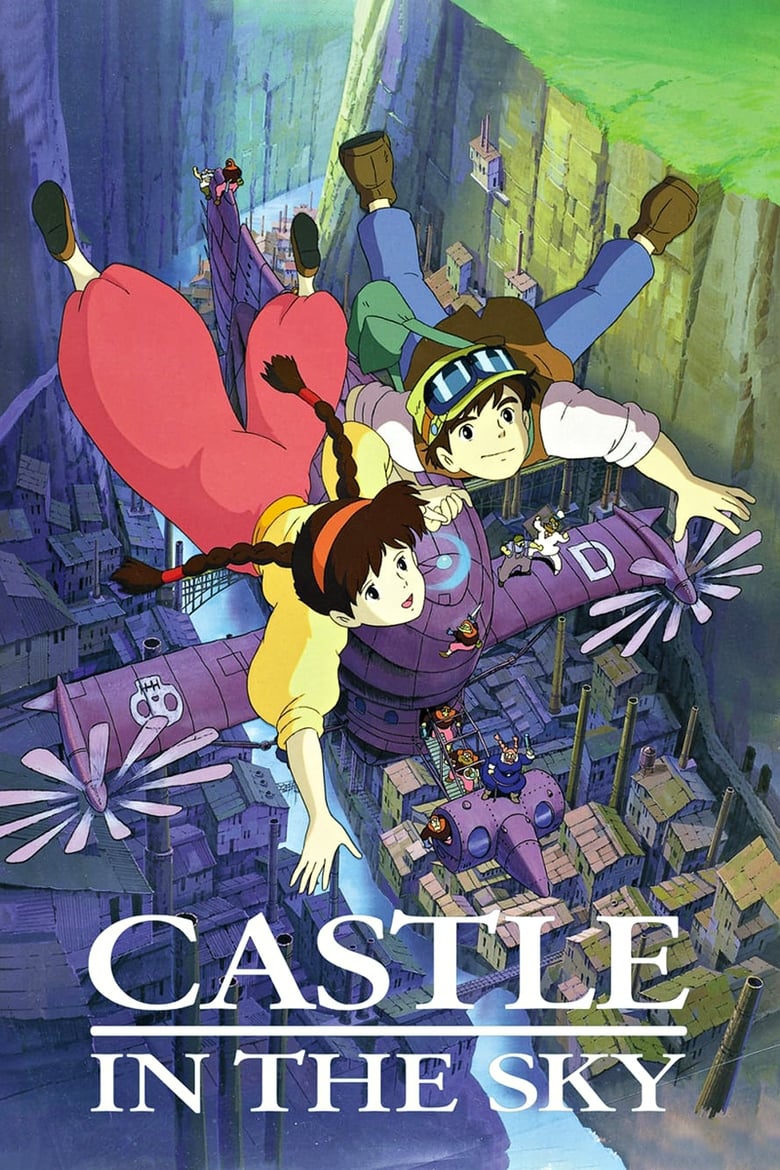
There's a moment in Castle in the Sky where the legendary floating island of Laputa finally comes into full view, draped in roots and moss and centuries of silence, and I genuinely felt my breath catch. Not because it was surprising, exactly. You've been chasing this place for the whole film. But Miyazaki earns it so completely, builds the anticipation with such effortless craft, that when it arrives it lands like something you've always half-remembered from a dream. That feeling, that particular flavour of wonder, is what this film does better than almost anything else I've ever seen.
Released in 1986 and the first film produced under the Studio Ghibli banner, Castle in the Sky follows two kids thrown together by fate: Pazu, an orphaned miner's boy with his father's unfinished dream burning in his chest, and Sheeta, a girl with a mysterious crystal and a destiny she doesn't yet understand. They're pursued by sky pirates, government agents, and a villain with cold eyes and colder ambitions, all in a race to find Laputa before the wrong hands get there first. The plot moves with the momentum of a rolling boulder, rarely pausing, never dragging.
What strikes me every time is just how joyful it all is. This isn't Miyazaki at his most complex or emotionally devastating. It won't leave you wrecked the way some of his later work can. But it might be his most purely fun film, and I don't mean that as a slight. Joy at this level is hard to manufacture. The pirate crew led by the formidable Dola are an absolute delight, a ramshackle found family who steal every scene they're in. Pazu's earnest bravery never tips into naivety. Sheeta's quiet resilience gives the film its emotional backbone. And the villain, Muska, is one of Miyazaki's most genuinely chilling creations, the kind of man who speaks softly because he knows he doesn't need to shout.
Joe Hisaishi's score deserves its own paragraph. That main theme, sweeping and melancholic and triumphant all at once, has lived in my head for years. It's the sound of possibility. Of standing on the edge of something vast and being a little frightened and wanting to leap anyway. The music and the imagery work in such perfect lockstep that separating them feels almost violent.
And the imagery. Look, I've made my peace with the fact that hand-drawn animation of this vintage will always do something to me that CGI simply cannot replicate. The clouds billow like something you want to reach into the screen and touch. The airships have weight to them, a sense of real mechanical mass drifting on warm thermals. Every frame carries the mark of human hands making deliberate choices, and that tactile quality gives the whole film a warmth that no amount of computing power has managed to match.
If you've already spent time with Kiki's Delivery Service or My Neighbor Totoro, you'll recognise that same quality here: a story told with total sincerity, without irony or condescension, trusting the audience to meet it where it is. And for those wanting to trace Miyazaki's roots even further back, Nausicaä of the Valley of the Wind is essential viewing alongside this one. You can feel the DNA running between them.
Castle in the Sky isn't trying to be profound. It's trying to make you feel like a child who still believes in floating islands and pirate ships and the possibility that the world is bigger and stranger than anyone's told you. And it does that with such warmth and skill and sheer love for the medium that I find it almost impossible to resist. Four stars, and I mean every one of them.
Rating: ★★★★ | Year: 1986 | Watched: 2026-03-22
Where to watch
Watch in the UK
Stream: Netflix · Netflix Standard with Ads
Physical: Amazon UK · Zavvi
Watch in the US
Stream: HBO Max Amazon Channel · HBO Max
Rent: Amazon Video · Apple TV Store · Google Play Movies · YouTube
Buy: Amazon Video · Apple TV Store · Google Play Movies · YouTube
Physical: Amazon US
Affiliate disclosure: Movies With Macca may earn a small commission on purchases or subscriptions started via these links. It costs you nothing extra.
Related on Movies With Macca
More from Hayao Miyazaki: Kiki's Delivery Service (1989) · Nausicaä of the Valley of the Wind (1984) · My Neighbor Totoro (1988) · Howl's Moving Castle (2004)
More from Japan: Mononoke the Movie: The Phantom in the Rain (2024) · Mononoke the Movie: Chapter II - The Ashes of Rage (2025) · Blue (1993) · The Ghost of Yotsuya (1959)
More from the 1980s: Nightmare City (1980) · A Better Tomorrow (1986) · Style Wars (1983) · Garlic Is as Good as Ten Mothers (1980)
More adventure: Alice in Wonderland (1951) · The Eagle (1925) · Louisiana Story (1948) · The General (1926)
More fantasy: Viy (1967) · Alice in Wonderland (1951) · Mononoke the Movie: The Phantom in the Rain (2024) · Mononoke the Movie: Chapter II - The Ashes of Rage (2025)