She Done Him Wrong (1933)
★★★ — She Done Him Wrong (1933)

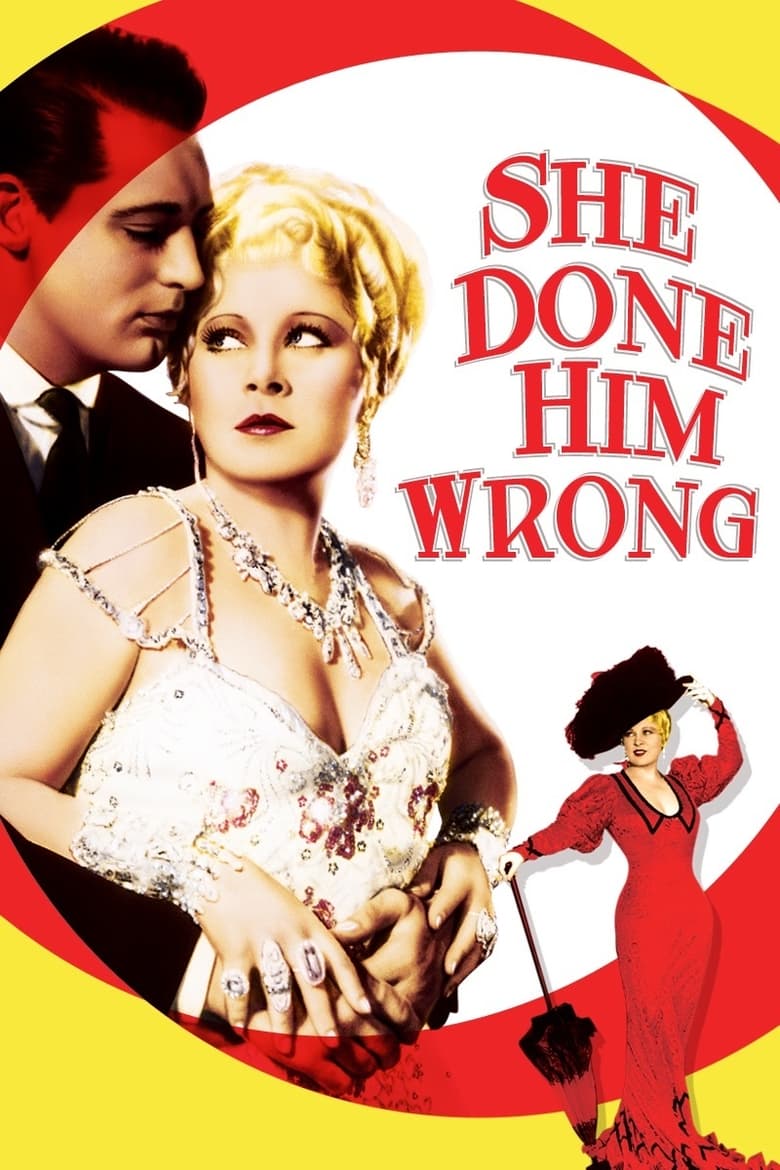
"Why don't you come up sometime and see me?" Seven words, and Mae West has already won. She doesn't deliver that line so much as lay it at your feet like a cat dropping a mouse, utterly certain of the effect. I'd never actually seen a Mae West film before sitting down with She Done Him Wrong, and I'll be honest, I wasn't entirely sure what to expect beyond the cultural shorthand, the hourglass figure, the raised eyebrow. What I got was someone who commands the screen with a kind of absolute confidence I wasn't prepared for. She doesn't just own every scene she's in. She owns you.
The delivery is the thing. Slow, deliberate, each line weighted as though she's savouring it before she lets it go. It reminded me immediately of Groucho Marx, and I kept turning that comparison over in my head as the film went on. Both are masters of saying one thing while meaning something considerably saucier underneath, but where Groucho fires at speed, West lets the silence hang. She lets you squirm a little, lets the audience fill the gap themselves, and then the punchline lands. It's a completely different rhythm, and it works just as brilliantly. Having already spent time with Monkey Business (1931), I think West actually has the edge when it comes to sheer screen magnetism, even if the Marx Brothers have the better film around them.
And that's probably the most honest thing I can say about She Done Him Wrong: the film around West is pretty thin. The plot, some knotted melodrama involving a saloon, crooked figures, and a reformed criminal or two, is scaffolding, pure and simple. It exists to give West somewhere to sway her hips and a reason to deliver the next wisecrack. As narrative cinema, it barely registers. As a vehicle for a specific persona? It does exactly what it needs to.
What genuinely surprised me is how modern West feels. There's a sexual agency to her performance that must have felt electric in 1933, maybe even a little scandalous. She's never the object of the gaze. She's the one directing it, controlling it, weaponising it. The men around her react to her on her terms. That dynamic still reads as fresh, which is remarkable considering we're talking about a performer born in the nineteenth century. It's the same jolt I got watching early pre-Code Hollywood more broadly, that sense that some of this material is more daring than films made decades later. I had a similar feeling revisiting Little Caesar (1931), that the era had a roughness and a freedom that the studios would soon sand away.
I don't want to oversell it, though. Three stars feels right, and I'm sticking there. The supporting cast are largely functional. The story gives you nothing to hold onto beyond West herself. There are stretches where the film coasts, and you're essentially just waiting for her to reappear and say something worth quoting. Fortunately, she does, regularly enough to keep things moving at a sprightly pace. The runtime is mercifully short, which helps.
What lingers is the historical weight of the thing, not in a dry, academic way, but in a genuinely vivid one. Watching West work, you can feel exactly why she mattered. She arrived fully formed, seemingly from nowhere, and just bent Hollywood's idea of what a woman on screen could be. For a first encounter, I came away entertained, a little dazzled, and keen to see more. That's about the best recommendation I can offer.
Three stars.
Rating: ★★★ | Year: 1933 | Watched: 2026-03-31
Where to watch
Watch in the UK
Rent: Apple TV Store · Amazon Video · Google Play Movies · Sky Store
Buy: Apple TV Store · Amazon Video · Google Play Movies · Sky Store
Physical: Amazon UK · Zavvi
Watch in the US
Rent: Amazon Video · Apple TV Store · Google Play Movies · YouTube
Buy: Amazon Video · Apple TV Store · Google Play Movies · YouTube
Physical: Amazon US
Affiliate disclosure: Movies With Macca may earn a small commission on purchases or subscriptions started via these links. It costs you nothing extra.
Related on Movies With Macca
More from the 1930s: Earth (1930) · Monkey Business (1931) · Sabotage (1936) · People on Sunday (1930)
More comedy: The Eagle (1925) · The General (1926) · Americana (2023) · The Naked Gun: From the Files of Police Squad! (1988)
More crime: A Better Tomorrow (1986) · Angst (1983) · Stolen Face (1952) · Cairo Station (1958)