Run Lola Run (1998)
★★★ — Run Lola Run (1998)

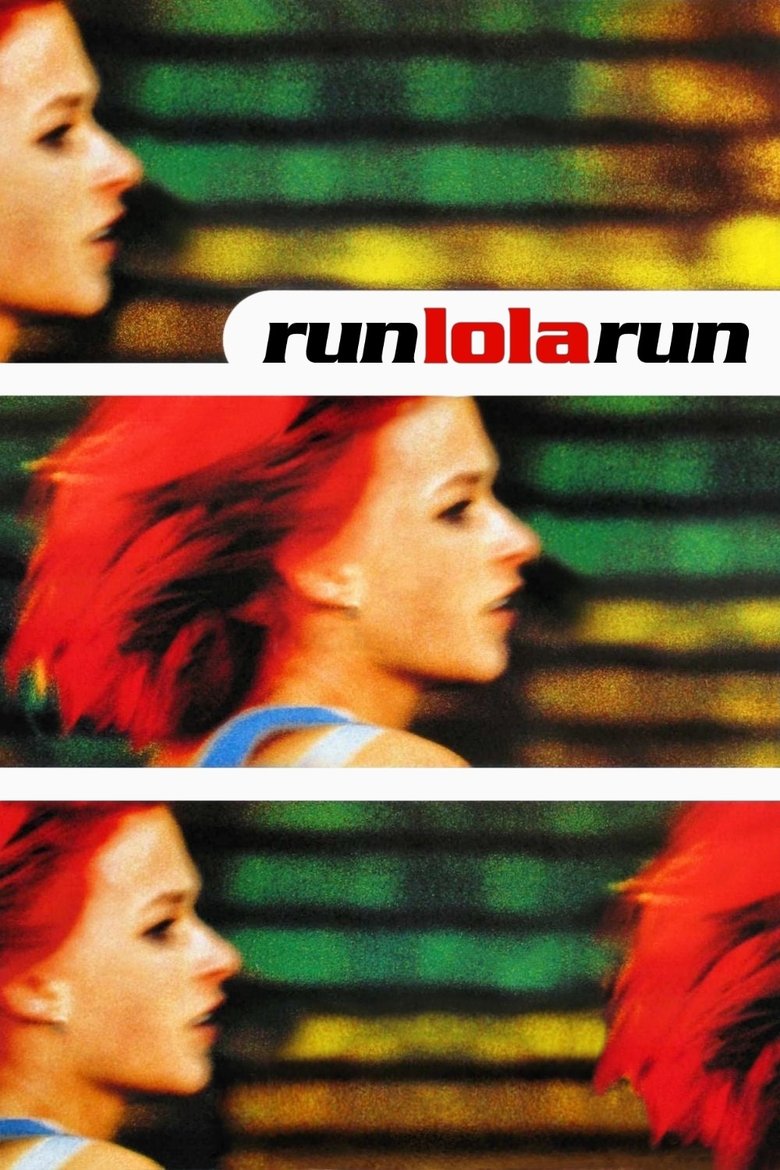
There's a moment in Run Lola Run where you realise you've been holding your breath. Not because you don't know what's coming, but because the film's relentless momentum has physically taken hold of you. That's a rare trick, and Tom Tykwer pulls it off with style to spare.
The setup is almost absurdly simple. Lola has twenty minutes to get 100,000 Deutsche Marks to her boyfriend Manni, or he's dead. That's it. What Tykwer does with that premise, though, is anything but simple. The film plays out three times over, each run beginning from the same starting gun but branching off in wildly different directions depending on tiny, almost imperceptible shifts. A stumble on the stairs. A stranger crossed at the wrong second. A heartbeat's difference in timing. The butterfly effect rendered as a breathless techno thriller.
Franka Potente is the engine of the whole thing. Breathless, desperate, utterly determined, she gives Lola a raw emotional urgency that stops the film from becoming a cold style exercise. Without her, this could easily feel like a very flashy music video. With her, it actually means something. She carries emotional weight through scenes that are, on paper, just a woman sprinting through Berlin streets. That's a real performance.
The technical craft is equally impressive. The editing is frenetic and inventive without ever losing you. The techno soundtrack, composed by Tykwer himself, drives the whole thing like a second pulse running underneath the action. And the aesthetic choices, animation sequences, surveillance camera textures, a video game logic that governs cause and effect, all feel remarkably fresh even now. There's a playfulness to the filmmaking that keeps you grinning even when the stakes are supposedly life and death.
Philosophically, the film gestures at chaos theory, fate and free will, but it does so lightly, almost cheekily. It's not preachy about any of it. It raises the questions and then gets back to running. I appreciate that restraint. A lesser film would've stopped to lecture you.
But here's the honest thing: it doesn't go much deeper than its own cleverness. It's a high-concept thriller built on repetition and rhythm, and it's brilliant at being exactly that. What it isn't, though, is a profound character study or a genuinely groundbreaking piece of storytelling. You come out buzzing, not changed. The form is extraordinary. The substance is, by design, fairly lean. For some films that's a fatal flaw. For this one, it's more of a trade-off you accept going in.
I've seen films with similar restless European energy that dig deeper into their characters, and I've seen plenty of high-concept thrillers that mistake style for soul. Run Lola Run sits somewhere between the two, aware enough of its own limitations to never overreach, and confident enough in its execution to make those limitations feel almost irrelevant while you're watching it. It reminded me a little of the anarchic visual energy I found in Cemetery Man (1994), that same willingness to let form do heavy lifting, though Tykwer's film is leaner and more disciplined about where it's going.
Three stars. A cult classic that earns its reputation. Not a masterpiece, and it knows it isn't trying to be one. It's a really good film that understood exactly what it wanted to do, and ran with it flat out. Sometimes that's enough.
Rating: ★★★ | Year: 1998 | Watched: 2025-11-24
Where to watch
Watch in the UK
Stream: BFI Player Amazon Channel · BFI Player Apple TV Channel
Rent: Apple TV Store · Rakuten TV · Amazon Video · Google Play Movies
Buy: Apple TV Store · Rakuten TV · Amazon Video · Google Play Movies
Physical: Amazon UK · Zavvi
Watch in the US
Stream: Hulu · Sundance Now · Sony Pictures Core Amazon Channel
Rent: Amazon Video · Apple TV Store · Google Play Movies · YouTube
Buy: Amazon Video · Apple TV Store · Google Play Movies · YouTube
Physical: Amazon US
Affiliate disclosure: Movies With Macca may earn a small commission on purchases or subscriptions started via these links. It costs you nothing extra.
Related on Movies With Macca
More from Tom Tykwer: A Hologram for the King (2016)
More from Germany: Lessons of Darkness (1992) · Cemetery Man (1994) · The Grand Budapest Hotel (2014) · Resident Evil: Retribution (2012)
More from the 1990s: Lessons of Darkness (1992) · Shinjuku Boys (1995) · Blue (1993) · Cemetery Man (1994)
More action: A Better Tomorrow (1986) · The General (1926) · Hand of Death (1976) · Daredevil (2003)
More drama: Viy (1967) · Wonder (2017) · A Better Tomorrow (1986) · Beautiful Boy (2018)