Karama Has No Walls (2012)
★★★ — Karama Has No Walls (2012)

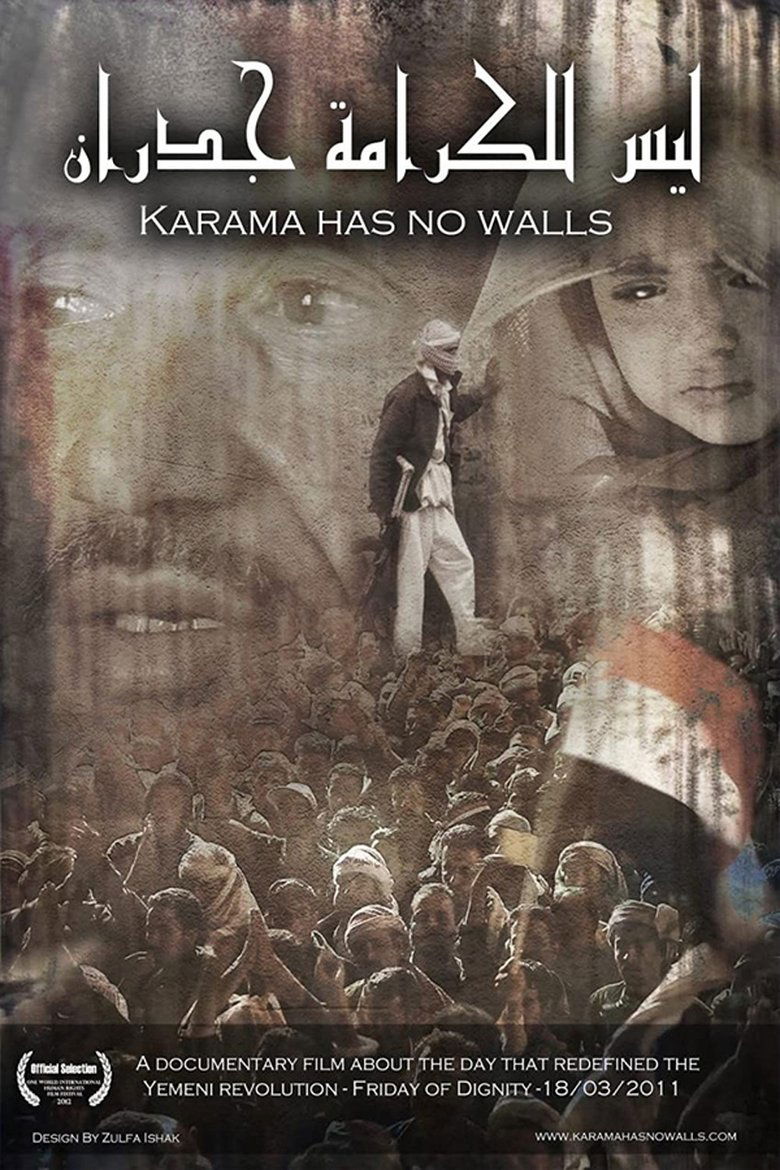
There's a moment in Karama Has No Walls where the camera catches a crowd of protesters, ordinary Yemeni men and women, chanting in Sana'a's Change Square, and you feel the electricity of it, the collective defiance, the sheer human weight of people deciding enough is enough. And then you remember what's coming. That dread, that awful foreknowledge, hangs over every frame of Sara Ishaq's documentary. It's not a comfortable watch. It's not meant to be.
This is Yemen's entry in my A-Z World Movie Tour, and it's a film that covers the events of 18th March 2011, the day government forces opened fire on peaceful demonstrators during the Arab Spring uprising. The title translates, I believe, as "dignity has no walls," and that word, karama, dignity, is exactly what the protesters were demanding. What they got instead is documented here with unflinching honesty.
What strikes you immediately is the form. This isn't your polished, narrated, talking-head documentary with expert commentary and neat contextual graphics. It's raw. Much of the footage was shot by the protesters themselves, on phones and handheld cameras, and it shows. The images are shaky, sometimes chaotic, occasionally hard to watch. But that roughness is precisely the point. There's no mediation between you and what happened. No presenter standing in front of archive footage telling you how to feel. You're dropped into the square, into the makeshift field hospitals, into the grief of families who went out that morning not knowing they'd never come home. The lack of polish isn't a weakness. It's the whole argument.
That said, I'll be honest about its limitations, because the film does have them. If you come to this without much background knowledge of the Yemeni uprising or the broader Arab Spring context, you might find yourself struggling. There's very little framing for international viewers. No real political landscape sketched in, no wider picture of what was happening across the country or the region. Ishaq keeps the focus tight, almost entirely on this one day and its immediate aftermath, and while that creates real intensity, it does mean the documentary asks a lot of you in terms of prior knowledge.
But here's the thing: bearing witness is itself a political act. And that's what this film does, above all else. It says, this happened, these people existed, their courage was real, and their deaths were not inevitable. Yemen's uprising was largely overshadowed globally by what was happening in Egypt, Libya, Syria. The news cycle moved on. Karama Has No Walls refuses to let it. In that sense it reminded me a little of Lost Boy in Juba, another documentary that insists on putting a human face on a conflict the wider world found easy to ignore.
The moments that hit hardest aren't the violence itself, difficult as that is. It's the quieter images around it. The grief on a father's face. The makeshift hospital running out of space. The protesters who keep chanting even after the shooting starts. There's a courage in those images that feels almost unbearable to watch, because you know, as they perhaps didn't, how the story ends, at least in the short term.
Is it a great piece of filmmaking? Not in a technical or structural sense, no. Three stars feels right to me. It's basic in form, thin on context, and there are moments where you wish someone had sat down and provided a bit more background to help international audiences fully grasp the stakes. But greatness of craft isn't the only measure of a film's worth. Sometimes a document just needs to exist. Sometimes the value is simply in the record.
The events of that March day in Sana'a deserve to be remembered. This film makes sure they are. That counts for something.
Rating: ★★★ | Year: 2012 | Watched: 2025-09-15
Where to watch
Watch in the US
Buy: Google Play Movies · YouTube
Physical: Amazon US
Affiliate disclosure: Movies With Macca may earn a small commission on purchases or subscriptions started via these links. It costs you nothing extra.
Related on Movies With Macca
More from United Kingdom: Lessons of Darkness (1992) · Shinjuku Boys (1995) · The Curse of Frankenstein (1957) · Blue (1993)
More from the 2010s: Wonder (2017) · Beautiful Boy (2018) · The Witch (2015) · What We Do in the Shadows (2014)
More documentary: Letter from Siberia (1957) · Lessons of Darkness (1992) · Style Wars (1983) · Here and Elsewhere (1976)