Godzilla 1985 (1985)
★★ — Godzilla 1985 (1985)

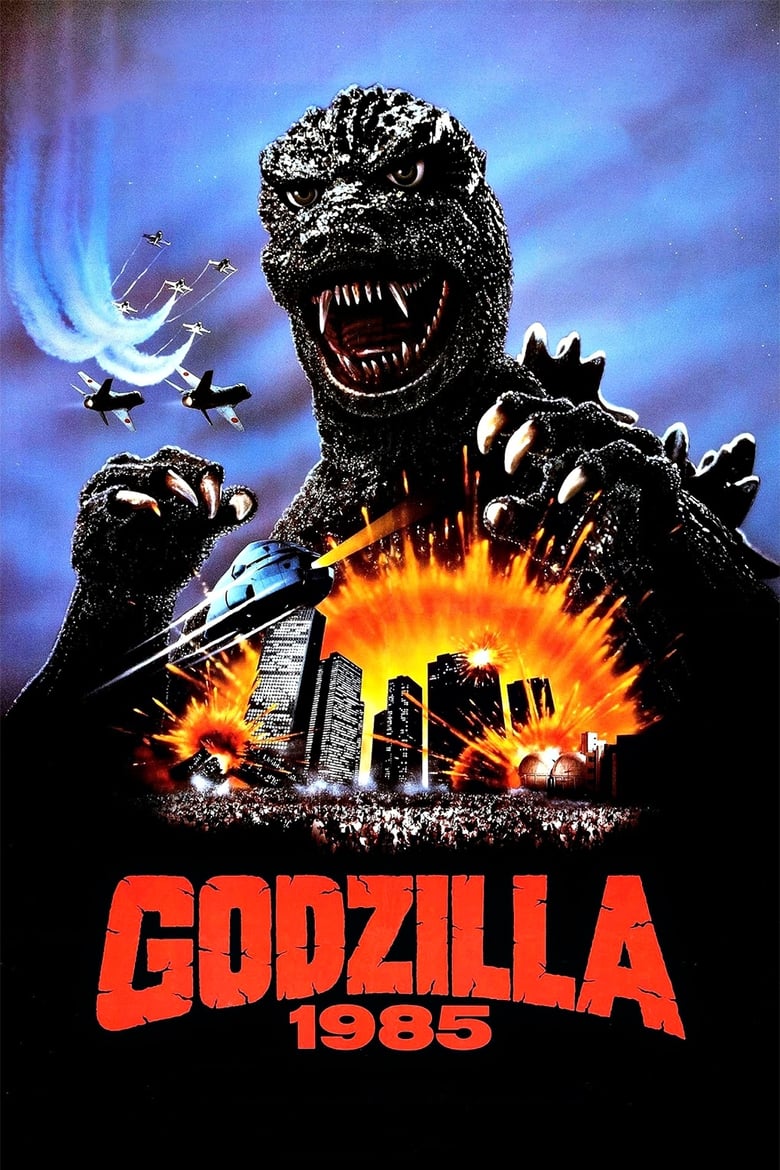
There's a particular kind of disappointment reserved for films that clearly want to mean something but can't quite get out of their own way. Godzilla 1985 is one of those films. It arrives with a decent idea at its heart, a genuine attempt to drag the big lizard back to his darker, more serious origins, and then buries that idea under clunky editing, flat human drama, and a structural identity crisis that never really resolves itself.
To be precise about what you're actually watching: this is an Americanised re-edit of the Japanese film The Return of Godzilla, chopped and stitched together with newly shot footage of Raymond Burr reprising his role as journalist Steve Martin from the 1956 American cut of the original. The conceit is that this is a direct sequel to that first film, skipping over nearly thirty years of Toho sequels entirely. It's a bold move in theory. In practice, it's a mess. Burr himself is game enough, but his scenes are so obviously shot separately, poorly lit and emotionally adrift from everything around them, that they feel less like connective tissue and more like a patch job. You can practically see the seams.
What's frustrating is that the underlying Japanese film has something worth saying. The Cold War anxiety is real, the nuclear dread is present, and there's a genuine attempt to recapture the moral weight that made the 1954 original so striking. Godzilla as a creature born of humanity's worst impulses, a walking consequence rather than just a monster to be defeated, is a compelling idea. And the decision to strip away the campier elements of the franchise and play it straight again is the right instinct. But good instincts don't automatically make good films.
The effects are where it really struggles for me. Now, I'm not someone who automatically dismisses suitmation or practical miniature work. Done well, there's real craft and even charm in it. But this doesn't do it especially well. The miniatures feel flimsy, the compositing is rough, and Godzilla himself lacks the imposing presence the film keeps insisting he has. Consider that 1985 also gave us Re-Animator, a film made on a fraction of the budget that absolutely delivers on its promises. Ambition and execution have to meet somewhere, and here they don't.
The human side of the story doesn't help. The formula is well established by this point: monster surfaces, city gets flattened, military throws everything at it and fails, someone finds a clever solution at the last minute. That formula can still work if the people caught in the middle of it are interesting. They're not, particularly. The drama between the human characters is functional at best, and the repeated sequences of screaming crowds and crumbling buildings pile up fast. After the third or fourth near-identical shot of panicked civilians running in the same direction, you start to feel the length.
Pacing is probably the single biggest issue. There are stretches where very little happens dramatically or visually, and the film doesn't have the confidence to sit with quiet tension the way the best monster films can. It's not terrible in any spectacular way. It doesn't embarrass itself. It just sort of exists, taking up space where something genuinely thrilling could have been.
If you're working through the whole Godzilla franchise chronologically, or you're specifically curious about how Toho tried to reset the series in the mid-eighties, there's reason enough to watch it. Context matters, and as a piece of franchise history it's not entirely without interest. But as a film that was supposed to launch a fresh era with real momentum behind it, it falls flat. The intention was there. The execution wasn't.
Two stars. A missed opportunity dressed up as a comeback.
Rating: ★★ | Year: 1985 | Watched: 2025-10-27
Related on Movies With Macca
More from Japan: Mononoke the Movie: The Phantom in the Rain (2024) · Mononoke the Movie: Chapter II - The Ashes of Rage (2025) · Blue (1993) · The Ghost of Yotsuya (1959)
More from the 1980s: Nightmare City (1980) · A Better Tomorrow (1986) · Style Wars (1983) · Garlic Is as Good as Ten Mothers (1980)
More action: A Better Tomorrow (1986) · The General (1926) · Hand of Death (1976) · Daredevil (2003)
More science fiction: Invasion of the Body Snatchers (1956) · Fantastic Planet (1973) · Nightmare City (1980) · The Long Walk (2025)