
Annie Oakley (1894)
★★★ — Annie Oakley (1894)

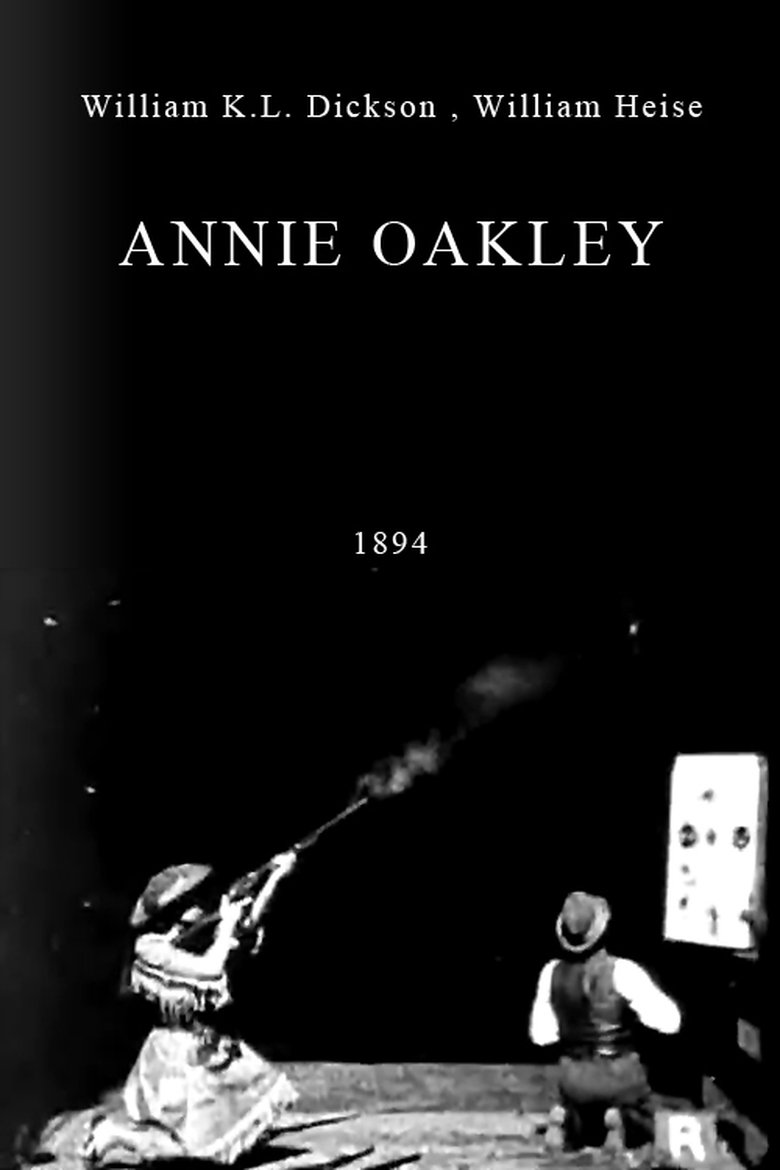
In the early 1890s, Thomas Edison's laboratory in West Orange, New Jersey, was producing something the world had never seen before: moving pictures. The facility purpose-built to make them, a tar-papered, rotating studio known as the Black Maria, became the unlikely birthplace of cinema as a commercial and cultural form. Edison's team, led by William K.L. Dickson and William Heise, pointed their Kinetoscope camera at dancers, boxers, acrobats and strongmen, capturing short bursts of motion for coin-operated viewing machines. In 1894, one of their subjects was Annie Oakley, the Ohio-born sharpshooter who had become one of the most famous performers on earth. Born Phoebe Ann Oakley Mozee in 1860, she had risen from rural poverty to international celebrity through her extraordinary marksmanship, eventually joining Buffalo Bill's Wild West show and touring before audiences across Europe and the Americas, including, reportedly, before various European royals. She was, in the parlance of the age, a genuine star. The fact that she walked into the Black Maria studio and performed for a camera is, in retrospect, a collision of two entirely different kinds of history.
William K.L. Dickson is perhaps the more important figure here than Edison himself when it comes to the actual mechanics of early filmmaking. It was Dickson who developed much of the practical technology behind the Kinetoscope, and it was Dickson who understood, almost instinctively, the value of pointing the apparatus at people worth watching. He directed a significant body of Edison's early output, including, four years after this short, another piece of living history: I also reviewed Pope Leo XIII Being Seated Bestowing Blessing, a similarly brief Edison-era document of a figure whose fame was, in 1898, essentially global. The Annie Oakley film belongs to this same impulse: not storytelling in any structured sense, but preservation. Record the famous person. Let the machine do its work. Whether Oakley was accompanied by her husband and fellow marksman Frank Butler during this particular shoot is not confirmed, but the performance itself is unmistakably professional, the movement of someone utterly accustomed to an audience.
Because the film predates any formal system of credited cinematography and carries no score, no editing of note, and no known writer, there is very little conventional craft to describe in the usual terms. What exists, visually, is the raw grain of nineteenth-century nitrate film stock, images flickering at the edge of legibility, the kind of footage where light and shadow seem to be fighting each other for control of the frame. The texture is less a stylistic choice than a historical fact, a function of where the technology stood in 1894. The Lumière brothers would not hold their famous public screening in Paris until December of 1895. This film was made before that moment. What you are watching is not cinema as a mature art form but cinema as an experiment, polished but unremarkable in craft terms, and extraordinary in almost every other sense. For a sense of how the documentary form eventually developed from these raw origins into something more formally ambitious, see also my thoughts on Titicut Follies, or for a companion piece in a very different register, Under a Jarvis Moon, another documentary I covered that takes the preservation of a specific cultural moment as its central purpose. On the western side of things, for a film that treats the mythology of the American frontier with considerably more modern resources, my review of The Assassination of Jesse James by the Coward Robert Ford offers a useful point of contrast.
This is an 1894 Edison short, shot at the Black Maria studio in New Jersey, and it's about as primitive as film gets. Grainy, flickering, the kind of footage that looks like it's being projected through fog. But none of that matters. What matters is that a woman who was born in 1860, who toured with Buffalo Bill's Wild West show and performed for crowned heads of Europe, is right there in front of you, doing her thing. History stops being a painting on a wall and becomes something breathing.
I think we underestimate how wild it is that any of this exists at all. Film was barely a technology when this was shot. The Lumière brothers hadn't even had their famous public screening yet. Edison and his team were essentially pointing this new contraption at interesting people and seeing what happened, and one of the people they pointed it at was Annie Oakley. Lucky us. She fires her rifle, hits her marks, moves with a practised ease that tells you everything about how many thousands of times she'd done this before a crowd. She's completely comfortable. She's a performer to her bones, even in front of a machine she'd probably never seen before.
It pairs nicely in my head with Pope Leo XIII Being Seated Bestowing Blessing (1898), another one of these early Edison-era glimpses of a famous figure caught on camera. That one gave me the same odd feeling: the sense of a gulf closing between now and then, of realising that these weren't just names in a history book but actual people who moved through the world. There's a particular magic to these early films that no amount of CGI recreation or dramatic biopic can replicate, because what you're watching is real. It happened. The light that bounced off Annie Oakley's face was captured on film, and here it still is, over a hundred and thirty years later.
Does it work as a "film" in any conventional sense? Not really. There's no story, no arc, no craft to speak of beyond the basic act of pointing and recording. But I find myself reluctant to hold that against it. Judging this by modern filmmaking standards would be like criticising the Wright brothers' first flight for not having a business class cabin. You have to meet it where it is, and where it is, is extraordinary: one of the earliest surviving records of a real human being doing the thing that made them famous.
If you've any interest at all in the Wild West era, in women's history, in the history of film itself, or honestly just in the sheer uncanny thrill of watching the past move, give this your thirty seconds. I'm genuinely chuffed I stumbled across it. Annie Oakley deserved to be remembered, and it turns out she got to do part of that herself.
Three stars.
For me, that thirty seconds carries more weight than many films ten thousand times its length. There is something genuinely disorienting about it, in the best possible way: the sense that the past is not fixed and distant but flickering, alive, just about reachable. Annie Oakley got to hand a piece of herself forward through time, and we are the ones on the receiving end. That feels like a privilege worth sitting with.
Rating: ★★★ | Year: 1894 | Watched: 2025-09-08
Related on Movies With Macca
More from William K.L. Dickson: Pope Leo XIII Being Seated Bestowing Blessing (1898)
More from the 1890s: Pope Leo XIII Being Seated Bestowing Blessing (1898)
More documentary: Letter from Siberia (1957) · Lessons of Darkness (1992) · Style Wars (1983) · Here and Elsewhere (1976)
More western: The Ox-Bow Incident (1943) · Rio Bravo (1959) · Ride Lonesome (1959) · The Great Train Robbery (1903)



