Rope (1948)

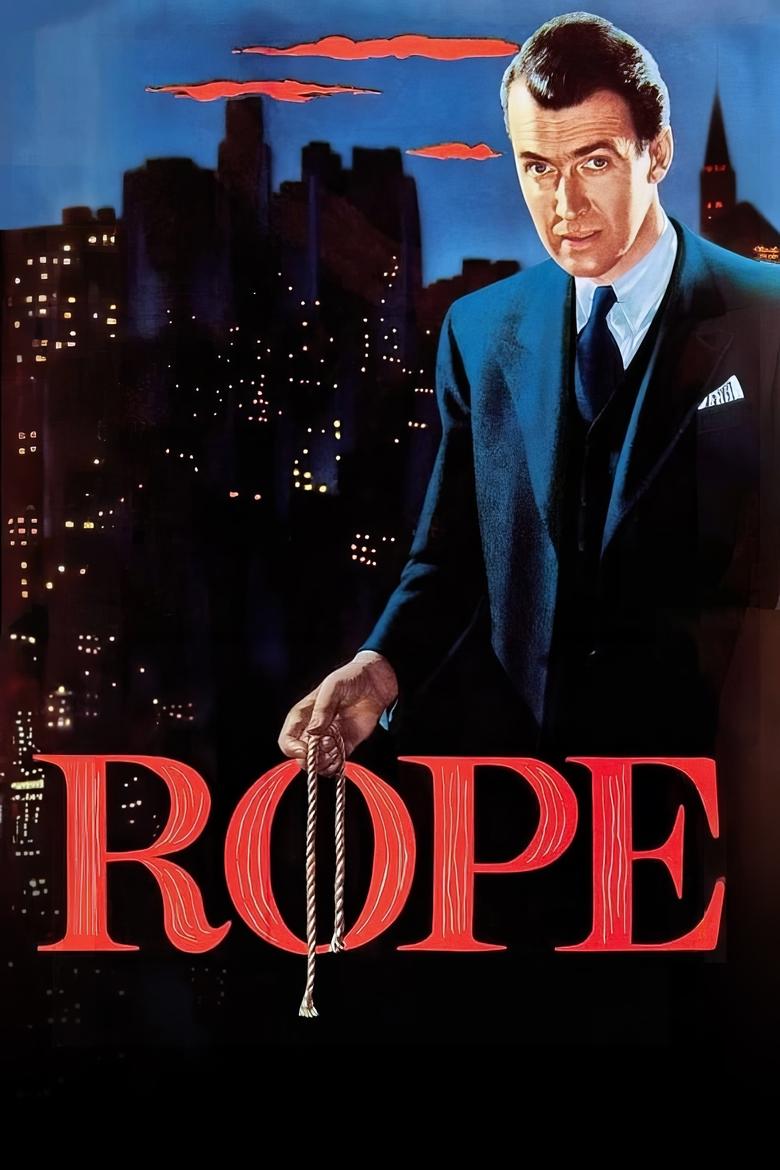
There is a moment near the start of Rope that sets the temperature for everything to follow: two young men, Brandon and Phillip, tighten a length of rope around the neck of a former classmate, and then, barely pausing for breath, begin arranging the furniture for a dinner party. The body goes into a wooden chest. The chest becomes the buffet table. The guests are arriving in an hour. Hitchcock understood, perhaps better than any director of his era, that horror is most effective when it is made domestic, and Rope is the cleanest distillation of that instinct he ever put on screen.
The film arrived in 1948, produced through Hitchcock's own independent shingle, Transatlantic Pictures, and adapted by Arthur Laurents from the 1929 Patrick Hamilton stage play. The Hamilton source material was itself loosely inspired by the real Leopold and Loeb case of 1924, in which two wealthy Chicago students murdered a fourteen-year-old boy in an attempt to commit what they considered an intellectually superior crime. Laurents retained the philosophical conceit but moved the action to New York and sharpened the Nietzschean grandstanding that sits at the moral core of the story. The film was Hitchcock's first in colour, and the production carries a deliberate theatrical quality, with virtually the entire running time confined to a single Manhattan penthouse apartment. At just 81 minutes, it is one of the tighter entries in his filmography, and the restraint is structural as much as it is budgetary. I also reviewed Dial M for Murder and Rear Window, both of which share something of this same enclosed, pressurised quality, and make for natural companions to Rope if you are working through Hitchcock's 1950s run.
The cast is led by James Stewart, here playing Rupert Cadell, the two killers' former housemaster, a man whose off-hand philosophising about superior individuals being above conventional morality has been received, to catastrophic effect, with complete sincerity. Stewart was already established as the great American everyman by 1948, not least through Frank Capra's work with him (see also It's a Wonderful Life), and Hitchcock uses that familiar decency against the audience, making Rupert's gradual, dawning realisation land with real weight. John Dall plays Brandon with a brittle, performative confidence that reads as both comic and genuinely unsettling, while Farley Granger's Phillip is all fraying nerves, the kind of performance that makes you feel the walls closing in on his behalf. Cedric Hardwicke and Constance Collier provide the social texture of the dinner party itself, polished but unremarkable on the surface, just convincing enough to keep the horror grounded in something recognisable as an ordinary evening among people who know each other.
The cinematography, shared between Joseph A. Valentine and William V. Skall, is inseparable from the film's central formal gambit. Hitchcock staged Rope in a series of very long takes, with cuts concealed behind actors moving across the lens or into darkness, creating the illusion of a single continuous shot across the entire film. It was a bold and genuinely difficult production choice: the camera had to be mounted on a specially designed dolly so it could move freely around the apartment, and the walls of the set were built on tracks to allow it through. The result is a film that breathes like a stage production but watches like something more intimate and invasive, the lens always circling, always finding somewhere uncomfortable to settle. The score is uncredited, though Poulenc's Perpetual Movement No. 1 appears on the diegetic record player, a piece of music that is deliberately, almost mockingly light for the company it is keeping.
Alfred Hitchcock is the master of wringing suspense out of almost nothing, and Rope may be his purest demonstration of the gift. He conjures intrigue and nail-biting tension from a single apartment and not much more than conversation, which has no business working as well as it does.
The murder at the heart of the film happens in the opening moments; everything after is a dinner party held around it, and the slow, creeping unravelling of the two men who did it.
Part of the thrill is in how it is made. Hitchcock stages the whole thing to feel like one long, unbroken take, the camera prowling the apartment in something close to real time, and that choice winds the tension tighter with nowhere for anyone to hide, the killers least of all. As the guests arrive and the small talk circles closer and closer to the horror sitting in plain sight, the screws turn exquisitely.
The characters are well drawn, too; they feel varied and purposeful, each earning their place at the table rather than padding it out. James Stewart, as the former teacher whose idle philosophising the two young men have taken to a monstrous conclusion, is as fantastic as ever, the moral centre the whole thing turns on. And then there is the finale: those last fifteen minutes or so are worth every second of the build. I was on the edge of my seat, and the remarkable part, the thing I kept having to remind myself, is that it is all just people talking.
More than anything, this is Hitchcock in the tight, single-room, meticulously constructed mode I love him in most, closer to the likes of Rear Window and Dial M for Murder than to the sprawl of a Vertigo. No chases, no gunfights, just dialogue and dread, and it grips like a vice. Four stars. A lean, ingenious and thoroughly gripping piece of work, and proof that Hitchcock needed no more than a room and a conversation to hold an audience in the palm of his hand.
Rope sits in an interesting position within Hitchcock's body of work: not as well known as Psycho or Vertigo, and occasionally treated as a curio, a formal experiment that is more interesting in theory than in practice. That reading has always felt slightly ungenerous. What Hitchcock and his collaborators built here is something precise and purposeful, a film that uses the grammar of theatre and the grammar of cinema simultaneously, and makes the tension between them do real work. It is the kind of film that reminds you how much can be accomplished with a locked door, a cluttered room, and people who cannot quite bring themselves to say what they know. Not bad for an evening's conversation.
Rating: ★★★★ | Year: 1948 | Watched: 2026-10-23
Trailer
▶ Watch the official trailer for Rope (1948) on YouTube
Where to watch
Watch in the UK
Rent: Apple TV Store · Amazon Video · Sky Store · YouTube
Buy: Apple TV Store · Rakuten TV · Amazon Video · Sky Store
Physical: Amazon UK · Zavvi
Watch in the US
Stream: Philo · YouTube TV
Rent: Amazon Video · Apple TV Store · Google Play Movies · YouTube
Buy: Amazon Video · Apple TV Store · Google Play Movies · YouTube
Physical: Amazon US
Affiliate disclosure: Movies With Macca may earn a small commission on purchases or subscriptions started via these links. It costs you nothing extra.