Neo Tokyo (1987)
★★★ — Neo Tokyo (1987)

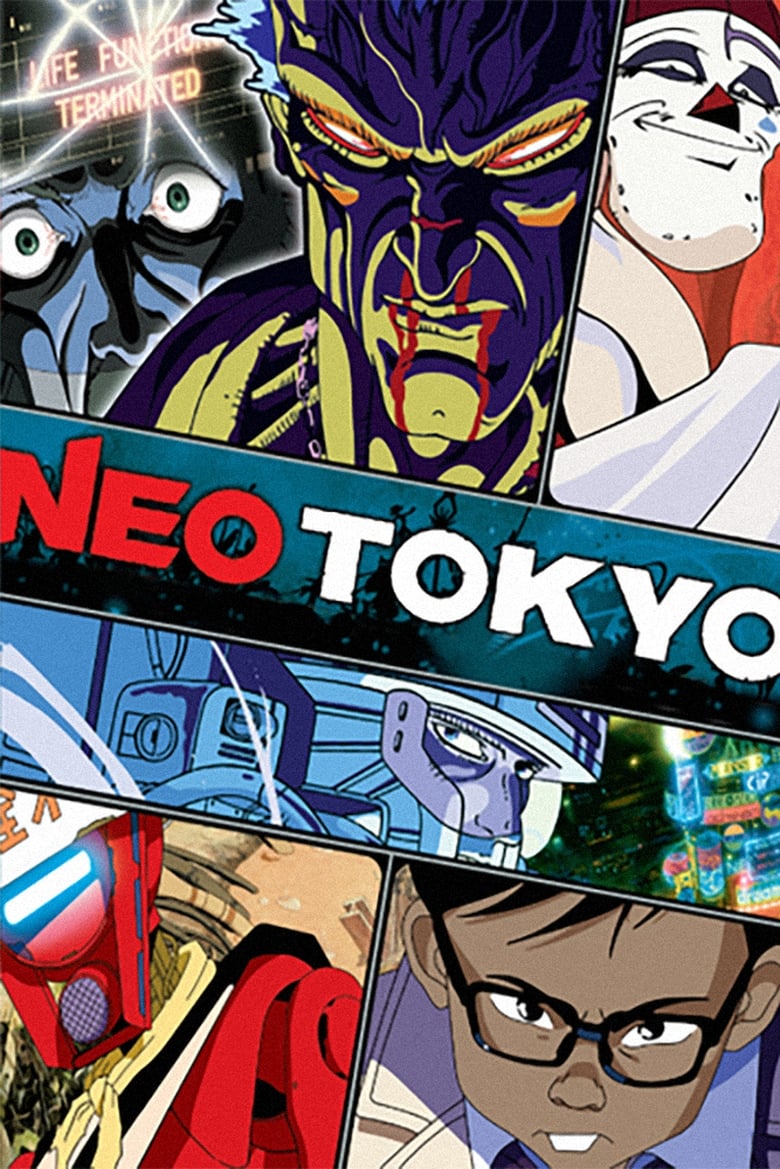
Let me be straight with you: Katsuhiro Otomo's segment alone is worth the price of admission here, and if the other two thirds of this anthology matched it, we'd be talking about one of the great anime films of the 1980s. We're not, though. What we have instead is a frustrating, fascinating, wildly uneven triptych that captures exactly what makes the anthology format such a gamble.
The opening segment, Rintaro's "Labyrinth Labyrinthos," nearly lost me completely. A girl and her cat tumble into some kind of surreal dreamscape, and the film just... floats there. Dialogue-light to the point of silence, visually busy but somehow inert, the whole thing gives you the sensation of watching someone else's dream rather than being invited into it. I kept waiting for the imagery to cohere into something, for the symbolism to attach itself to an idea or a feeling, and it never quite did. Patience is genuinely required to get through it, and I'd be lying if I said I wasn't tempted to bail before part one even wrapped up.
Yoshiaki Kawajiri's "The Running Man" pulled me back from the edge. The animation here is extraordinary, fluid and hyper-stylised racing sequences that show you exactly what late-80s anime was capable of when it was firing. There's a kineticism to it, a physical energy in every frame, that reminds you why this era of animation still holds up so well. But here's the thing: once you get past marvelling at how it looks, the story underneath is paper-thin. A racer chasing some form of transcendence against a cosmic opponent sounds compelling on paper, and it's rendered beautifully, but it doesn't give you much to hold onto emotionally or thematically. Style over substance, and it knows it. Gorgeous, but one-note.
Then Otomo arrives, and everything shifts. "Construction Cancellation Order" is the kind of short film that makes you annoyed it's only a short film. The premise is deceptively simple: a lone inspector travels to a remote construction site to decommission the sentient AI running the project, only to find the machine locked into its programming, rigidly, eerily, unstoppably committed to building. What Otomo does with that is build tension almost entirely through conversation and atmosphere. No action set-pieces, no visual fireworks. Just dread, accumulating slowly, like water rising in a sealed room. The AI's behaviour calls to mind HAL 9000, that same chilling quality of a machine following its instructions with complete sincerity while the humans around it scramble to reassert control. The philosophical unease it generates stays with you well after the credits. Otomo, who of course gave us Akira, had already proven himself a visionary, and this segment makes you wish someone had let him expand it into a feature. I'd have watched two hours of it.
Anthology films live and die by their weakest entry, and that's the central problem here. Two segments falter, one through pretension and one through simplicity, and only the third genuinely soars. It's a bit like ordering a three-course meal and only enjoying the main. Worth it? Probably, yes. But you go in with your eyes open. Fans of Japanese animation from this period, particularly those who've explored the more atmospheric end of the tradition (I've been enjoying a lot of that lately, including Mononoke the Movie: The Phantom in the Rain (2024)), will find plenty to appreciate here, even through the patches that drag.
Neo Tokyo is a historically interesting document of late-80s anime talent, a showcase of what the form was doing and what it was still figuring out. Rintaro, Kawajiri, Otomo: three distinct voices, three wildly different results. Come for Otomo's contribution, stay curious about the rest, and temper your expectations accordingly.
Three stars.
Rating: ★★★ | Year: 1987 | Watched: 2026-03-23
Where to watch
Watch in the UK
Stream: Crunchyroll · Crunchyroll Amazon Channel
Physical: Amazon UK · Zavvi
Watch in the US
Stream: Crunchyroll · Crunchyroll Amazon Channel
Physical: Amazon US
Affiliate disclosure: Movies With Macca may earn a small commission on purchases or subscriptions started via these links. It costs you nothing extra.
Related on Movies With Macca
More from Japan: Mononoke the Movie: The Phantom in the Rain (2024) · Mononoke the Movie: Chapter II - The Ashes of Rage (2025) · Blue (1993) · The Ghost of Yotsuya (1959)
More from the 1980s: Nightmare City (1980) · A Better Tomorrow (1986) · Style Wars (1983) · Garlic Is as Good as Ten Mothers (1980)
More science fiction: Invasion of the Body Snatchers (1956) · Fantastic Planet (1973) · Nightmare City (1980) · The Long Walk (2025)
More animation: Fantastic Planet (1973) · Alice in Wonderland (1951) · Mononoke the Movie: The Phantom in the Rain (2024) · Mononoke the Movie: Chapter II - The Ashes of Rage (2025)