Meshes of the Afternoon (1943)
★½ — Meshes of the Afternoon (1943)

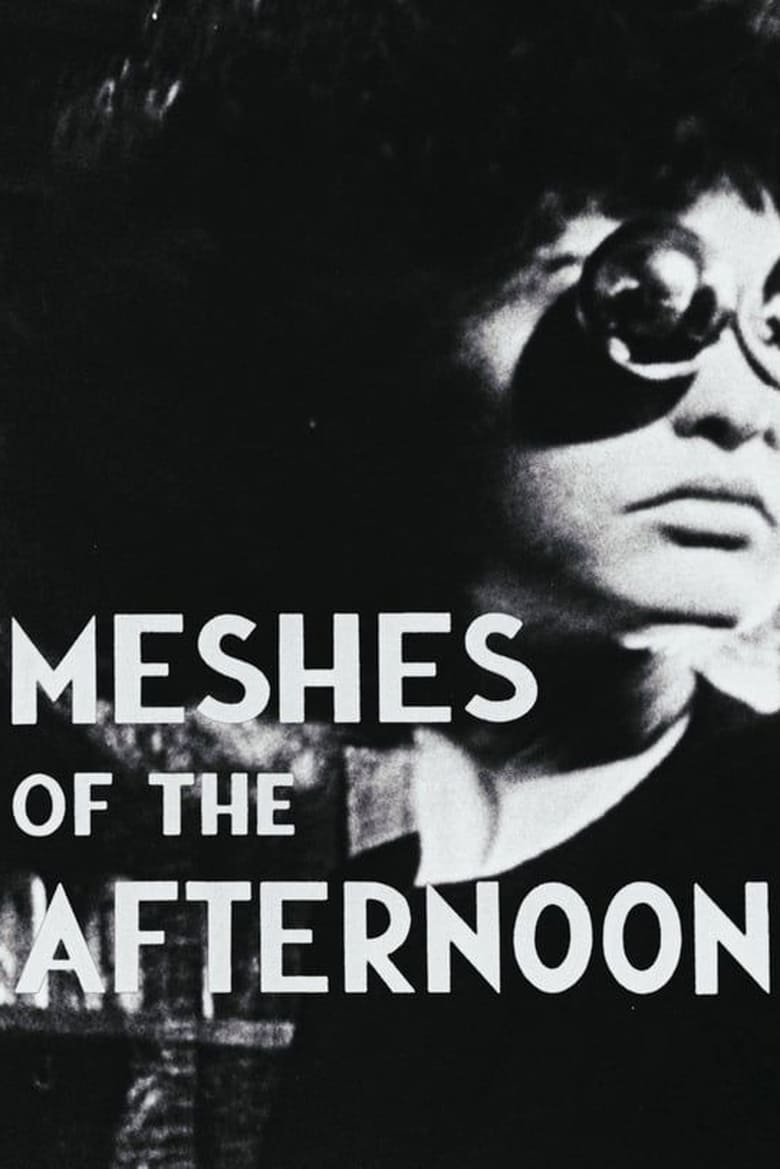
Here's the honest truth: I respect Meshes of the Afternoon far more than I enjoyed it. And I'm not entirely sure those two things can ever fully coexist for a film like this.
Maya Deren and Alexander Hammid made this in 1943 on what must have been a shoestring, and what they pulled off technically is genuinely impressive. Fluid camera movements, inventive editing, double exposures, a recurring cast of unsettling symbols: a key dropping from nowhere, a cloaked figure whose face is a mirror, a knife buried in a loaf of bread. For its time, this was radical. You can trace a direct line from Meshes to decades of arthouse cinema, music videos, and film school productions. Its fingerprints are everywhere, and that matters. It deserves its place in the canon.
But knowing something is important and finding it compelling to sit through are very different things.
What we have here is a fourteen-minute dreamscape with no dialogue, no traditional characters, and no narrative in any conventional sense. Just mood, motif, and metaphor folding back on themselves in a loop. I understand the intention. It's trying to map the subconscious, to evoke anxiety and alienation through pure visual poetry, to get at something beneath language. And there are moments where the rhythm of it does pull you under a little, where the hypnotic quality works.
But for me, emotionally? It stays at arm's length the entire time. I never felt anything beyond mild intellectual acknowledgement. That might be a personal failing. I'll own that. I've never been naturally drawn to pure arthouse abstraction, and I know this kind of film isn't really asking to be "felt" in the way a conventional drama does. It's asking to be interpreted, to be sat with, maybe returned to.
The problem is, I spent a lot of years working in a college, and in that time I sat through more student film screenings than I care to remember. Dream sequences, symbolic objects passed between hands in slow motion, eerie ambient music, someone staring into a mirror. I've seen it all. And I know, rationally, that those students were copying Meshes (whether they knew it or not), not the other way around. But when everyone has been imitating something for eighty years, it becomes genuinely difficult to see the original with fresh eyes. The revolutionary feels routine. The groundbreaking feels familiar. That's not Deren and Hammid's fault, but it is the reality of watching this in 2024.
I kept asking myself: if I stripped away the historical context entirely, if this just turned up on my screen with no label, no date, no reputation attached, what would I make of it? And honestly, I think I'd find it opaque and a little cold. A series of enigmatic images that gesture at meaning without quite landing it, at least for me.
For a completely different kind of unsettling imagery rooted in folklore and the subconscious, I found Viy far more viscerally engaging, even if it's working in an entirely different register.
One and a half stars. A landmark, without question. A film that changed what cinema thought it could be. But as a modern viewing experience, it's challenging, opaque, and not something I'd put on again by choice. Some monuments are better admired from a distance than lived in.
Rating: ★½ | Year: 1943 | Watched: 2025-09-22
Where to watch
Watch in the US
Stream: Criterion Channel
Physical: Amazon US
Affiliate disclosure: Movies With Macca may earn a small commission on purchases or subscriptions started via these links. It costs you nothing extra.
Related on Movies With Macca
More from the 1940s: Louisiana Story (1948) · The Ox-Bow Incident (1943) · Men Without Wings (1946) · The Bank Dick (1940)
More mystery: Mononoke the Movie: The Phantom in the Rain (2024) · Mononoke the Movie: Chapter II - The Ashes of Rage (2025) · Carnival of Souls (1962) · One Way or Another (1975)
More fantasy: Viy (1967) · Alice in Wonderland (1951) · Mononoke the Movie: The Phantom in the Rain (2024) · Mononoke the Movie: Chapter II - The Ashes of Rage (2025)