Let Us Persevere in What We Have Resolved Before We Forget (2013)
★★½ — Let Us Persevere in What We Have Resolved Before We Forget (2013)

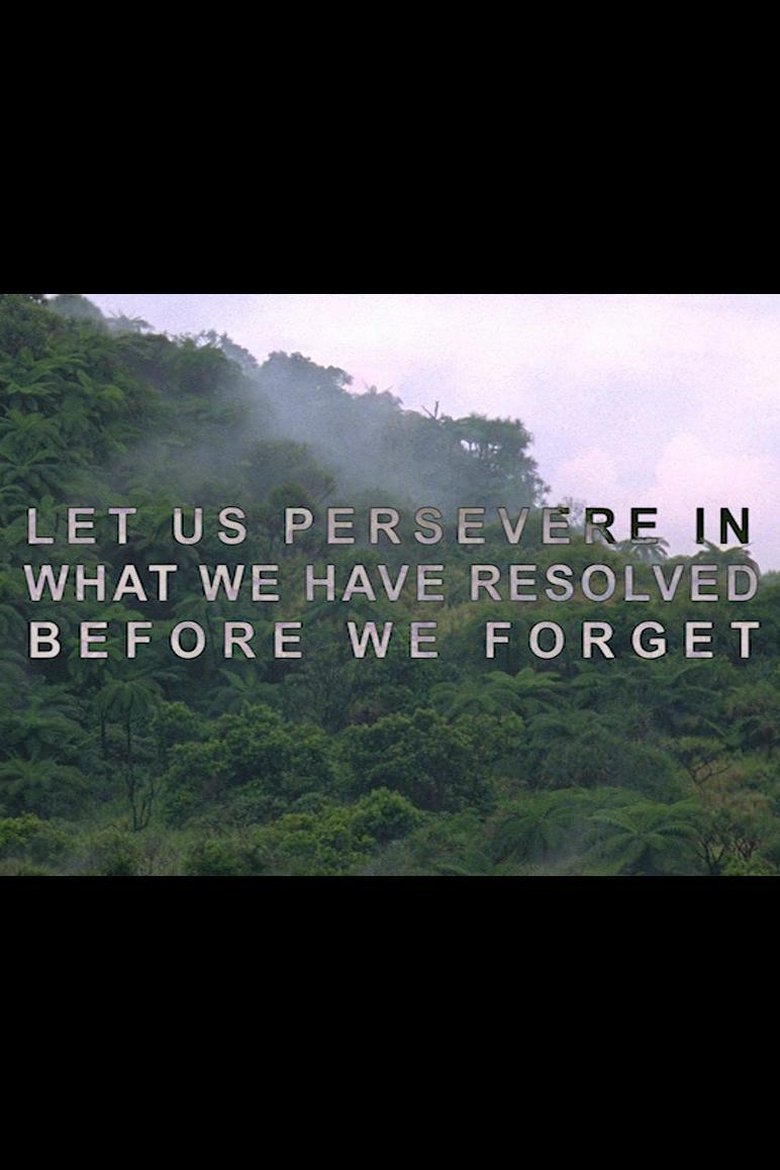
There's a version of this film that I find quietly extraordinary. And there's another version, the one I actually sat with for its entire runtime, that left me admiring it from a distance I could never quite close. Ben Russell's Let Us Persevere in What We Have Resolved Before We Forget is one of those experiences where I can see exactly what it's doing and still struggle to fully surrender to it.
Shot on location in Vanuatu as part of my A-Z World Movie Tour, this is a film you cannot summarise in the traditional sense, because nothing happens, deliberately, carefully, almost defiantly so. Long, static takes. No narration, no interviews, no score. Just life: a man carving wood with unhurried hands, children walking barefoot along a jungle path, smoke curling up through humid air, villagers gathered around fires. The camera watches. It doesn't explain, doesn't guide, doesn't contextualise. It simply observes.
And in those moments, something genuine does happen. The 16mm grain gives everything a warmth that feels earned rather than stylised. The natural light shifts and breathes. You stop waiting for something to occur and start noticing texture, rhythm, the small choreography of daily life. There's real respect in that approach. Russell isn't packaging these people for an outside audience, isn't framing them as exotic or other. The film resists that pull almost entirely, and that restraint is genuinely admirable.
But admirable and accessible are two different things, and this film sits firmly on the admirable side of that line. Without any narrative thread or even the slightest contextual anchor, I found myself drifting. Not in a transcendent, meditative way. More in the way you drift when you're not quite sure you're supposed to be somewhere. It has the intimacy of home movies, unguarded and unperformed, but home movies are made for people who already know the story. I didn't know the story, and the film has no interest in telling me.
That may well be the point. I'm open to that argument. There's a tradition of ethnographic filmmaking that treats observation itself as the work, and on those terms this holds together. It reminded me a little of my experience watching Candomblé in Togo, another film that asks you to receive rather than decode, though that one gave me just enough of a ritual framework to hang onto. Here, even that small handhold is absent.
The result is something I'd call a tone poem rather than a film, and I mean that with mixed feelings. As pure sensory experience, as a way of spending time inside a place and a pace of life entirely unlike my own, it works. I could feel the humidity. I could hear the hush beneath the ambient sound. There were individual images that lodged themselves somewhere behind my eyes. But I never felt invited in. I felt like I was peering through a window at something I couldn't quite reach, which might be a sophisticated artistic choice, or might just be inaccessibility dressed up as rigour. I genuinely can't decide which.
So I land somewhere in the middle, respecting what it's doing while wishing it gave me slightly more to work with. If you approach it as a mood piece, a half-hour spent letting the rhythms of another life wash over you, it offers something real. If you come looking for engagement, for the sense that a film is reaching back toward you as you reach toward it, you might find it as frustratingly remote as I did.
Two and a half stars. Beautiful in stretches, elusive throughout. Worth the watch for the right frame of mind, but don't go in expecting a film that meets you halfway.
Rating: ★★½ | Year: 2013 | Watched: 2025-09-15
Where to watch
Watch in the US
Stream: Fandor Amazon Channel
Physical: Amazon US
Affiliate disclosure: Movies With Macca may earn a small commission on purchases or subscriptions started via these links. It costs you nothing extra.
Related on Movies With Macca
More from France: Fantastic Planet (1973) · Letter from Siberia (1957) · Lessons of Darkness (1992) · Here and Elsewhere (1976)
More from the 2010s: Wonder (2017) · Beautiful Boy (2018) · The Witch (2015) · What We Do in the Shadows (2014)
More documentary: Letter from Siberia (1957) · Lessons of Darkness (1992) · Style Wars (1983) · Here and Elsewhere (1976)