Cat People (1942)
★★½ — Cat People (1942)

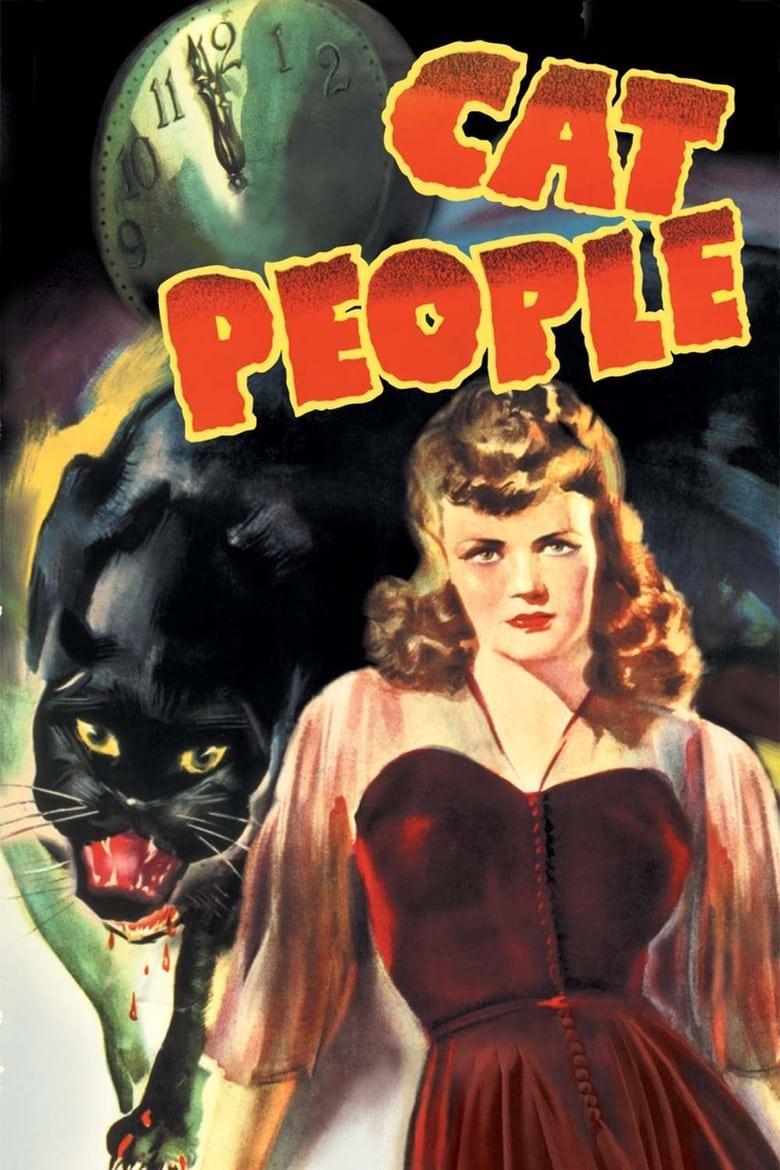
There are two scenes in Cat People that genuinely work. The first is a woman being stalked through a darkened park, the tension coiling tighter with every footstep, until the shriek of a bus door cuts through the silence like a blade. The second is a night-time swimming pool sequence, all shadows and echoing water, where dread seeps in through the edges of the frame. Both scenes are legitimately unsettling. Both scenes are also, unfortunately, about the sum total of what this film delivers on its considerable promise.
The reputation that precedes Cat People is enormous. A landmark of psychological horror. Suggestion over spectacle. Atmosphere over gore. And yes, in a narrow technical sense, that's all true. Val Lewton's production and Jacques Tourneur's direction do conjure a mood, and there's no question that what they were doing at RKO in the early forties was genuinely innovative for studio horror of the time. But "innovative for its era" and "actually frightening" are not the same thing, and I think decades of critical reverence have blurred that distinction considerably.
The premise is genuinely interesting. A woman believes she carries an ancient curse that will cause her to transform into a panther if she ever gives herself fully to passion or jealousy. It's the kind of concept that, handled boldly, could carry real psychological weight. Simone Simon brings a quiet, otherworldly quality to the lead role, and when the film leans into her strangeness it almost works, even if her accent is frankly distracting throughout. The lighting is moody, the cinematography shadowy in all the right ways, and there's a creeping unease in the better moments that you can appreciate even when it doesn't quite get under your skin.
The trouble is that beyond the mood, there isn't much. The horror is so restrained it tips over into non-existence. Nothing truly happens. The supernatural elements are kept so vague and ambiguous that they feel less like genuine menace and more like a metaphor for marital anxiety and sexual repression, which is fine in principle, except that the characters aren't drawn with enough depth to make that subtext land with any real force. The dialogue is stiff. The resolution is flat. For a film celebrated as terrifying, it's bloodless in more ways than one.
What you're actually watching, if you strip away the horror trappings, is a slow-burn melodrama about jealousy and fear of intimacy. And melodrama can be powerful. But it needs characters you care about and a dramatic engine that actually builds. Cat People has neither. It has atmosphere in search of a story.
I'll give it this: it's historically interesting as part of the Lewton-Tourneur cycle, and if you're curious about that lineage it's worth seeing. I found I Walked with a Zombie, which came out of the same collaboration the following year, considerably more effective at doing what Cat People is aiming for. That film earns its eerie reputation in a way this one never quite manages. And if you want to see how the idea of animalistic transformation and female otherness can be explored with genuine unease, Tiger Stripes is a far more visceral and unsettling take on the same territory.
As a piece of atmospheric studio filmmaking, Cat People is decent. As actual horror, it's tame, predictable, and more than a little overpraised. Not bad, exactly. Just average. A whisper in a genre that usually demands a scream.
Two and a half stars.
Rating: ★★½ | Year: 1942 | Watched: 2025-11-24
Where to watch
Watch in the UK
Buy: Apple TV Store · Amazon Video · Sky Store
Physical: Amazon UK · Zavvi
Watch in the US
Stream: YouTube TV
Rent: Amazon Video · Apple TV Store · Google Play Movies · YouTube
Buy: Amazon Video · Apple TV Store · Google Play Movies · YouTube
Physical: Amazon US
Affiliate disclosure: Movies With Macca may earn a small commission on purchases or subscriptions started via these links. It costs you nothing extra.
Related on Movies With Macca
More from Jacques Tourneur: I Walked with a Zombie (1943)
More from the 1940s: Louisiana Story (1948) · The Ox-Bow Incident (1943) · Men Without Wings (1946) · The Bank Dick (1940)
More mystery: Mononoke the Movie: The Phantom in the Rain (2024) · Mononoke the Movie: Chapter II - The Ashes of Rage (2025) · Carnival of Souls (1962) · One Way or Another (1975)
More horror: Invasion of the Body Snatchers (1956) · Viy (1967) · Nightmare City (1980) · Angst (1983)