The Man Who Sold His Skin (2020)
★★★½ — The Man Who Sold His Skin (2020)

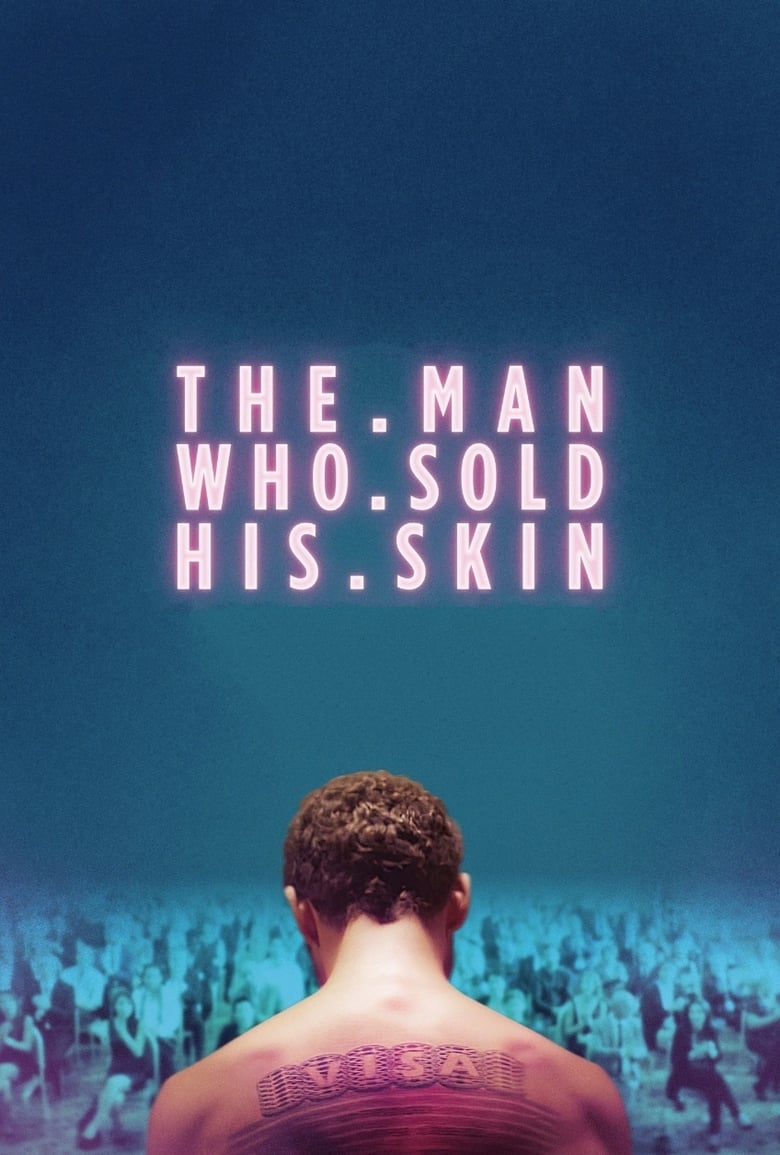
What would you do if the only way to cross a border, to finally be free, was to hand over your own body? Not metaphorically. Literally. That's the question at the centre of The Man Who Sold His Skin, and it's one that sticks with you long after the credits roll. I picked this up as part of my A-Z World Movie Tour, representing Tunisia, and I'll be honest, I wasn't quite sure what to expect. What I got was one of the most striking and genuinely provocative films I've seen in a while.
The setup sounds like it could tip into pure gimmick: Sam, a Syrian refugee, agrees to have his back tattooed by a controversial European artist, turning himself into a "living artwork" to be displayed in galleries across the continent. In exchange, he gets the visa, the freedom of movement, the ability to cross the borders that war and displacement have made impossible for him. It's surreal, yes, but the film wears that surrealism with confidence. Director Kaouther Ben Hania knows exactly what she's doing with this premise, and she never lets it become mere provocation for its own sake.
The fact that this is the first film directed by a Muslim woman to earn an Academy Award nomination in the International Feature category is worth noting, not as a footnote, but as context. Because the film itself carries that kind of weight, that sense of someone saying something that needed saying, and doing it with real craft. The satire aimed at the contemporary art world is sharp and often darkly funny. There's something almost gleeful in the way the film skewers collectors, curators, and gallery culture, people who fetishise suffering so long as it's framed properly and hung at the right height. But beneath the wit, there's genuine emotional pain. Sam's situation forces him into a kind of living performance, his body no longer fully his own, his dignity dependent on the whims of an art market that sees him as product first, person second. The parallels to how the world treats refugees more broadly are hard to miss, and they're not meant to be.
The tone walks a fine line throughout, and mostly it holds. There's something of the tradition of bold, female-directed films from the region in here, and if you enjoyed Lingui, the Sacred Bonds (2021), which similarly uses a striking central situation to expose systemic cruelty with both fury and tenderness, I think you'd find a lot to appreciate here too.
The final act is where the film really earns its keep. Without spoiling anything, there are twists that reframe everything that's come before, and they don't feel cheap. They feel like the argument clicking into place. The critique sharpens rather than scatters, and I came away feeling like the film had actually said something, rather than just gestured at saying it.
It's not flawless. Some moments are a touch heavy-handed, spelling out what the imagery is already communicating clearly enough. And the pacing wobbles in the middle section, losing a bit of momentum before the finale pulls things back together. These aren't dealbreakers, but they do keep the film from quite reaching the heights it's clearly aiming for.
Still, as a concept piece with genuine nerve and emotional intelligence, it stands out. Visually it's striking too, the contrast between the cold glamour of European gallery spaces and the quiet, aching humanity of Sam's situation is handled with a lot of care. It's the kind of film that makes you think about what freedom actually costs, and who gets to decide that price.
Three and a half stars. Intelligent, daring, and well worth your time.
Rating: ★★★½ | Year: 2020 | Watched: 2025-09-13
Where to watch
Watch in the UK
Stream: Amazon Prime Video · Amazon Prime Video with Ads
Rent: Amazon Video · Sky Store · BFI Player
Buy: Amazon Video · Sky Store
Physical: Amazon UK · Zavvi
Watch in the US
Stream: Amazon Prime Video · Amazon Prime Video with Ads
Rent: Amazon Video · Apple TV Store · Google Play Movies · YouTube
Buy: Amazon Video · Apple TV Store · Google Play Movies · YouTube
Physical: Amazon US
Affiliate disclosure: Movies With Macca may earn a small commission on purchases or subscriptions started via these links. It costs you nothing extra.
Related on Movies With Macca
More from Germany: Lessons of Darkness (1992) · Cemetery Man (1994) · The Grand Budapest Hotel (2014) · Resident Evil: Retribution (2012)
More from the 2020s: Mononoke the Movie: The Phantom in the Rain (2024) · Mononoke the Movie: Chapter II - The Ashes of Rage (2025) · The Long Walk (2025) · Americana (2023)
More drama: Viy (1967) · Wonder (2017) · A Better Tomorrow (1986) · Beautiful Boy (2018)