
The Mad Masters (1955)
The Mad Masters (1955)

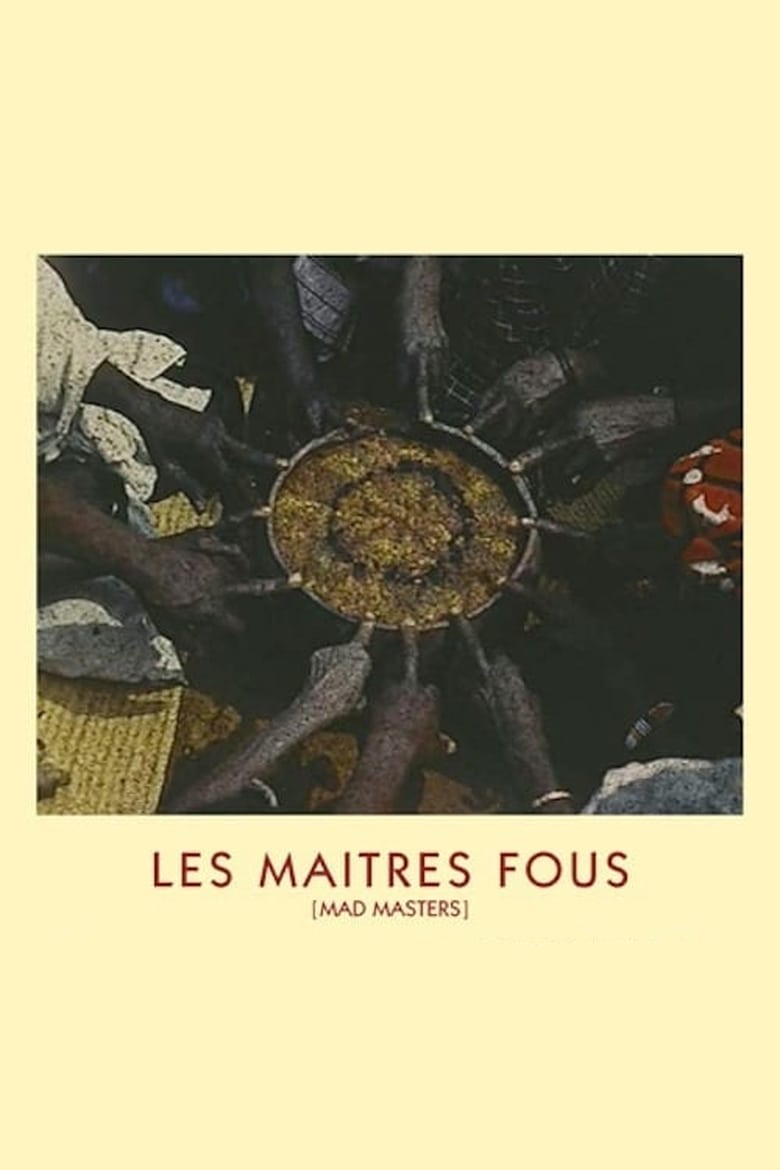
There's a moment in The Mad Masters where the camera holds on a man in trance, body rigid, eyes gone somewhere else entirely, barking commands in an exaggerated impression of a colonial officer. It's extraordinary to watch. It's also deeply uncomfortable. And that tension, between the extraordinary and the uncomfortable, never really resolves across the film's 36 minutes. Nor should it, maybe. But that's precisely what makes Jean Rouch's short documentary so difficult to sit with.
The film documents the Hauka possession rituals in colonial Ghana, in which participants enter trance states and embody figures of colonial authority. Governors. Generals. European officials. They mimic the stiff postures, the barked orders, the puffed-up self-importance. It's a kind of spiritual mockery, a ritual act of subversion, and Rouch framed it as anti-colonial critique. The colonised reclaiming power by turning the coloniser into a costume, into something to be worn and discarded. Taken on those terms, it lands with genuine force. There's something remarkable about watching a community transform the machinery of oppression into a vehicle for spiritual release.
But here's where it gets tangled, and why the film has attracted argument ever since it was made. Rouch is a white French filmmaker. His subjects are Black Africans in states of extreme physical and psychological vulnerability. The camera lingers on convulsing bodies, on foaming mouths, on animal sacrifice. And you can't help asking: who is this film actually for? Because whatever Rouch's intentions, the primary audience was European. Which means the "subversive" act of reclaiming power through ritual was, in its distribution and consumption, filtered straight back through the very gaze it was supposedly critiquing.
That's not a comfortable thought. It doesn't make the film worthless, but it does make the "empathetic document of resistance" reading much harder to sustain without qualification. The line between documentation and exploitation feels dangerously thin throughout, and I'm not sure Rouch ever fully reckons with his own position within the frame, literally and politically. His presence shapes everything we see, and the film doesn't interrogate that with anything like the rigour the subject demands.
I've spent time with Candomblé in Togo (1972), another short ethnographic film dealing with West African spiritual ritual, and the same questions hover over that one too. The ethics of this kind of filmmaking don't have easy answers, and I'm not sure they're supposed to. But The Mad Masters is a particularly stark case because the political stakes are so explicit. Rouch wants you to read this as resistance, and yet the film's own existence as an object complicates that at every turn.
If you want a film that wrestles more self-consciously with the ethics of representation and the filmmaker's gaze, Jean-Luc Godard and Anne-Marie Miéville's Here and Elsewhere (1976) is a more rigorous, and more honest, confrontation with those questions. Rouch doesn't go there. Whether that's a failing or simply a product of his moment, I genuinely can't decide.
What I can say is this: The Mad Masters is historically significant in a way that's hard to argue with. It's one of the documents that sparked serious debate about ethnographic filmmaking, about who gets to represent whom and under what conditions. It provokes real questions about power and representation that remain as live now as they were in 1955. But "important conversation starter" and "satisfying film" aren't the same thing, and I'd be doing you a disservice if I pretended otherwise. Watch it, by all means. Watch it with your critical faculties fully switched on. Just don't expect it to resolve anything neatly, because it doesn't, and it can't.
No rating from me on this one. It feels wrong to reduce it to stars either way.
Rating: Not rated | Year: 1955 | Watched: 2026-03-13
Where to watch
Watch in the US
Stream: OVID
Physical: Amazon US
Affiliate disclosure: Movies With Macca may earn a small commission on purchases or subscriptions started via these links. It costs you nothing extra.
Related on Movies With Macca
More from France: Fantastic Planet (1973) · Letter from Siberia (1957) · Lessons of Darkness (1992) · Here and Elsewhere (1976)
More from the 1950s: Invasion of the Body Snatchers (1956) · Alice in Wonderland (1951) · Letter from Siberia (1957) · Invaders from Mars (1953)
More documentary: Letter from Siberia (1957) · Lessons of Darkness (1992) · Style Wars (1983) · Here and Elsewhere (1976)



