Sacred Creatures (2026)

Some films leave you turning them over for days, not because they soared but because you can see the far better version hovering just out of reach. Sacred Creatures is one of those. Frieda Luk's debut feature, a Canadian and Italian co-production that premiered in competition at this year's Edinburgh International Film Festival, has a genuinely arresting idea at its centre, and for a good while it had me completely. It is only in the closing stretch that it lets go of the thread, and what should have been a payoff turns out to be a shrug. A weird one, for sure, and I mean that as a compliment as often as not.
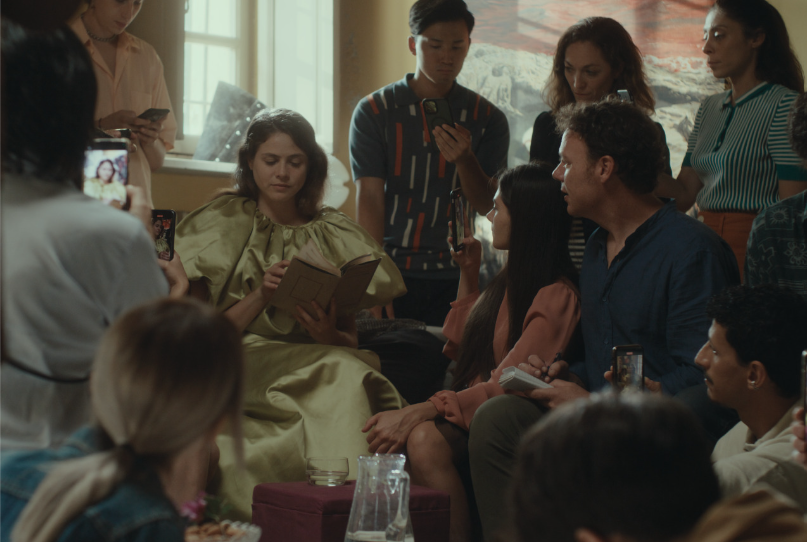
The set-up is quietly loaded. Three Canadian siblings reunite at a house in rural Italy after an unspecified time apart. Ray lives out there with his partner Renzo, and the arrival of his sisters, Michelle and the film's centre of gravity, Miriam, tips a settled domestic world off its axis. Miriam, played by Olivia Luccardi, is in recovery from what the others describe as a psychotic episode, and they close ranks around her, keeping her in the house and watching her the way you watch someone you love and no longer trust. Miriam experiences all of this rather differently. To her it was not a breakdown but an awakening, and she looks on her siblings as spiritual primitives who simply cannot see what she has seen.
That gap, between the woman convinced she has touched something divine and the family convinced she is unwell, is a brilliant engine for a film, and Luk knows it. What gives Sacred Creatures its charge is the slow creep of doubt. One by one, the people who come to the house fall under Miriam's spell, drawn to her stillness and her pronouncements until they start to believe she really is some kind of divine vessel. Pia Engleberth is the standout here as Zia, whose devotion curdles into something close to worship, and there is a real unease in watching a household reorganise itself around one person's certainty. It plays on that queasy line, familiar from any good story about a cult, where you are never quite sure whether you are witnessing madness or a miracle.
Here is where my reservations begin, though. For the film to truly work, Miriam's utterances need to carry at least a flicker of the profundity everyone around her responds to, and for me they never do. Her supposedly inspired musings land as vague, hollow and oddly synthetic, the sort of thing an algorithm might generate if you asked it for wisdom, and yet the other characters lap them up as gospel. I could not tell whether that was the point, a sly comment on how easily we mistake the empty for the enlightened, or simply a script that could not rise to the demand it had set itself. Either way, the effect is the same. The spell that holds the characters never quite fell over me, and once you are outside the trance, you spend the film waiting for everyone else to snap out of it too.
It builds, at least, with patience. Miriam eventually ends up in hospital, over the protests of siblings who are, by now, half starting to believe she might be special after all, and the film dangles its one properly tantalising clue. A doctor reports that her vital signs are all perfectly normal, but that the oxygen levels in her blood are, somehow, beyond measurement. It is a lovely, creepy detail, the kind of thing that promises the ground is about to shift, and I sat up for it. The trouble is the film never returns to it. That thread, like several others, is simply left hanging.
And so to the ending, which is where Sacred Creatures finally lost me. Miriam goes missing, and the finale settles for ambiguity, siblings and onlookers gazing up into the sky with a pale glow washing over their faces, the answer left deliberately, frustratingly open. Open endings can be the bravest choice a film makes, but they have to feel earned, and this one felt more like a film that had written itself into a corner and reached for the exit. After such a careful, unsettling build, the lack of any real payoff is a genuine disappointment. It is the difference between a mystery that lingers and one that simply stops.
The craft around all this is muted, sometimes to a fault. The performances are perfectly solid, Luccardi in particular holding the camera with a blank, unreadable calm that works well for a woman you are meant to keep second-guessing, and there is barely any score to speak of, which lends the whole thing a chilly, becalmed quality that suits the material even as it risks flatness. Three stars. Sacred Creatures is a frustrating film to grade, because the idea and the atmosphere are strong enough that I wanted to go higher, and the execution and the empty finale kept pulling me back down. There is a real intelligence and a real strangeness here, and Frieda Luk is clearly a film-maker with something on her mind. I just wish the ending had trusted its audience the way the set-up did. Worth a look for the ambition, as long as you go in braced for a build that promises more than it pays off.
Reviewed from a screener provided by the film's UK press team. Sacred Creatures premiered in competition at the Edinburgh International Film Festival.
Related on Movies With Macca
More from Edinburgh International Film Festival: First Zone: In Conversation with Director Thom Lunshof, First Zone (2026), The Mad World of Harvey Kurtzman (2026)
More from Country Italy: The Good, the Bad and the Ugly (1966), Once Upon a Time in the West (1968), Cinema Paradiso (1988)
More from the 2020s: Look Back (2024), The Whale (2022), All That's Left of You (2025)
More drama: Summer School, 2001 (2025), Over/Under (2026), Something Pointless (2026)