Porco Rosso (1992)

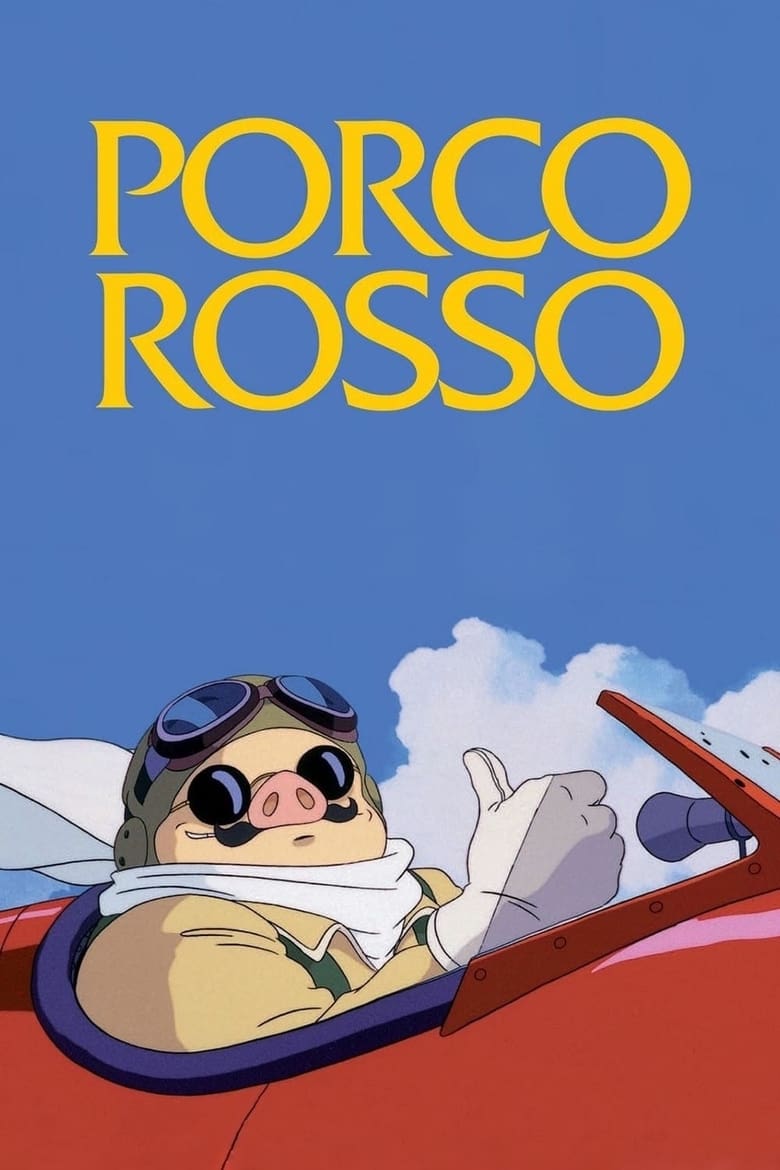
There is a telling moment in the production history of Porco Rosso that says a great deal about the film's particular flavour: Hayao Miyazaki has described it as a film for tired, middle-aged men. Not a ringing commercial pitch, perhaps, but an honest one. Released in Japan in the summer of 1992 by Studio Ghibli, the film is set along the sun-bleached coastline of the interwar Adriatic, a world of flying boats, seaplane pirates, and languorous evenings on hotel terraces. It is Miyazaki in an unusually personal, indulgent register, reaching for nostalgia rather than the epic sweep of something like Nausicaä of the Valley of the Wind or the domestic warmth of My Neighbor Totoro. The premise is disarmingly odd: a former World War One Italian flying ace, cursed by some unexplained wartime event into the form of a pig, now works as a freelance bounty hunter, battling the biplaned brigands who prey on passenger liners. He is called Porco Rosso, literally "red pig", and he is one of the more quietly melancholy protagonists in the entire Ghibli catalogue.
Miyazaki wrote the screenplay himself, adapting it from his own manga serial Hikôtei Jidai ("The Age of the Flying Boat"), which had run in a Japanese model enthusiast magazine. That origin matters: this is a film steeped in the mechanics and romance of vintage aviation, in the particular pleasure of a perfectly drawn aeroplane banking into a Mediterranean sky. The production brought together Ghibli's regular collaborators and a consortium of backers including Nippon Television, Japan Airlines, and Tokuma Shoten, with Japan Airlines having enough involvement that the finished film was for a period shown on long-haul flights, a fitting venue given the subject matter. The voice cast in the original Japanese includes Shûichirô Moriyama as the weary, sardonic Porco, Tokiko Kato as the cabaret singer and old flame Madame Gina, Akemi Okamura as the resourceful young mechanic Fio Piccolo, and the rakugo comedian Bunshi Katsura VI bringing a particular theatrical texture to one of the supporting roles. Rakugo is a centuries-old Japanese tradition of solo comic storytelling, and there is something fitting about that art form, built on timing and the deployment of character through voice alone, finding its way into a film so fond of performance and persona.
Visually the film is the work of cinematographer Atsushi Okui and the Ghibli animation team operating at a high level of craft. The palette is warm and almost painterly: pinks and ambers over still water, the hard blue of a cloudless sky interrupted by the white spray of a seaplane's hull. The aerial sequences in particular have a looseness and physical credibility that rewards attention, each machine feeling like it has actual weight and drag. The editing by Takeshi Seyama keeps the pace unhurried without becoming slack, at least in the film's stronger passages. Joe Hisaishi, who had already scored Castle in the Sky and Kiki's Delivery Service for Miyazaki by this point, provides a score that leans into jazz and Mediterranean folk, all accordion colour and brass warmth, sitting well with the period setting without feeling like pastiche. The musical collaboration between Miyazaki and Hisaishi was by 1992 already one of the more productive and consistent partnerships in world animation, and the score here shows that easy fluency.
I am a big fan of Studio Ghibli, but I had been actively avoiding Porco Rosso for years, with a nagging sense that it just would not be for me. Having finally sat down with it, I think my instincts were about right. It is lovely to look at, as they always are, but it never quite won me over.
Let me give it its due first. The charm, the talent, the artwork and the animation are all there in abundance, exactly as you would expect from this studio. Ghibli does what Ghibli does best, which is to make something beautiful, and on that front Porco Rosso does not disappoint for a second. Visually it is right up there with the rest of them.
The problem, for me, is that I simply did not care much about the story or the people in it. The premise is on the light side, and that turns out to be the whole film's undoing. It was only afterwards that I learned it had originally been conceived as a short, somewhere around forty minutes, before being stretched out to feature length. That explains an awful lot. You can feel the padding, the sense of a slender idea being asked to carry far more weight than it comfortably can, and the whole thing sags through the middle as a result.
At heart it is a wartime romance about a fighter ace who happens to be a pig, which is about as charmingly Ghibli a sentence as I can imagine writing, and in a tighter, shorter form I suspect I would have liked it a good deal more. As it stands, it is gorgeous and good-natured but slight, and for my money one of the weaker entries in the Ghibli canon, a long way from the heights of something like Spirited Away. Three stars. Beautiful, as they all are, but well short of the studio at its best.
Porco Rosso occupies a curious place in the Ghibli canon: made between two of the studio's most beloved films, admired by those who find its slower tempo and melancholy romance precisely what they needed, and quietly passed over by those who came expecting something with more structural heft. It is, by any measure, a film made with enormous skill and genuine affection for its setting and its strange, self-deprecating hero. Whether that affection is enough to carry ninety-three minutes is the real question it leaves you with. Some films are best appreciated when you meet them at the right moment, and this one, perhaps more than most, has a way of meaning different things depending on where you are in life when you finally sit down with it. A pig in a red seaplane at sunset is either exactly what you needed, or it isn't.
Rating: ★★★ | Year: 1992 | Watched: 2026-10-07
Trailer
▶ Watch the official trailer for Porco Rosso (1992) on YouTube
Where to watch
Watch in the UK
Stream: Netflix · Netflix Standard with Ads
Physical: Amazon UK · Zavvi
Watch in the US
Stream: HBO Max Amazon Channel · HBO Max
Rent: Amazon Video · Apple TV Store · Google Play Movies · YouTube
Buy: Amazon Video · Apple TV Store · Google Play Movies · YouTube
Physical: Amazon US
Affiliate disclosure: Movies With Macca may earn a small commission on purchases or subscriptions started via these links. It costs you nothing extra.