First Zone: In Conversation with Director Thom Lunshof
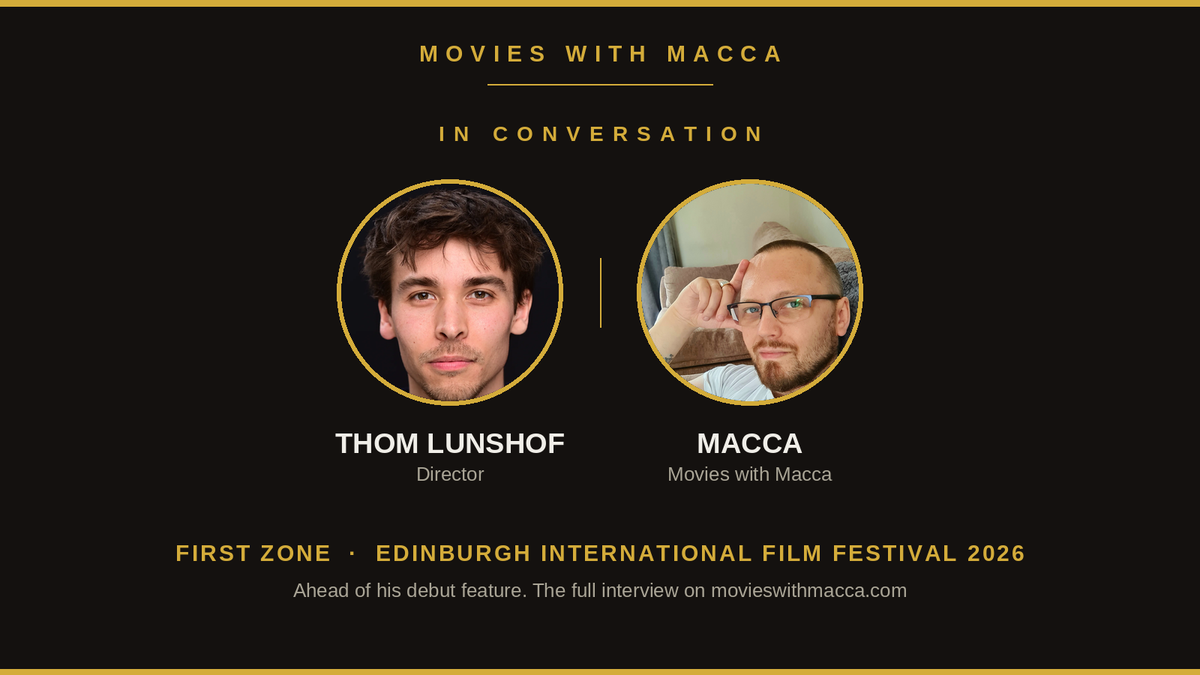
First Zone was one of the films I was most curious about at this year's Edinburgh International Film Festival, and it did not disappoint. Thom Lunshof's debut feature imagines the Netherlands almost entirely underwater, a drowned country crossed by boat by a lone woman in search of something to hold on to, and it marks the arrival of a real new voice. You can read my full review here.
I was lucky enough to put some questions to Thom about the film, from the Friesland childhood that shaped its flooded world, to the spare, country-inflected score, to that intriguing ending. His answers were every bit as thoughtful as the film itself, so I have kept them more or less in full below.
First Zone imagines the Netherlands almost entirely underwater. Where did that image come from, and how much was the film a response to real anxieties about climate and rising seas, particularly for a country that already lives with water the way Holland does?
I grew up in Friesland, the province with the most water in the Netherlands. Growing up there, you're very conscious of water, but you also enjoy it. As I got older, though, and kept returning to Friesland, I started to see the other side of that relationship, especially as climate change accelerated. A large part of the Netherlands lies below sea level, protected only by a system of dykes. I wanted to visualise, in as realistic a way as possible, what the future could look like if we carry on this way.
The film deliberately withholds a lot: we never learn exactly what caused the flood, what the different zones are, or how the world beyond them works. Was that a conscious decision, and what did you want an audience to focus on instead of the mechanics of the world?
I didn't want to make a disaster narrative with a lot of action or emphasis on everything that happened during the flooding. People already know about climate change and its consequences, and I don't think throwing big doom-scenario images at them is going to move that conversation forward. Instead, I wanted to focus on a smaller story, about someone seeking reconnection, roaming a flooded landscape that becomes a kind of backdrop onto which the audience can project their own idea of what happened. Ironically, conversations about climate change are often about the disappearance of nature. But in the end, nature will recover and reshape itself, much as it does in many scenes of the film. It's humans who'll fade away.
Almost the entire film takes place on water, shot on real Dutch locations. What were the biggest practical challenges of that, and did the logistics ever end up shaping the story itself?
To shoot in these remote locations, we worked with a very small crew and shot most scenes in natural light. It was still very hard to get to the right spots at the right time. For one scene on the mudflats, we had only five hours before the tide came in; we were essentially filming on the sea floor. The shooting days were rough on both cast and crew, but over time that also created an immersive experience for all of us. Everyone was half-swimming, constantly wet, ploughing through mud. In a way, we were making Fenna's journey alongside her. That was even more true for the actors, which I believe shaped their performances in a radical way.
Fenna carries a buried grief the film never spells out. How did you and Hadewych Minis build that interior life for her, and how much of it was written versus found on set?
I wrote a very long backstory for Fenna, tracing how she became the person she is at the beginning of the film. But early in the process, Hadewych and I chose to build her without a clear, articulated memory of her past. She became, and perhaps even survived, because she was able to forget and to bury things. A large part of her journey as a character is about the tension between remembering and looking away. So during shooting, it was a constant exploration of how much she was allowing that grief to surface, and what that would mean for her.
The structure is an odyssey. Fenna meets survivors and then moves on from them, one after another. What did you want that rhythm of connection and loss to say?
I wanted to use that travelling rhythm to provoke Fenna's harsh, resolute idea of what life should still mean. By constantly meeting people and moving on, she is increasingly challenged to reconsider that worldview and what lies at its root. For me, each encounter stirs a new side that she has locked away.
The soundtrack really stayed with me, those spare, mournful acoustic textures. How did you approach the music, and what were you looking for from it tonally?
From early on, I had this image of a lonely traveller wandering through an endless flooded landscape, almost like a western. I'm a big fan of early Bob Dylan and Townes Van Zandt, that bluesy, country-inflected music with a sombre but moving feel. Together with composer Nico Maas, we looked for a sound that carried those western influences while also giving depth to Fenna's emotional journey.
Shooting on real water and real locations gives the film a lived-in quality. Was there a deliberate resistance to visual effects or spectacle in favour of that realism?
I wanted the flooded world to feel as real as possible. Visual effects can take you very far these days, but I still believe that being in a real environment, letting the actors and crew actually feel, hear and smell everything, is more convincing in the end.
The film ends quite abruptly, on an open note. What were you hoping to leave the audience sitting with as the credits came?
I don't want to give away too much about the ending, but for me it felt like the right place to let Fenna sail on as a character, and to leave the audience behind, still dwelling on the story and beyond.
This is your first feature after a run of shorts. What was the hardest lesson in scaling up to something this ambitious, and what surprised you most?
My previous short films involved harsh shoots in difficult locations too, the last one in a remote desert. So in a way, I already had some training for this. But a feature is still quite different in terms of schedule, flexibility and time. At the same time, I also experienced a kind of narrative freedom: the chance to grow with the film, explore with the characters, and keep building the story during shooting.
First Zone premieres In Competition at Edinburgh, competing for the Sean Connery Prize. What does it mean to launch the film there, in front of an international festival audience?
I'm very honoured and proud that the film is premiering In Competition at Edinburgh. A lot of young, debuting filmmakers gave everything they had to make this film happen. But most importantly, I'm glad it will reach a broad audience, especially at a time when climate change seems to be pushed aside more and more often.
Finally, what's next for you, and is there more of this world, or these questions, you want to keep exploring?
I'm currently writing my next feature film, which is well underway. I'm not at liberty to say much about it yet, but I can say it is indeed exploring a world again, though a completely different one this time.
First Zone had its world premiere In Competition at the Edinburgh International Film Festival, where it screened from 16 August 2026. My thanks to Thom Lunshof for his time, and to Christian at Hype Park. You can read my review of First Zone here.