Kizumonogatari Part 3: Reiketsu (2017)
★★ — Kizumonogatari Part 3: Reiketsu (2017)

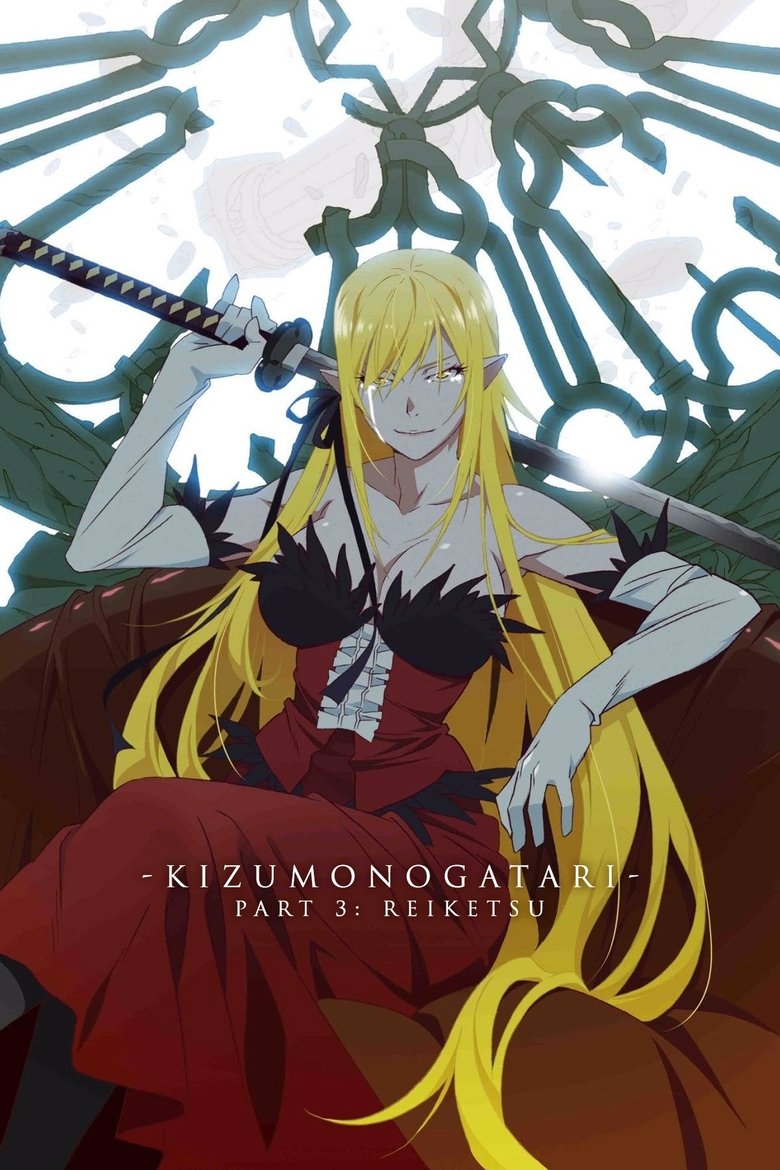
There's a particular kind of frustration that comes from watching something genuinely, undeniably beautiful and feeling almost nothing. That's where Kizumonogatari Part 3: Reiketsu left me. Gorgeous frame after gorgeous frame, Shaft Studio pulling out every trick in their considerable arsenal, and me sitting there waiting to feel something that never quite arrived.
The animation itself is extraordinary, I'll give it that without hesitation. Fluid swordplay rendered in stark monochrome slashed through with crimson, surreal dreamscapes that feel genuinely hallucinatory, and that signature Monogatari talent for turning dialogue into visual metaphor. On a purely technical level, this is a studio operating at the top of its game. But here's the thing about technique: it has to be in service of something. And by the time Reiketsu rolls around as the trilogy's supposed climax, I was increasingly convinced the style was covering for a story that had run out of things to actually say.
The pacing, already languid in the second part, grinds here into something closer to abstraction. Endless philosophical monologues, circular debates about vampire ontology, debates about the debates. There's a version of this that works, where the repetition and the circling feel purposeful and hypnotic. Reiketsu never quite gets there. Instead it mistakes opacity for depth, confusing the sensation of being slightly lost with the experience of being genuinely challenged.
The finale is where this really stings. Araragi's ultimate choice, which should land as the emotional centre of the entire trilogy, thuds rather than resonates. And I think I know why: the emotional stakes were never properly established in the first place. Kiss-shot, who ought to be a compelling and complicated figure at the heart of all this, remains an enigma wrapped in exposition. We're told she matters. We're shown she's visually striking. But we're never truly made to feel it, and that's a fundamental storytelling failure that no amount of beautiful imagery can paper over.
I went back and looked at my thoughts on Kizumonogatari Part 1: Tekketsu, where a lot of this felt fresh and genuinely exciting. The visual language was inventive, the strangeness had energy to it. By the third part, the novelty has thoroughly worn off, and you're left with the hollow echo of a story that was perhaps always more interested in being admired than in being felt. Watching all three consecutively shouldn't be a chore. Reiketsu made it one.
There will be Monogatari devotees who find deep satisfaction here, and I don't want to entirely dismiss that. If you're already invested in this universe, already fluent in its rhythms and its references, perhaps the symbolic resolution lands differently. Perhaps the circularity feels earned rather than exhausting. I can only speak to my own experience, and my experience was of a film that kept me at arm's length for its entire runtime.
For comparison, when I watched Mononoke the Movie: The Phantom in the Rain (2024), another stylistically bold piece of Japanese animation, I found the ambition and the emotion pulling in the same direction rather than against each other. Reiketsu never manages that alignment.
Two stars. Technically accomplished, emotionally inert. Beauty without engagement is just decoration, and decoration alone isn't enough to carry a trilogy home. The high praise this series attracts remains, to me, a mystery it never got around to solving.
Rating: ★★ | Year: 2017 | Watched: 2026-04-02
Where to watch
Watch in the US
Rent: Amazon Video
Buy: Amazon Video
Physical: Amazon US
Affiliate disclosure: Movies With Macca may earn a small commission on purchases or subscriptions started via these links. It costs you nothing extra.
Related on Movies With Macca
More from Tatsuya Oishi: Kizumonogatari Part 2: Nekketsu (2016) · Kizumonogatari Part 1: Tekketsu (2016)
More with Hiroshi Kamiya: Mononoke the Movie: The Phantom in the Rain (2024) · Mononoke the Movie: Chapter II - The Ashes of Rage (2025) · Kizumonogatari Part 2: Nekketsu (2016) · Kizumonogatari Part 1: Tekketsu (2016)
More from Japan: Mononoke the Movie: The Phantom in the Rain (2024) · Mononoke the Movie: Chapter II - The Ashes of Rage (2025) · Blue (1993) · The Ghost of Yotsuya (1959)
More from the 2010s: Wonder (2017) · Beautiful Boy (2018) · The Witch (2015) · What We Do in the Shadows (2014)
More animation: Fantastic Planet (1973) · Alice in Wonderland (1951) · Mononoke the Movie: The Phantom in the Rain (2024) · Mononoke the Movie: Chapter II - The Ashes of Rage (2025)
More fantasy: Viy (1967) · Alice in Wonderland (1951) · Mononoke the Movie: The Phantom in the Rain (2024) · Mononoke the Movie: Chapter II - The Ashes of Rage (2025)