High Noon (1952)
★★★½ — High Noon (1952)

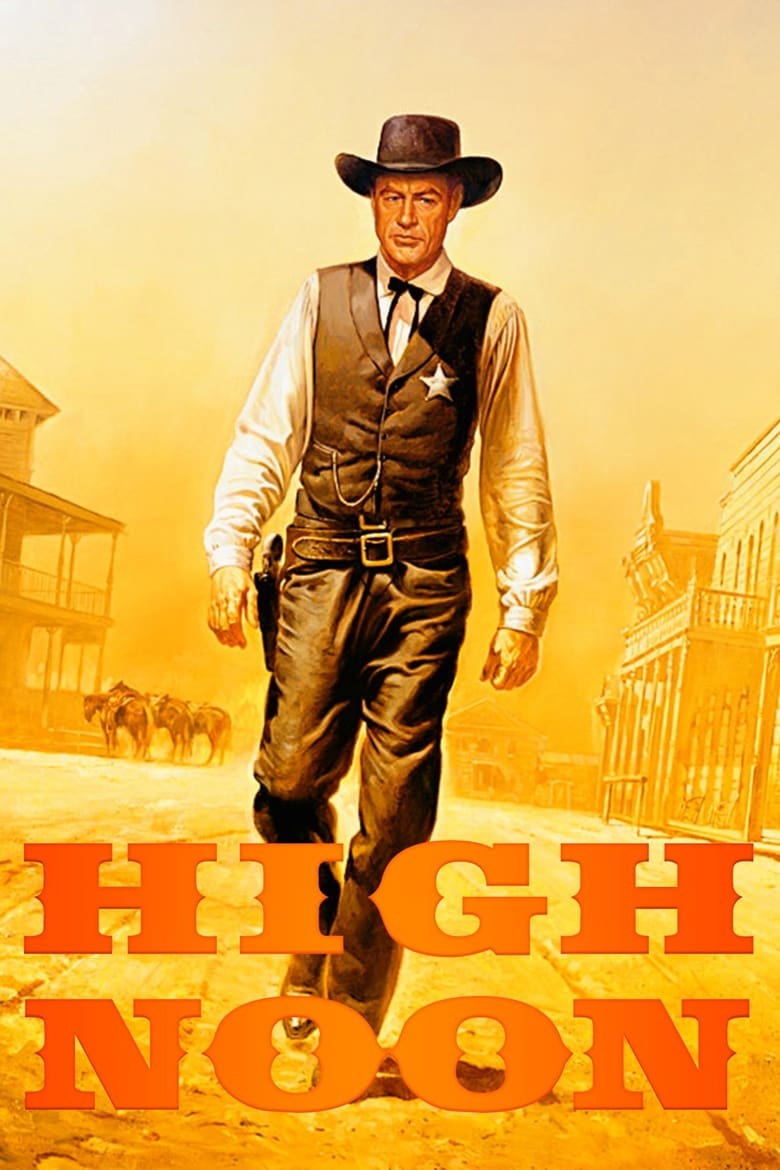
There's a moment in High Noon where Gary Cooper walks down the middle of an empty street, hat in hand, going door to door asking for help, and every door closes in his face. No music swells. No dramatic speech follows. He just keeps walking. That image, quiet and devastating, tells you everything you need to know about what kind of Western this is and what it's really about.
Cooper's Will Kane is a town marshal on his wedding day. A killer he put away is arriving on the noon train, and the men riding with him are already waiting at the station. All Kane has to do is ride out of town with his new wife and let it be somebody else's problem. He almost does. Then he turns back. What follows isn't an action film, not really. It's a sustained portrait of a man watching his community dissolve around him in real time, one refusal, one excuse, one averted gaze at a time.
The film runs close to its story's actual duration, which is a bold structural choice that pays off completely. Every scene with a clock on the wall carries weight. Every conversation that ends without a commitment to stand beside Kane tightens the screw a little further. It's slow by the standards of the genre, more dialogue than gunplay, more moral debate than bravado, but that restraint is the whole point. Heroism here isn't loud or triumphant. It's grim and lonely and costs something.
Grace Kelly is excellent as Amy, Kane's Quaker wife, a woman of genuine principle who is not simply an obstacle or a prop. Her opposition to violence is sincere and earned, which makes her arc through the film genuinely interesting rather than frustrating. The tension between her beliefs and her love for Kane gives the film its emotional backbone, and Kelly carries it with quiet authority. It's a strong performance in a role that could easily have been underwritten.
The black-and-white photography is sharp and spare, all dust and shadow and open space used not for grandeur but for isolation. The score, built around that recurring title song, keeps time like a drumbeat under everything. None of it is showing off. Every technical choice is in service of the same idea: a man alone, the clock running, the world looking the other way.
It's worth saying that this isn't a film without its critics, and I understand the argument that it wears its allegory a little too plainly on its sleeve. If you know the context in which it was made, it can feel less like a Western and more like a pointed commentary dressed in frontier clothes. Personally, I think that reading adds to it rather than diminishes it, but I can see why some find the moral positioning a touch too tidy. Kane is almost saintly in his steadfastness, and the townspeople are almost uniformly cowardly. There's not a great deal of grey.
I've written about other Westerns from this era, including Rio Bravo (1959), which Howard Hawks made partly as a direct response to High Noon, arguing that a real lawman wouldn't go begging for help. It's a fascinating contrast, two genuinely great films in direct conversation with each other, and I'd strongly recommend watching them as a pair. And if you want another early fifties film grappling with moral cowardice and communal failure, Invasion of the Body Snatchers (1956) scratches a surprisingly similar itch, just with rather more pods involved.
As for that final showdown, yes, it delivers. Not through scale or spectacle, but because you've earned it, sitting through every agonising minute of build-up, every slammed door, every clock face. When it comes, the relief is enormous and the aftermath is even better. Kane's last gesture before riding out of town is one of the great mic-drop endings in American cinema.
Three and a half stars. Revered for good reason. Not the flashiest Western ever made, not the most morally complicated, but deeply, stubbornly human. A film about what integrity actually costs when nobody's watching and nobody cares.
Rating: ★★★½ | Year: 1952 | Watched: 2025-09-25
Where to watch
Watch in the UK
Rent: Apple TV Store · Rakuten TV · Amazon Video · Google Play Movies
Buy: Apple TV Store · Rakuten TV · Amazon Video · Google Play Movies
Physical: Amazon UK · Zavvi
Watch in the US
Rent: Amazon Video · Apple TV Store · Google Play Movies · YouTube
Buy: Amazon Video · Apple TV Store · Google Play Movies · YouTube
Physical: Amazon US
Affiliate disclosure: Movies With Macca may earn a small commission on purchases or subscriptions started via these links. It costs you nothing extra.
Related on Movies With Macca
More from the 1950s: Invasion of the Body Snatchers (1956) · Alice in Wonderland (1951) · Letter from Siberia (1957) · Invaders from Mars (1953)
More western: The Ox-Bow Incident (1943) · Rio Bravo (1959) · Ride Lonesome (1959) · The Great Train Robbery (1903)
More drama: Viy (1967) · Wonder (2017) · A Better Tomorrow (1986) · Beautiful Boy (2018)