Monsieur Hulot's Holiday (1953)

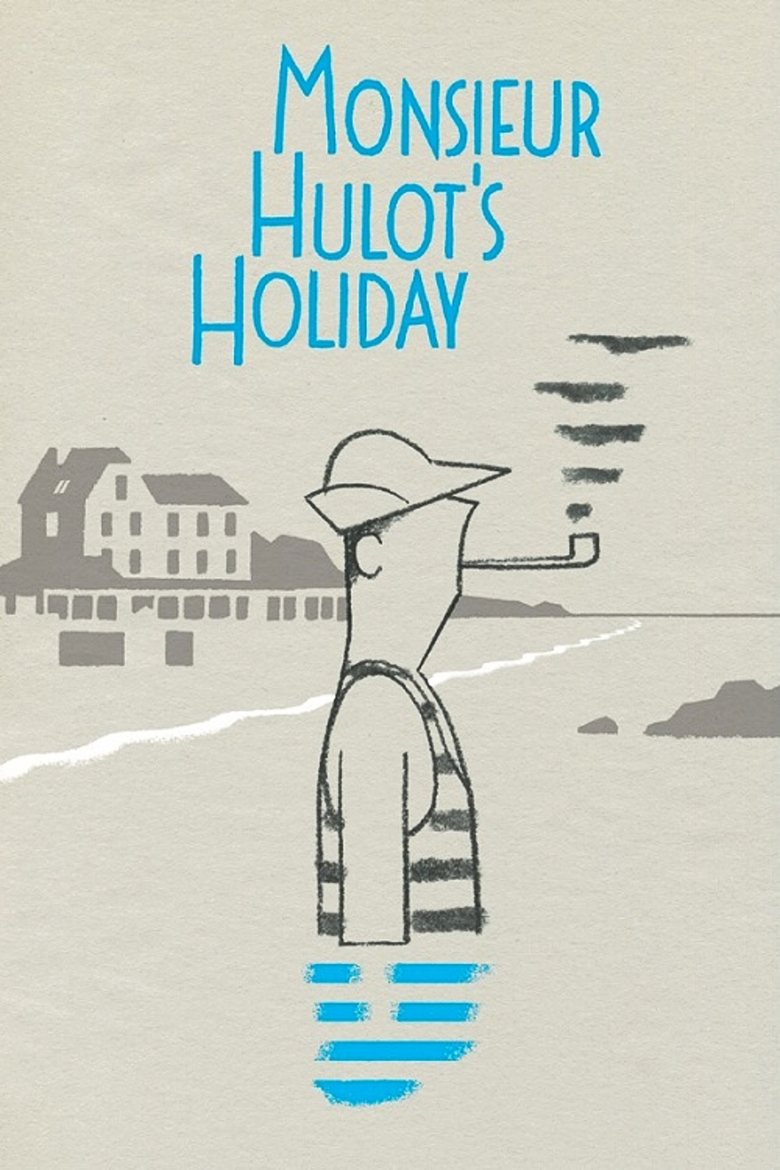
There are films that arrive quietly and reshape everything around them. Jacques Tati's Monsieur Hulot's Holiday, released in France in 1953 and picked up for international distribution shortly after, is one of those. It came out at a peculiar moment for European comedy: the great silent clowns had ceded ground to dialogue-heavy Hollywood pictures, and physical comedy was in something of a holding pattern. Tati, who had honed his craft in music hall and short films before graduating to features, offered something that felt both old-fashioned and genuinely fresh, a comedy that trusted the image over the word, that let its gags breathe at their own unhurried pace. The film earned Tati an Academy Award nomination for Best Original Screenplay (shared with co-writers Henri Marquet and Pierre Aubert), a remarkable distinction for a French comedy built almost entirely around what people do rather than what they say. It was, by any measure, the film that made Tati's name outside France.
The production was a modest one, shot on location at the real seaside resort of Saint-Marc-sur-Mer in the Loire-Atlantique, a choice that gives the film an easy, documentary-adjacent quality that studio shooting could never have replicated. Tati co-wrote the script with Marquet and Aubert, though calling it a script in any conventional sense is perhaps generous: the film is less a plotted narrative than an architecture of moments, designed to let the character of Hulot, played by Tati himself, bump gently against the world. The supporting cast includes Nathalie Pascaud, Louis Pérault, Micheline Rolla, and Valentine Camax, playing the assorted holidaymakers and locals who orbit Hulot without ever quite being able to account for him. None of them are required to do much beyond react, but that reaction, the perpetual bafflement of ordinary people confronted with Hulot's particular brand of benign disruption, is very much the engine of the comedy.
Cinematographers Jean Mousselle and Jacques Mercanton shoot the resort in a way that feels relaxed and observational, wide enough in frame to let sight gags play out in full rather than cutting around them, sun-bleached and a little hazy in the manner of a genuine French summer. It is the kind of photography that does not announce itself, which is precisely the point: the film wants you watching Hulot, not the camera. Alain Romans provides the score, and it is a light, jaunty thing, brass-led and slightly bouncy, the sort of music that sits just on the right side of the line between cheerful and grating. Editors Charles Bretoneiche and Suzanne Baron (Suzanne Baron would go on to edit Tati's Mon Oncle and Playtime, making her a key figure in his creative world) cut the film loosely, allowing individual gags their full duration rather than punching in and out for emphasis. The rhythm is deliberate, and whether that rhythm works for you is likely to be a fairly reliable guide to how you will feel about the whole enterprise. For a companion piece from the same year and a similar European mood, see also Journey to Italy (1954), which shares that postwar continental texture even as it operates in an entirely different register. I also covered The Crime of Monsieur Lange (1936), a useful earlier reference point for French cinema's particular gift for finding the comic and the melancholy occupying the same frame.
Monsieur Hulot's Holiday sits at an interesting point in the lineage of screen comedy. To me it plays like an evolution of Buster Keaton and Laurel and Hardy, that same tradition of gentle, largely wordless physical comedy, carried forward a few decades. You can also, I think, draw a clear line from it to Mr Bean; there is exactly that energy here, the hapless, well-meaning man leaving quiet chaos in his wake, and the fact that a film called Mr Bean's Holiday exists only underlines the debt.
My biggest problem is that there is no story to speak of. It is less a film than a loose collection of ideas and gags strung together, set at a seaside resort and held together by not much more than that setting and the man at the centre of it. Hulot himself is, at least, not an irritating presence, which is something; but nor did he give me much reason to care what happened to him. Without a story to pull me along, I found my interest steadily drifting.
There are some good set pieces dotted through it, the odd sight gag that lands beautifully, and you can see the craft and the precision in how they are built. But for every one that works, there is another that simply does not, and the hit rate was not quite high enough to carry a film this loosely assembled. Two and a half stars. Charming and influential, clearly, and I can see its fingerprints on the comedy that came after it, but too plotless and uneven to win me over.
Monsieur Hulot's Holiday holds a complicated place in the canon: revered by critics, beloved by filmmakers (its influence on everyone from Rowan Atkinson to Jacques Rozier has been traced and re-traced), and yet not always an easy sit for modern audiences approaching it without a prior attachment to Tati's sensibility. Its reputation as a masterwork is secure enough that a middling reaction feels almost like a category error, as if the problem must lie with the viewer. But honest engagement with films means allowing that influence and enjoyment are not the same thing, and that a film can be both historically significant and, for a particular viewer, a touch too shapeless to land. If you have found yourself similarly unmoved by celebrated minimalist comedy, my thoughts on The Assassin (2015) and Marty (1955) touch on that same question of whether a film's reputation and your own experience of it ever quite meet in the middle. Monsieur Hulot's Holiday is polished but unhurried, gentle but occasionally inert: a film that many people have loved, and that quietly declines to explain itself to those who haven't.
Rating: ★★½ | Year: 1953 | Watched: 2026-10-22
Trailer
▶ Watch the official trailer for Monsieur Hulot's Holiday (1953) on YouTube
Where to watch
Watch in the UK
Stream: Studiocanal Presents Amazon Channel
Rent: Apple TV Store · Amazon Video
Buy: Apple TV Store · Amazon Video
Physical: Amazon UK · Zavvi
Watch in the US
Stream: HBO Max Amazon Channel · Criterion Channel · HBO Max
Rent: Amazon Video · Apple TV Store · Fandango At Home
Buy: Amazon Video · Apple TV Store · Fandango At Home
Physical: Amazon US
Affiliate disclosure: Movies With Macca may earn a small commission on purchases or subscriptions started via these links. It costs you nothing extra.