The Crime of Monsieur Lange (1936)

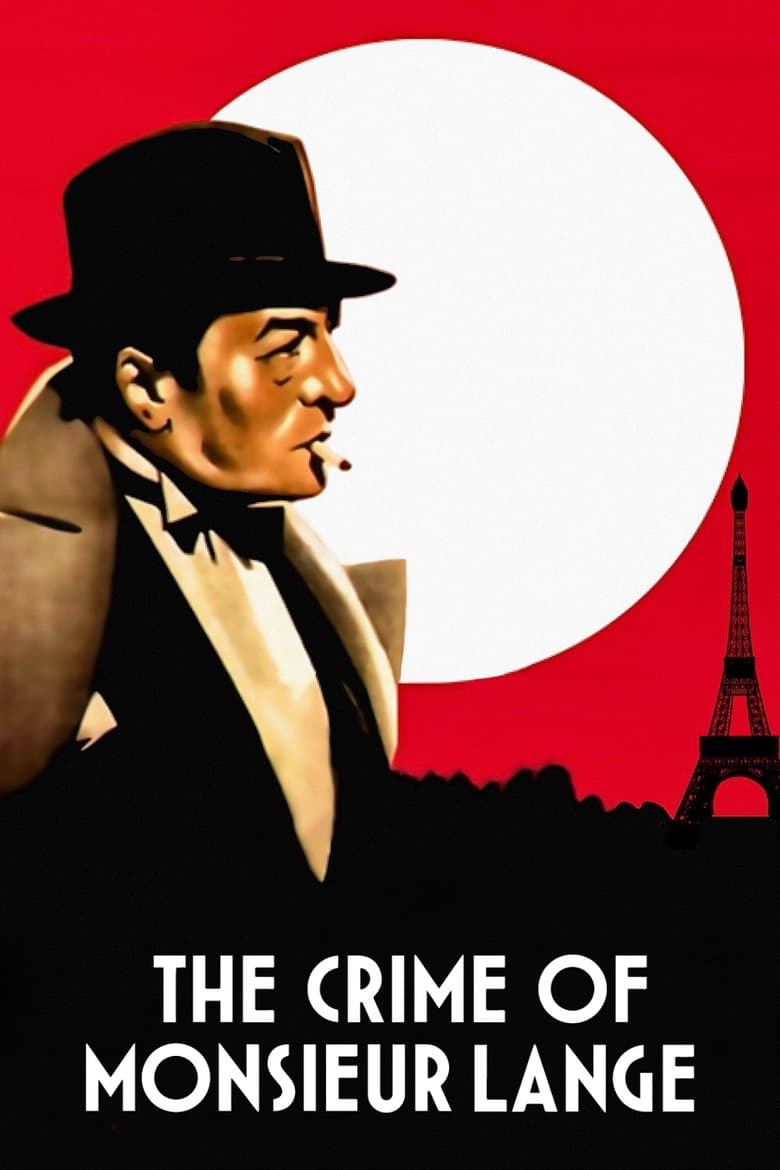
Jean Renoir made The Crime of Monsieur Lange in 1936, at a moment when French political life was crackling with tension. The Popular Front coalition was in the process of coming together, and the idea of workers' cooperatives as an alternative to exploitative ownership was not an abstract thought experiment but a live topic in Parisian cafes, newspapers and union halls. The film sits squarely inside that climate. Written by Renoir alongside Jean Castanier, it tells the story of Amédée Lange, a mild, daydreaming writer of pulp Westerns who finds himself, along with the rest of the staff at a small publishing house, suddenly free of their grasping boss Batala when the man vanishes in circumstances that suit everyone rather well. The cooperative they build in his absence becomes the film's central image, a courtyard community that produces, organises and thrives. When Batala reappears to reclaim what he regards as rightfully his, the film tilts toward its title's promise. For British and Irish audiences coming to classic French cinema, this sits in a similar neighbourhood to the poetic realism of Marcel Carné, though Renoir's register here is lighter, more comedic and more openly political than anything Carné was making at the same time.
Renoir by 1936 had already made Boudu Saved from Drowning and Toni, and was building what would become one of the most admired bodies of work in European cinema, culminating two years later in La Grande Illusion and La Règle du Jeu. The Crime of Monsieur Lange belongs to the earlier, scrappier phase, produced by Films Obéron on what was evidently a modest budget, with the courtyard of a Parisian apartment block doing a great deal of atmospheric work. René Lefèvre plays Lange himself, a performance built around a kind of absent-minded goodness, and Jules Berry brings considerable energy to Batala, the charming, self-serving publisher whose villainy never quite hardens into genuine menace. Florelle appears as Valentine, the laundress whose practical intelligence anchors the cooperative's human drama. Marcel Lévesque and Odette Talazac round out the ensemble, which has the feel of a company rather than a star vehicle, very much in keeping with the cooperative theme the film is exploring.
Cinematographer Jean Bachelet shoots the courtyard sequences with a particular attentiveness to the shared space: the way characters cross through each other's sightlines, the layering of doors and windows and balconies that gives the setting a sense of collective life rather than individual isolation. It is a polished but unremarkable visual approach that serves the material without calling attention to itself. The score, provided by Joseph Kosma and Jean Wiener, keeps things light and Parisian in texture, the kind of music that sits somewhere between a street song and a stage revue. Editors Marthe Huguet and Marguerite Renoir cut the film at what feels like a deliberate, unhurried pace, a choice clearly meant to let the community rhythms breathe, though how well that serves the overall experience is a question worth asking. I also reviewed A Day in the Country, another Renoir project from roughly the same period, which makes for an interesting companion piece when thinking about how his sensibility developed. And for a sense of what else 1936 was producing on the other side of the Atlantic, see also My Man Godfrey, a film wrestling in its own way with class, money and who deserves what.
I came away from The Crime of Monsieur Lange feeling distinctly underwhelmed.
It is an early Jean Renoir, set largely around a Parisian courtyard and a publishing firm, where a put-upon group of workers end up running the business as a cooperative after their exploitative boss disappears. There is a decent idea buried in there somewhere, but I found the whole thing surprisingly basic, and it moved at a crawl.
My main trouble was that it is so very on the nose. Every point it wants to make, it makes plainly and then makes again, with none of the subtlety or surprise that might have drawn me in. The pacing does it no favours either, slow enough that I felt my attention wandering, and the story never quite develops into something I cared about on its own terms. It stays an idea rather than becoming a drama I could invest in.
What it mostly amounts to, for me, is a commentary, on politics, on class, on exploitation and the dignity of labour, rather than a story that earns those themes through its characters. I can see what Renoir was reaching for, and I have no doubt it spoke powerfully to its moment, the France of the mid-thirties. Watched cold today, though, it felt more like a message than a film, and that is not quite enough to carry it. Two and a half stars. Well-meaning and clearly heartfelt, but slight, and something of a slog.
The Crime of Monsieur Lange is one of those films that film historians value considerably more than general audiences tend to when they actually sit down with it. Its place in Renoir's filmography is secure, and the scholarship around its Popular Front politics is genuinely interesting reading. Whether that context translates into a satisfying viewing experience in 2024 is a different matter, and the gap between a film's historical importance and its immediate dramatic life is one that comes up more often than critics sometimes like to admit. I wrote about a broadly similar tension when covering The Tale of the Fox, another film from this corner of 1930s European cinema where reputation and experience do not always shake hands. Some films are best understood as documents. Whether that is enough to make them worth your evening is the question only you can answer, but it is worth going in with your eyes open rather than your expectations primed by the history books.
Rating: ★★½ | Year: 1936 | Watched: 2026-10-04
Trailer
▶ Watch the official trailer for The Crime of Monsieur Lange (1936) on YouTube
Where to watch
Watch in the UK
Stream: Studiocanal Presents Amazon Channel
Rent: Apple TV Store · Amazon Video · Sky Store · YouTube
Buy: Apple TV Store · Amazon Video · Sky Store · YouTube
Physical: Amazon UK · Zavvi
Watch in the US
Physical: Amazon US
Affiliate disclosure: Movies With Macca may earn a small commission on purchases or subscriptions started via these links. It costs you nothing extra.