Marty (1955)

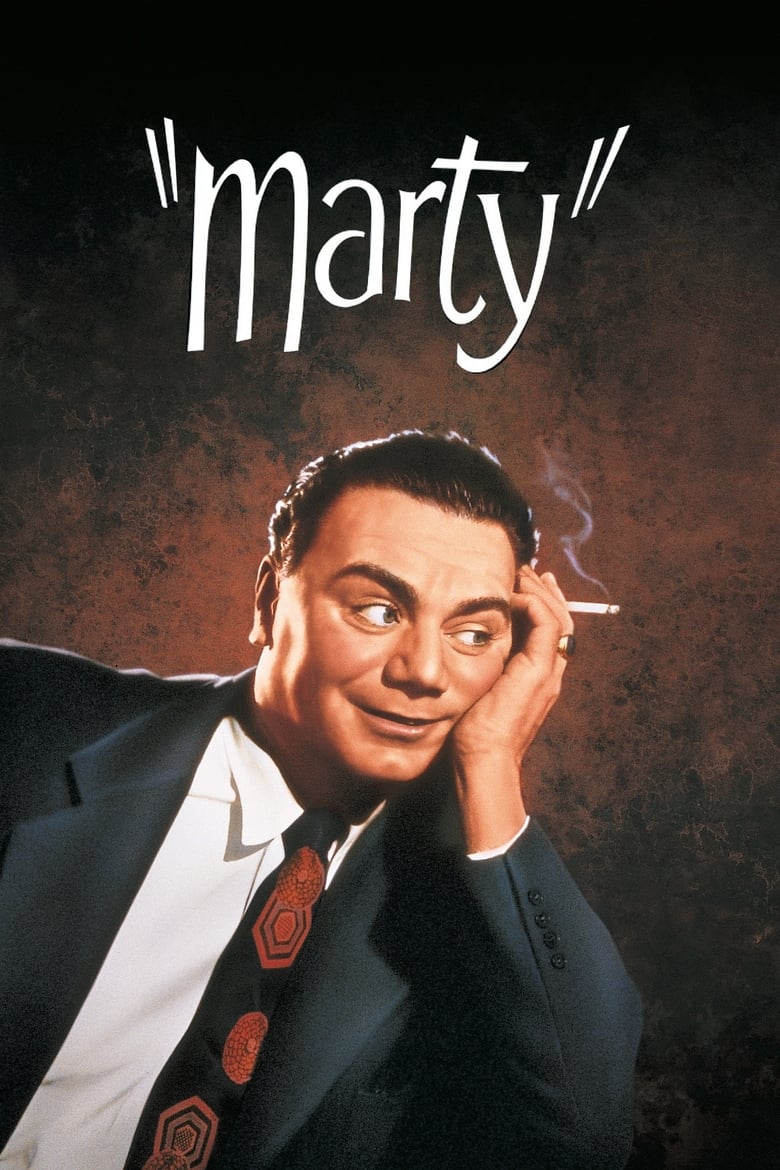
There is a particular kind of American film that Hollywood occasionally stumbled into during the 1950s, almost by accident: modest in budget, intimate in scale, and completely unconcerned with spectacle. Marty (1955) is the purest example of the type. Produced by Hecht-Lancaster Productions, the independent outfit that Harold Hecht and Burt Lancaster had built partly as a vehicle for exactly this sort of left-field project, the film began life as a 1953 television play broadcast on NBC's Philco Television Playhouse. Paddy Chayefsky wrote both versions, and the expansion from small screen to cinema is almost imperceptible in terms of ambition or canvas, which is itself a kind of achievement. The story is simple: Marty Piletti, a 34-year-old butcher from the Bronx, unmarried and resigned to staying that way, meets a schoolteacher named Clara at a Saturday-night dance. What follows is less a plot than a series of conversations, hesitations, and small pressures applied by the people around them. The Bronx setting is not incidental. Chayefsky was writing about a specific world, the working-class Italian-American neighbourhoods of post-war New York, and the film carries that specificity in every scene.
Delbert Mann directed, having also helmed the original television production, which gives the film an unusual coherence between source and adaptation. Mann was a television man first, trained in the medium's preference for close quarters and close faces, and he brought those instincts directly to the cinema version. Joseph LaShelle, the cinematographer, shoots the film in a manner that suits that approach: the images are clean and unshowy, preferring the faces of the characters to any broader visual statement. There is a texture to the black-and-white photography that feels genuinely urban, catching the particular drabness of a Bronx Saturday night without making a point of it. Roy Webb's score, spare and kept largely at the edges of the film, resists the temptation to underline emotion that the performances and the writing are doing perfectly well on their own. The music arrives gently, holds back, and departs without making itself the story. For a film this quiet, that kind of discipline in the score is not a small thing.
Ernest Borgnine was, at the time, not an obvious candidate for the kind of role that wins awards. He had built a career playing heavies, most memorably the sadistic Fatso in From Here to Eternity (1953), and casting him as Marty required a producer and director willing to trust that audiences could see something different in him. They could. Betsy Blair plays Clara, and she brings to the role a watchfulness and a fragile self-possession that makes the chemistry between the two characters feel earned rather than arranged. Esther Minciotti as Marty's mother and Augusta Ciolli as his Aunt Catherine provide two versions of the same social pressure, each convinced they are acting out of love, and Joe Mantell as Angie, Marty's aimless best friend, is the film's wry embodiment of a man who has given up without quite knowing it. For a companion piece from the same era, I also covered Rebel Without a Cause, another 1955 film preoccupied with loneliness and social expectation, and the two make an interesting pair: one operatic and colour-saturated, the other barely raising its voice. See also my review of The Defiant Ones for more of the decade's socially conscious drama in a similarly stripped-back register.
Not a great deal happens in Marty, and that turns out to be the whole point.
It is a small, tender story about a 34-year-old Bronx butcher, unmarried, shy, and worn down by everyone forever asking why he has not found himself a girl, who one evening meets a schoolteacher every bit as lonely as he is. That is more or less the film, and I was completely won over.
Part of it, I will admit, is a weakness I have for films of this vintage. Something in the way people talk in a 1950s picture, the rhythms, the clothes, the whole texture of it, holds my attention even when not much is happening, and I have never quite been able to explain why. If this was a modern film, I doubt I'd have given it as much praise.
But Marty is far more than period charm. Ernest Borgnine, in the role that won him an Oscar, is wonderful as a decent, defeated man slowly allowing himself to hope again, and Paddy Chayefsky's screenplay finds so much feeling in the smallest of exchanges.
What lands hardest is how kindly it treats its two lonely souls. It never mocks them or tidies them up; it simply lets them be ordinary and entirely worth caring about, which is far rarer than it sounds. It also happens to be one of only a handful of films ever to win both the Palme d'Or and Best Picture, and watching it you can see how the modest, humane ones sometimes go the distance. Four stars, a warm-hearted charmer that reached me far more than its small surface ever promised.
Marty remains, almost seventy years on, a polished but unremarkable-looking film that turns out to contain something rather remarkable inside it. Its double triumph at Cannes and the Academy Awards, the Palme d'Or and Best Picture in the same year, places it in genuinely rare company, and yet it has never quite acquired the cultural weight of other Best Picture winners from the period. Perhaps that is because there is nothing to argue about in it, no formal innovation, no controversy, no grand theme to decode. What Chayefsky and Mann made was simply a film about two people who deserved more than life had given them, treated with care and without condescension. I also looked at The Assistant, a much later film that shares something of Marty's interest in the quiet accumulation of ordinary disappointment, and the comparison is instructive. Some stories don't need much room. They just need to be told honestly, and then left alone to do their work.
Rating: ★★★★ | Year: 1955 | Watched: 2026-09-16
Trailer
▶ Watch the official trailer for Marty (1955) on YouTube
Where to watch
Watch in the UK
Rent: Apple TV Store · Amazon Video · Google Play Movies · Sky Store
Buy: Apple TV Store · Amazon Video · Google Play Movies · Sky Store
Physical: Amazon UK · Zavvi
Watch in the US
Rent: Amazon Video · Apple TV Store · Google Play Movies · YouTube
Buy: Amazon Video · Apple TV Store · Google Play Movies · YouTube
Physical: Amazon US
Affiliate disclosure: Movies With Macca may earn a small commission on purchases or subscriptions started via these links. It costs you nothing extra.