
Inside Out (2015)
★★★★★ — Inside Out (2015)

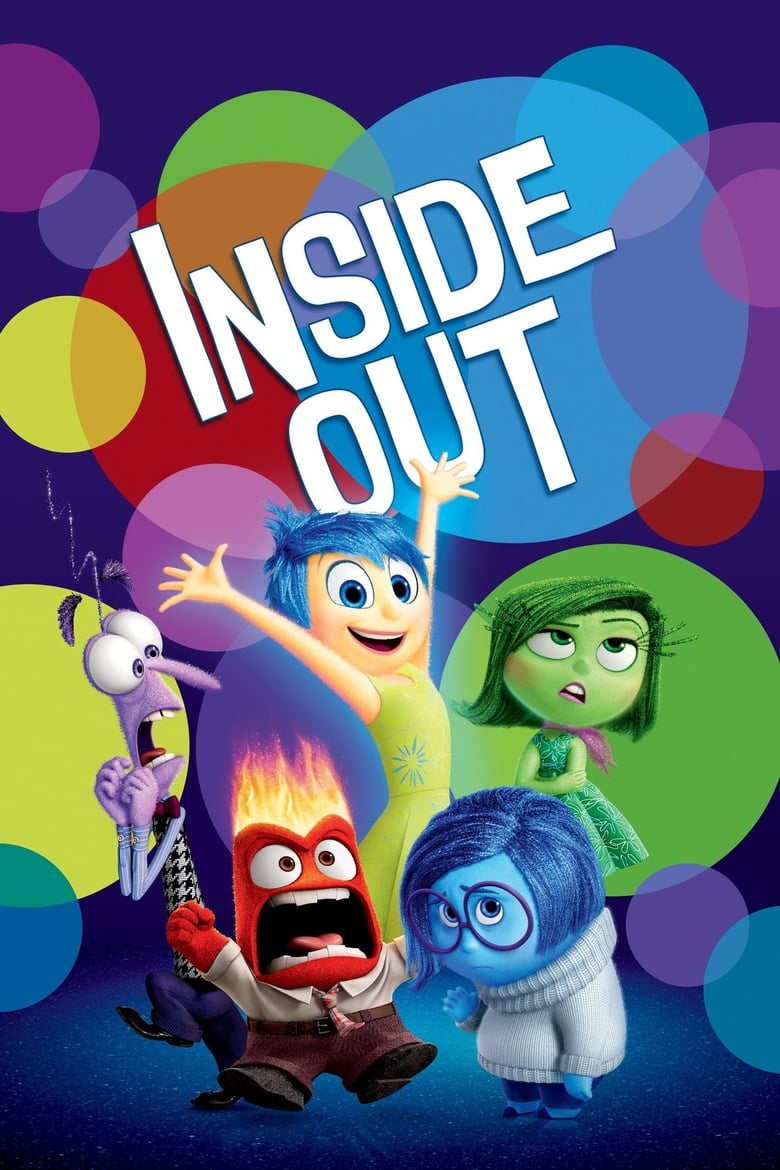
I'm going to say it plainly: Inside Out is the greatest kids' film ever made. Not one of the greatest. The greatest. And while I'm at it, it belongs in the conversation for one of the greatest films of any kind, full stop.
On the surface, what you've got is a beautifully animated, wildly imaginative adventure about a young girl uprooting her life and moving to a new city. Change, loss, growing pains. The kind of story that's been told a thousand times. But what Pete Docter and his team have done here is something I genuinely didn't think a mainstream animated film was capable of: they've built a story that works on the surface level for children, and then buried something profound underneath it for everyone else. And I don't mean the usual winking adult jokes. I mean something real.
I'm a psychotherapist. I work with people every day who are trying to make sense of their own emotional lives. And I'm still, nearly a decade on, blown away by how elegantly and accurately this film captures complex psychological concepts. Core memories. Identity formation. Emotional regulation. The way our sense of self shifts and cracks during periods of transition. These aren't throwaway ideas dressed up in bright colours. They're handled with a rigour and a sensitivity that most textbooks don't manage. And the film does it all while being genuinely funny and completely gripping for a six-year-old. That's not an accident. That's craft of the highest order.
Joy, Sadness, Anger, Fear and Disgust aren't just comic relief or visual shorthand. They're deeply symbolic of how our inner worlds actually operate, the competing voices, the shifting hierarchies, the moments when one emotion has to step aside and let another take the wheel. And the moment this film chooses to let Sadness lead is the moment it stops being a great animated feature and becomes something genuinely profound. It's a quiet, radical act of storytelling: telling children, and the adults watching with them, that sadness isn't something to be managed or suppressed or rushed through. It's something to be felt. To be shared. And that sharing is how we heal.
I've watched this with my daughter more times than I can count, and every single time it hits differently. Where I am in life changes what the film is about, which is something I'd usually only say about a novel I've returned to over the years. Sometimes I laugh. Sometimes I cry. And sometimes I just sit quietly when it finishes, not quite ready to talk yet. That's a rare thing.
What strikes me most is the complete absence of cynicism. There are no cheap jokes lobbed over the kids' heads at the parents. No winking irony to keep adults at a comfortable distance from the emotion. It trusts its audience, all of its audience, to feel deeply. Pixar have managed this before, Up being the obvious example, but Inside Out sustains it for its entire runtime in a way that still astonishes me. And if you want to see how the team approached the next chapter for these characters, I've written about Inside Out 2 (2024) too, though nothing quite recaptures the lightning-in-a-bottle quality of the original.
It's emotionally intelligent and emotionally devastating, and it somehow remains completely appropriate for children. That's an almost impossible balance to strike, and this film makes it look effortless. "Flawless" doesn't come close to covering it. Five stars, and I'd give it six if I could.
Rating: ★★★★★ | Year: 2015 | Watched: 2025-05-14
Where to watch
Watch in the UK
Stream: Disney Plus
Rent: Apple TV Store · Rakuten TV · Amazon Video · Google Play Movies
Buy: Apple TV Store · Rakuten TV · Amazon Video · Google Play Movies
Physical: Amazon UK · Zavvi
Watch in the US
Stream: Disney Plus
Rent: Amazon Video · Apple TV Store · Google Play Movies · YouTube
Buy: Amazon Video · Apple TV Store · Google Play Movies · YouTube
Physical: Amazon US
Affiliate disclosure: Movies With Macca may earn a small commission on purchases or subscriptions started via these links. It costs you nothing extra.
Related on Movies With Macca
More from Pete Docter: Monsters, Inc. (2001) · Up (2009)
More with Amy Poehler: Inside Out 2 (2024)
More from the 2010s: Wonder (2017) · Beautiful Boy (2018) · The Witch (2015) · What We Do in the Shadows (2014)
More animation: Fantastic Planet (1973) · Alice in Wonderland (1951) · Mononoke the Movie: The Phantom in the Rain (2024) · Mononoke the Movie: Chapter II - The Ashes of Rage (2025)
More family: Alice in Wonderland (1951) · Wonder (2017) · Kirikou and the Wild Beasts (2005) · Anastasia (1997)



