Gamera 2: Advent of Legion (1996)

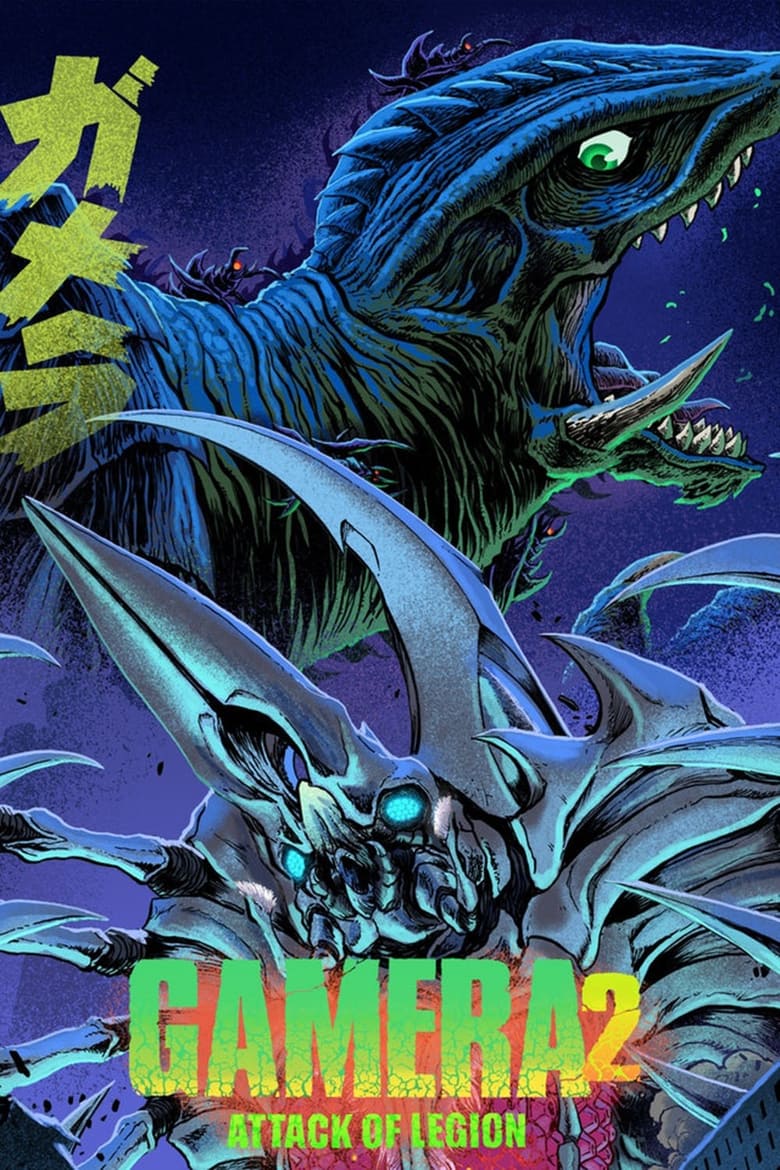
By 1996, the giant monster genre, known in Japan as tokusatsu or, more specifically in this context, kaiju eiga, had spent four decades in Godzilla's considerable shadow. Gamera, the enormous fire-breathing turtle originally created by Daiei Film in 1965, had always occupied a slightly awkward position in that landscape: popular enough to sustain a long run of increasingly low-budget films through the late sixties and seventies, but rarely taken seriously as a franchise property. That changed sharply in 1995, when director Shusuke Kaneko and writer Kazunori Ito delivered a rebooted Gamera: Guardian of the Universe that critics and genre fans received with genuine enthusiasm. Gamera 2: Advent of Legion is their direct follow-up, arriving just one year later and attempting to build on that restored goodwill. The premise moves the threat decisively into science fiction territory: a meteor impact releases a vast swarm of insect-like alien organisms, quickly designated "Legion," whose colonial behaviour and biological adaptability present a challenge that the Japanese military, for all its hardware, cannot contain. Into that breach, inevitably, lumbers Gamera. For those who want a guide to where this film sits in the broader context of Japanese cinema across different genres, The Best Japanese Films to Stream is a useful starting point.
Kaneko brings a director's instinct for controlled escalation that keeps the film moving at a disciplined pace despite its ninety-nine minute runtime. His collaborator Kazunori Ito, who had already built a considerable reputation through his screenwriting work with Mamoru Oshii (including the original Ghost in the Shell), gives the Legion a biological logic that feels considered rather than arbitrary, lending the threat a texture slightly above the genre average. The production is a joint venture between Tokuma International, Nippon Television Network Corporation, and Daiei Film, and while the budget is not astronomical by Hollywood standards, it is clearly sufficient: the suit work and practical effects are handled with genuine craft, and the film does not have the cut-corner quality that plagued many of the franchise's earlier instalments. The principal cast includes Toshiyuki Nagashima as a military officer anchoring the human drama, Miki Mizuno, Tamotsu Ishibashi, and Mitsuru Fukikoshi in supporting roles, and Ayako Fujitani reprising her role from the first film. None of them are asked to do more than the genre requires, which is to react convincingly to things that are not there and carry the connective tissue between the larger set-pieces.
Cinematographer Junichi Tozawa shoots the film with a visual approach that favours practical, location-grounded imagery over studio abstraction. The urban destruction sequences are framed to give a sense of genuine scale, often placing human figures in the foreground against backgrounds of chaos in a way that grounds the spectacle without deflating it. There is a particular visual quality to late-period analogue Japanese filmmaking, a slight density to the grain, a warmth in the street-level photography, that Tozawa preserves rather than smooths away. Editor Shizuo Arakawa cuts the action sequences with enough clarity that the spatial geography of each confrontation remains legible, which is a harder technical feat than it sounds when your protagonist is a building-sized reptile. Composer Kow Otani provides a score that works in the grand orchestral register the genre demands, swelling appropriately during the monster clashes without overwhelming the quieter character scenes. Otani would go on the following year to score Takashi Yamazaki's debut, and his work here shows the same ear for matching musical weight to image. For another Japanese film from almost exactly this period that rewards attention to its craft and cultural context, I also reviewed Neon Genesis Evangelion: The End of Evangelion (1997), which occupies a very different emotional register but belongs to the same ferment of mid-nineties Japanese genre filmmaking.
I came to Gamera 2 purely because it sits on Letterboxd's top 250 horror list, having never seen the first one, and I will admit I spent a good while assuming Gamera was just another beast from the Godzilla stable. Turns out he is not: different studio, different creature, a whole separate kaiju lineage. Think Marvel and DC. Once I had that straight, I settled in for what I correctly guessed would be a fairly typical giant-monster romp.
And that is more or less what it is, in the best way. For a kaiju film you know exactly what you are signing up for: man-in-a-suit monster action, a healthy helping of melodrama, cities flattened wholesale, and a gloriously loopy science-fiction plot to string it all together. What surprised me is how well made it is. There is more craft here than you might expect, the effects and the staging a cut above what the genre often settles for, and it takes its daft premise seriously enough to make it land.
The thing I enjoyed most, though, is almost incidental to the monsters: I love the aesthetic of 1990s Japan, and the film is steeped in it, from the fashions to the streets to the slightly grainy texture of the whole production. The acting is perfectly fine, nothing more and nothing less, and that is the film in a nutshell. Three stars, a decent, well-crafted kaiju film that does exactly what it sets out to do, and does it with rather more care than it strictly needed to.
Gamera 2: Advent of Legion is a polished but unremarkable addition to kaiju cinema that earns its place on genre watchlists through care and commitment rather than ambition. Kaneko and Ito do not reinvent the form here, but they execute it with enough skill that the film holds up well against considerably bigger productions. For those building an appetite for Japanese genre cinema more broadly, Kamikaze Girls (2004) offers a very different flavour of the same national cinema's capacity for genre playfulness, while From Up on Poppy Hill (2011) captures that same mid-century Japanese aesthetic through an entirely different lens. In the end, Advent of Legion is the kind of film that rewards exactly the expectations you bring to it: come for a giant turtle fighting space insects, leave having seen a giant turtle fighting space insects, executed rather better than it had any obligation to be.
Rating: ★★★ | Year: 1996 | Watched: 2026-10-09
Trailer
▶ Watch the official trailer for Gamera 2: Advent of Legion (1996) on YouTube
Where to watch
Watch in the UK
Stream: Amazon Prime Video · Arrow Video Amazon Channel · Amazon Prime Video with Ads · ARROW
Rent: Apple TV Store · Amazon Video · Google Play Movies · YouTube
Buy: Apple TV Store · Amazon Video · Google Play Movies · YouTube
Physical: Amazon UK · Zavvi
Watch in the US
Stream: Amazon Prime Video · Philo · Screambox Amazon Channel · Midnight Pulp
Rent: Amazon Video · Apple TV Store · Google Play Movies · YouTube
Buy: Amazon Video · Apple TV Store · Google Play Movies · YouTube
Physical: Amazon US
Affiliate disclosure: Movies With Macca may earn a small commission on purchases or subscriptions started via these links. It costs you nothing extra.